
By Rodrigo Uchoa, special for Brazil Stock Guide
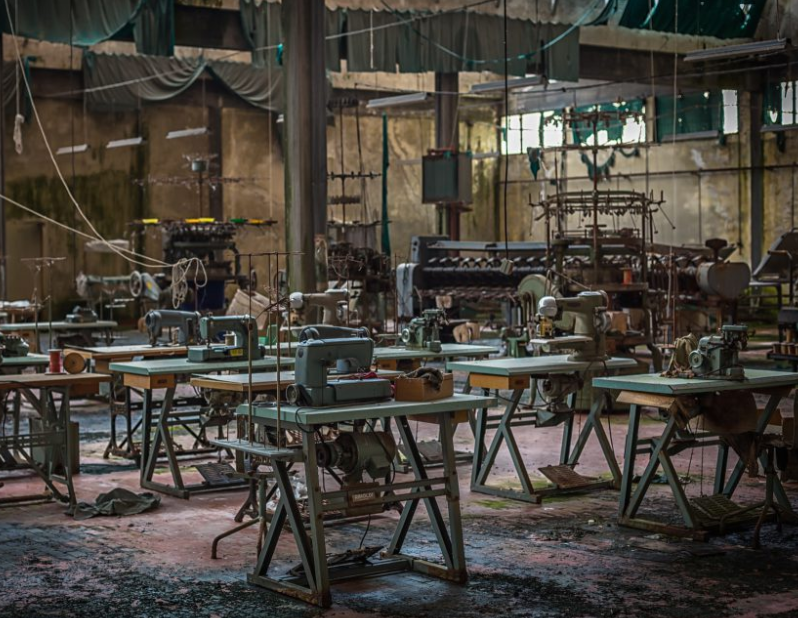
If you happen to be passing through the valley above Lake Como on an autumn afternoon, as mist descends over the dark water, close your eyes for a moment and imagine the sound of looms, the smell of damp cotton. Almost within reach, it seems, is the touch of some of the finest fabric the world has ever seen, shaped by the hands of weavers trained over decades.
In the small town of Asso, in the hills above Lake Como, the Oltolina mill operated for decades as one of fashion’s best-kept secrets. It was never a name on shop windows or advertising campaigns. It was a name whispered among the most demanding shirtmakers in Naples, London and Tokyo. Oltolina’s shirting fabrics — the finest Egyptian cotton poplins, translucent batistes, millimetre-precise piqués — made their way to the cutting tables of the world’s great camicerie. A shirt made from that cloth cost as much as a good suit.
In 2016, a Milan court brought that chapter to a close. Oltolina was declared bankrupt, after two years in creditor protection that failed to stem the financial haemorrhage. Fifty of the country’s most highly skilled textile workers found themselves unemployed, owed three months of unpaid wages. The historic mill had not survived the perfect storm that has for years been battering Europe’s high-end textile industry.

It is not an isolated case. It is, in fact, only one chapter in a much longer story. The Cotonificio Cantoni, founded in Legnano in 1828, was for nearly a century Italy’s largest cotton manufacturer. At its peak it employed 5,000 people across six factories in Lombardy. In 2004, after decades of decline accelerated by foreign competition and rising energy and labour costs, it shut its doors. Its buildings became apartment blocks and shopping centres.
Over the past five years alone, nearly 15% of Italy’s wool processors have consolidated or simply closed, according to industry data. Euratex, the European textile association, recorded 2025 as the third consecutive year of negative results across every key indicator: output, turnover and employment. “The causes are clear,” the body said in a recent report. “Structurally high energy costs, weak consumer demand, growing import pressure from Asia and an increasingly heavy regulatory burden on European producers.”
The numbers bear this out. Chinese polyester fabrics arrive in Europe priced 28% below what Italian mills can offer. In cotton blends, that discount reaches 34%. Energy costs surged 12% to 18% in Germany and Spain in 2024 alone, eating into already-thin margins — particularly among smaller companies with no capacity to hedge energy exposure. And there are growing compliance costs tied to carbon-reduction measures that manufacturers in Vietnam, Bangladesh and Cambodia simply do not face.

If Asian competition and European costs were already enough to shake the sector, a third force emerged in full after the pandemic: the definitive casualisation of corporate dress.
The global suiting fabrics market is not negligible — valued at $15.9bn in 2024. But that headline figure sits within a more complex cultural context. Today, 42% of Generation Z professionals prefer cheaper alternatives to the traditional wool suit, according to industry surveys. The dress shirt, the natural territory of mills like Oltolina, has lost its mandatory place in the meeting rooms of global corporations. The business casual dress code — which in current usage often means chinos and trainers — has dismantled a market that took centuries to build.
It is the culmination of the perfect storm: aggressive Asian competition, prohibitive European costs, onerous regulation and, finally, the customer simply stopping buying the product.
The survivors and their bets
Not everyone has succumbed. The major players who remain at the top of the ultra-luxury segment have learned that survival demands constant reinvention — but without abandoning the identity that makes them irreplaceable.
Loro Piana, founded in 1924 in Piedmont and now controlled by LVMH, is the most iconic of all. Its vicuña fabrics — the rarest and most expensive fibre in the world, shorn once a year from wild camelids in the Peruvian Andes — can cost more than €3,000 a metre. There is also baby cashmere from Mongolia and Super 180s wool, woven to micron tolerances that push the limits of textile engineering. The brand is riding the crest of the quiet luxury trend: the idea that true luxury needs no logo, that recognition comes from touch and drape, not from a visible label.
Ermenegildo Zegna, also founded in Biella in 1910, took a different route — aggressively verticalising and transforming itself into a full fashion house rather than merely a fabric supplier. Its Techmerino and High Performance lines — machine-washable wools, crease-resistant, thermally adaptive — are a direct answer to casualisation. Zegna understood that its customer no longer wants to choose between comfort and elegance.

Dormeuil, founded in Paris in 1842, is a name inseparable from Savile Row — the street in the heart of London’s Mayfair that has been synonymous with bespoke tailoring since the 18th century, where suits are made entirely by hand and can cost upwards of £20,000. The house maintains a deliberate aura of inaccessibility: some of its most exclusive patterns are produced in only a few metres worldwide. Its collections draw on fibres of near-legendary rarity — Taewit wool from high-altitude goats in Kyrgyzstan, mohair-silk-cashmere blends that produce a particular, unmistakable lustre.

Scabal, founded in Brussels in 1938, pioneered the “Super” designation system for superfine wools — the vocabulary that the entire industry now uses. Its Super 180s and 210s fabrics are literally finer than a single strand of natural silk.

For shirting, the defining example is the Cotonificio Albini of Bergamo, founded in 1876 and now in its fifth generation of family management. It produces more than 13,000 fabric variations a year, working with Egyptian Giza cotton and the rare Sea Island Cotton of Barbados. In 1992, the Albini Group acquired the iconic English brand Thomas Mason — founded in 1796 and a historic supplier to the British royal family — preserving its heritage while renewing its production.

What unites all these survivors is a shared bet: traceability as a selling proposition. QR codes backed by blockchain, documenting fibre origin, chemical processing and carbon footprint, are today part of the value offer — not merely a regulatory requirement, but a narrative for consumers willing to pay more in exchange for knowing exactly what they are wearing.
The thread that holds
The ultra-luxury suiting fabric market is projected to grow at a compound annual rate of 4.4% through 2032. There is an irony here: much of that growth is expected to come from Asia, where the corporate professional class is expanding and the culture of tailored dress is rising — precisely as the West abandons it. India’s consumption of suiting fabrics is growing at 9% a year. China is seeking to build its own symbols of prestige.
“European ultra-luxury textiles survive not through scale — the field in which Asia wins by a wide margin — but through the combination of verifiable historical heritage, genuine technical innovation and a provenance narrative that no factory in Hangzhou or Surat can yet credibly replicate,” says Ercole Botto Poala, chief executive of Italian mill Reda, which posted $83m in revenues in 2024. “The physical product and the story that accompanies it must both be equally impeccable.”
In the valley above Asso, the Oltolina mill stands empty. But in Biella, in Bergamo, in Como, in the mills of Yorkshire and the ateliers of Paris, the looms are still running. The thread still holds — finer and more taut than ever.






Leave a Reply