
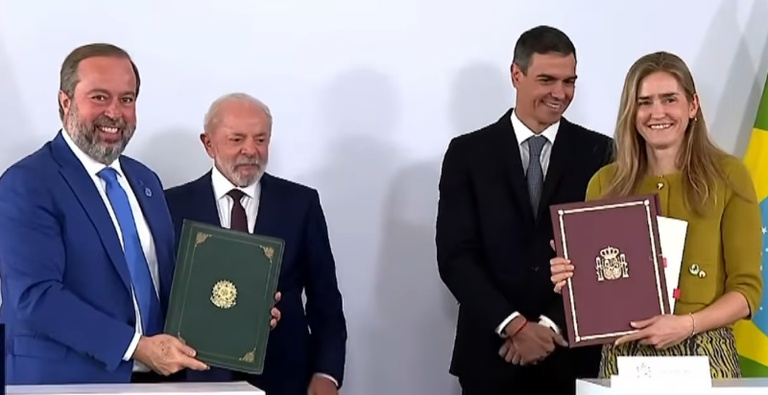
By Brazil Stock Guide – Brazil and Spain signed a strategic memorandum of understanding on Friday to deepen cooperation in critical minerals, a move aimed at strengthening supply chains tied to the energy transition and boosting industrial capabilities in both countries.
The agreement, signed by Mines and Energy Minister Alexandre Silveira alongside President Luiz Inácio Lula da Silva and Spanish Prime Minister Pedro Sánchez, establishes a framework for joint investment, technological development and coordination across the critical minerals value chain — from exploration to recycling. The pact follows Brazil’s participation in the first Brazil–Spain Summit and reflects a broader push to secure access to inputs essential for electrification, batteries and renewable energy systems.
Under the terms of the memorandum, the two countries will collaborate on research and development, mining, refining and transformation of strategic minerals, while also advancing initiatives in environmental management, regulatory exchange and workforce training.
The agreement explicitly includes the use of digital technologies such as artificial intelligence for geological analysis and supply chain optimization — signaling a shift toward higher value-added activities rather than raw material exports.
Silveira framed the partnership as a strategic step in positioning Brazil within global energy transition dynamics. “Access to critical minerals is central to industrial transformation and economic security,” he said, emphasizing the need to expand domestic value chains while preserving national sovereignty over resources.
Value chain ambition
The deal highlights Brazil’s growing ambition to move beyond its traditional role as a commodity exporter and capture more value in processing and downstream applications. With vast reserves of minerals such as lithium, nickel and rare earths, the country has become increasingly relevant in global supply discussions, particularly as Western economies seek to diversify away from concentrated supply sources.
For Spain, the agreement aligns with European efforts to secure stable and sustainable access to critical raw materials amid tightening geopolitical competition. The partnership could also open the door for European capital and technology to accelerate project development in Brazil.
Policy and governance alignment
Beyond industrial cooperation, the memorandum includes provisions for developing public policies focused on sustainability, including traceability, circular economy practices and decarbonization. It also предусматриes exchange of regulatory frameworks and governance models, an area where European standards may influence Brazil’s evolving approach to mining oversight.
While the agreement remains non-binding, it signals a convergence of strategic interests at a time when critical minerals have become a cornerstone of energy, industrial and geopolitical policy — and a new axis of competition in global markets.
What’s at stake
For investors, the pact underscores a structural theme: the reorganization of global supply chains around energy transition materials. Brazil’s ability to translate resource endowment into industrial capacity — and to attract long-term capital — will be key in determining whether it can move up the value chain or remain primarily a supplier of raw inputs.



Leave a Reply