
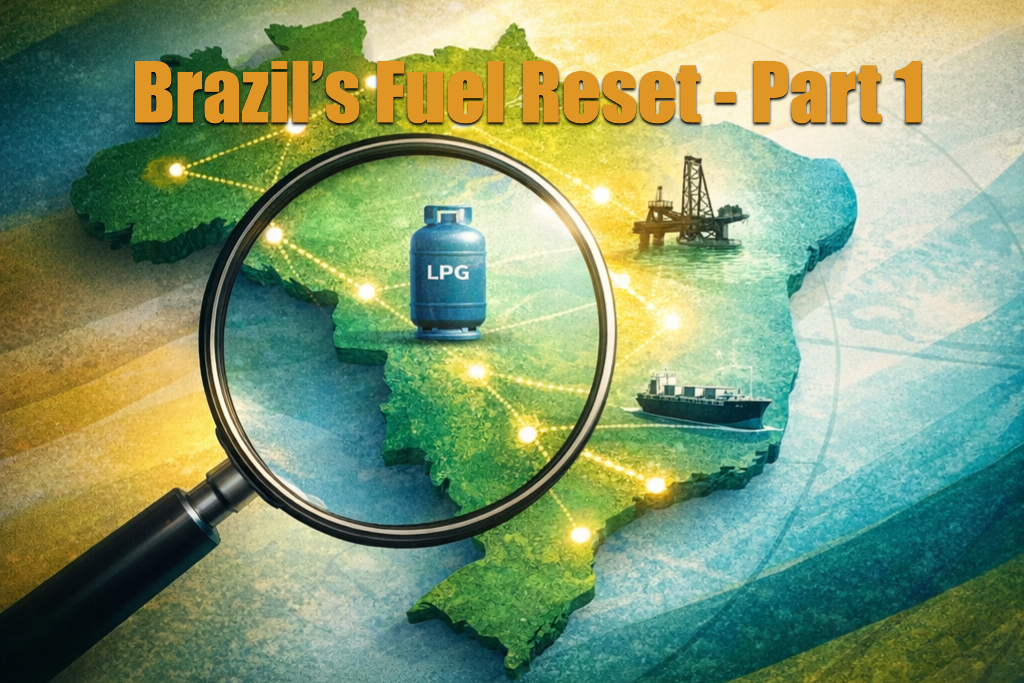
By Brazil Stock Guide – Brazil has completed one of its most comprehensive assessments of the national fuel market, consolidating five technical reports that are now under review by the National Energy Policy Council (CNPE). The package, developed under Resolution CNPE No. 10/2024, maps structural inefficiencies across key segments and proposes a coordinated reform agenda that could reshape pricing dynamics, competition and investment flows in the country.
The studies cover five strategic markets: liquefied petroleum gas (LPG), aviation fuels, sustainable aviation fuel (SAF), marine fuels and sustainable maritime fuels. The work brought together 17 federal entities — including ANP, ANAC, BNDES, Cade and EPE — alongside contributions from industry, academia and civil society, giving the recommendations both technical depth and institutional weight.
Brazil Stock Guide has reviewed the reports and will publish a special series this week, breaking down the key findings and what they mean for markets, policy and investors.
The diagnosis is broadly consistent across segments: high market concentration, infrastructure bottlenecks, partial dependence on imports and a lack of clear economic signals to support energy transition investments. In practice, these factors translate into elevated costs, limited competition and barriers to entry for new players.
In LPG, the issues center on concentrated supply and limited storage capacity, which constrain supply security. In aviation fuel, jet fuel remains one of the largest cost components for airlines, shaped by a restricted distribution structure. In maritime fuels and emerging low-carbon segments, the challenge is more structural: lack of scale, regulatory uncertainty and high upfront capital requirements.
The key differentiator of the reports, however, is not the diagnosis — but the attempt to articulate a coordinated policy response.
Common diagnosis
Despite differences across markets, the reports identify a recurring set of structural constraints: high concentration in production and distribution, logistical bottlenecks, limited storage capacity, exposure to import dynamics, low regulatory predictability and weak effective competition. Together, these factors create friction that limits efficiency gains and discourages private investment.
Reform agenda
The proposed measures follow a market-oriented logic, seeking to address distortions without direct price intervention.
Key recommendations include increasing competition by lowering entry barriers and revising infrastructure access rules; expanding storage and logistics capacity to improve supply security; enhancing regulatory predictability through more transparent allocation mechanisms; and attracting capital via instruments such as infrastructure tax incentives and incentivized debentures.
The reports also propose revisiting restrictions on LPG use in certain applications, aiming to unlock demand and improve energy efficiency across sectors.
Energy transition at the core
A central pillar of the package is the alignment of Brazil’s fuel markets with global decarbonization trends.
Sustainable aviation fuel is positioned as a strategic lever for reducing emissions in the aviation sector, while low-carbon maritime fuels — including biofuels and emerging alternatives — are highlighted as a frontier market. In both cases, the reports acknowledge the economic challenge: production costs remain significantly higher than conventional fuels, requiring policy support to achieve scale.
Political timing
Whether the proposals move forward will depend as much on political timing as on technical merit.
The reports arrive at CNPE as Brazil moves toward a new electoral cycle — a period that typically reduces appetite for reforms that could affect fuel prices, especially in socially sensitive segments such as LPG, which is widely used by low-income households.
While the package avoids direct price controls and instead focuses on structural measures — such as boosting competition, expanding infrastructure and improving regulatory clarity — the implementation of these changes could still have indirect effects on pricing dynamics. That creates a natural tension for policymakers balancing reform with electoral risk.
In practice, this raises a key question for investors and industry participants: whether the government will prioritize long-term market efficiency or defer more impactful measures until after the electoral cycle.
What is at stake
The reports outline more than incremental adjustments — they represent a blueprint for restructuring key segments of Brazil’s energy market.
If implemented, the measures could unlock infrastructure investment, enhance competition, reduce structural inefficiencies and position Brazil more competitively in emerging low-carbon fuel markets. If stalled, existing bottlenecks are likely to persist, with direct implications for prices, supply security and competitiveness.
This is the first part of a special series on Brazil’s fuel market reforms.
In the coming days: LPG and energy poverty, aviation fuel costs and competition, SAF and decarbonization, and the future of maritime fuels.



Leave a Reply