
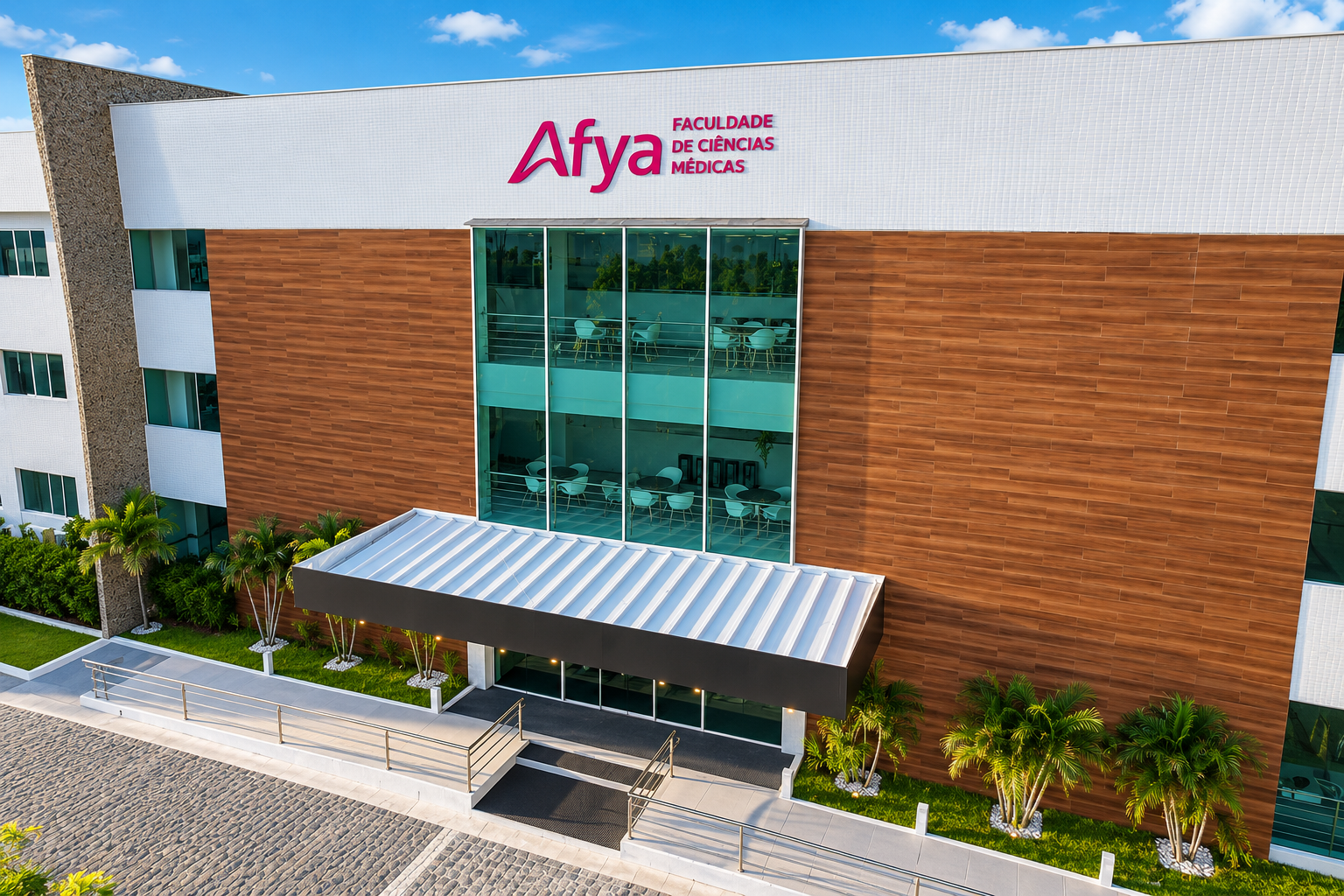
By Brazil Stock Guide – The combination of Yduqs and Afya, announced on the evening of September 23, will create one of Brazil’s largest private education companies, with about 1.6 million students, combined net revenue of R$9.4 billion and adjusted EBITDA of roughly R$3.6 billion.
While the companies describe the transaction as a merger, its structure gives Afya and its shareholders the greater economic and governance weight in the combined group.
Under the announced terms, existing Afya shareholders will own 69% of the combined company, while Yduqs shareholders will hold the remaining 31%. Legally, Afya will be merged into Yduqs and cease to exist as a separate corporate entity, while Yduqs will remain the listed vehicle on B3’s Novo Mercado segment.
The management structure will follow the same direction. German media and education group Bertelsmann, Afya’s current controlling shareholder, will become the largest shareholder of the combined company, with about 47% of the capital, and will appoint a majority of the board members. Virgilio Gibbon, Afya’s current CEO, will become chief executive of the combined group, while Yduqs CEO Rossano Marques will oversee higher education businesses outside medical education.
The transaction therefore preserves Yduqs as the listed company while significantly reshaping its ownership and management structure.
Each Afya share will be exchanged for 6.408347 Yduqs shares. The exchange ratio was set using the companies’ financial positions as of June 30, 2026, and will not be adjusted for subsequent changes in net debt, working capital, EBITDA, earnings or share prices, except in certain circumstances provided for in the agreement.
Before closing, Yduqs may also distribute to its shareholders the greater of R$750 million or the adjusted net cash flow to shareholders generated during the period. As a condition for the transaction to close, Yduqs’ net debt cannot exceed its June 30 level by more than R$750 million.
Medical education moves to the center of the group
Medical education will become the main economic pillar of the combined company.
The new group will have approximately 38,000 undergraduate medical students and 5,888 authorized annual medical-school seats — 3,768 from Afya and 2,120 from Yduqs.
At Yduqs, medical education is already its most profitable business. In the first half of 2026, the segment posted an EBITDA margin of 49% and accounted for 38% of the company’s adjusted EBITDA. Medical education and business-school brand Ibmec together represented 48% of EBITDA.
Following the combination, the premium segment — primarily medical education and Ibmec — is expected to account for 55% of net revenue and roughly two-thirds of the combined company’s EBITDA. Undergraduate medical programs alone are expected to generate about 45% of revenue.
The companies point out that their nearly 5,900 authorized medical-school seats represent about 12% of the more than 50,000 annual seats available nationwide.
That national market share, however, does not settle the antitrust question. The transaction still requires final approval from Brazil’s antitrust watchdog, Cade.
The regulator is expected to assess not only the companies’ combined nationwide market share but also the degree of overlap in individual local markets, particularly in in-person medical programs, where supply is subject to authorization by Brazil’s Education Ministry.
The companies themselves say their geographic overlap is limited. That assumption is likely to be one of the issues examined by the antitrust authority.
Synergies are largely cost-driven
Another central element of the deal is the expected synergies.
Yduqs and Afya estimate that the combination could generate R$2 billion to R$2.2 billion in net present value from synergies, with about 80% of those efficiencies expected to be captured within the first three years after closing.
Yduqs’ material fact filing shows that most of the gains are expected to come from lower costs, general and administrative expenses and capex optimization. The companies have not yet detailed how much of those savings would result from eliminating overlapping structures or from other cost-reduction measures.
The companies’ institutional announcement emphasizes potential benefits in academic quality, technology, artificial intelligence, research and innovation. The financial benefits that have been quantified so far, however, are concentrated primarily in operating and administrative synergies.
The combined company will also have a broad medical-education ecosystem. In addition to roughly 38,000 undergraduate medical students, Afya has more than 56,000 students enrolled in continuing medical education and more than 200,000 paying users of digital tools for medical professionals, including Whitebook and iClinic.
Bertelsmann expands its presence in Brazil
The transaction also marks a significant expansion of Bertelsmann’s exposure to Brazil’s education market.
The German group, which currently controls Afya, will remain the largest shareholder of the combined company and will play a central role in shaping its board.
Advent and the Zaher family, reference shareholders of Yduqs, as well as the Esteves family, which helped found Afya, will also have representation in the new company’s governance structure.
The main shareholders have also entered into voting commitments in support of the transaction, as well as agreements governing board nominations and temporary restrictions on share sales.
The combined group will operate 176 campuses across 26 Brazilian states, with businesses ranging from on-campus and digital undergraduate programs to postgraduate education, medical residency preparation and digital tools for healthcare professionals.
The deal still requires approval from shareholders of both companies, Cade and education-sector regulators. The companies expect the transaction to close within 12 months, although the agreement sets March 31, 2028 as the outside date.
The agreement provides for break-up fees of R$325 million in certain circumstances before shareholder approval and up to R$650 million in some cases after the transaction has been approved. A rejection by Cade is among the circumstances in which the penalty would not apply.
The combination will create a larger and more profitable company with substantially greater exposure to medical education. At the same time, it shifts the balance of power at Yduqs toward Afya’s existing shareholder base, led by Bertelsmann, while making concentration in medical education one of the key issues to be examined before the transaction can be completed.





Leave a Reply