

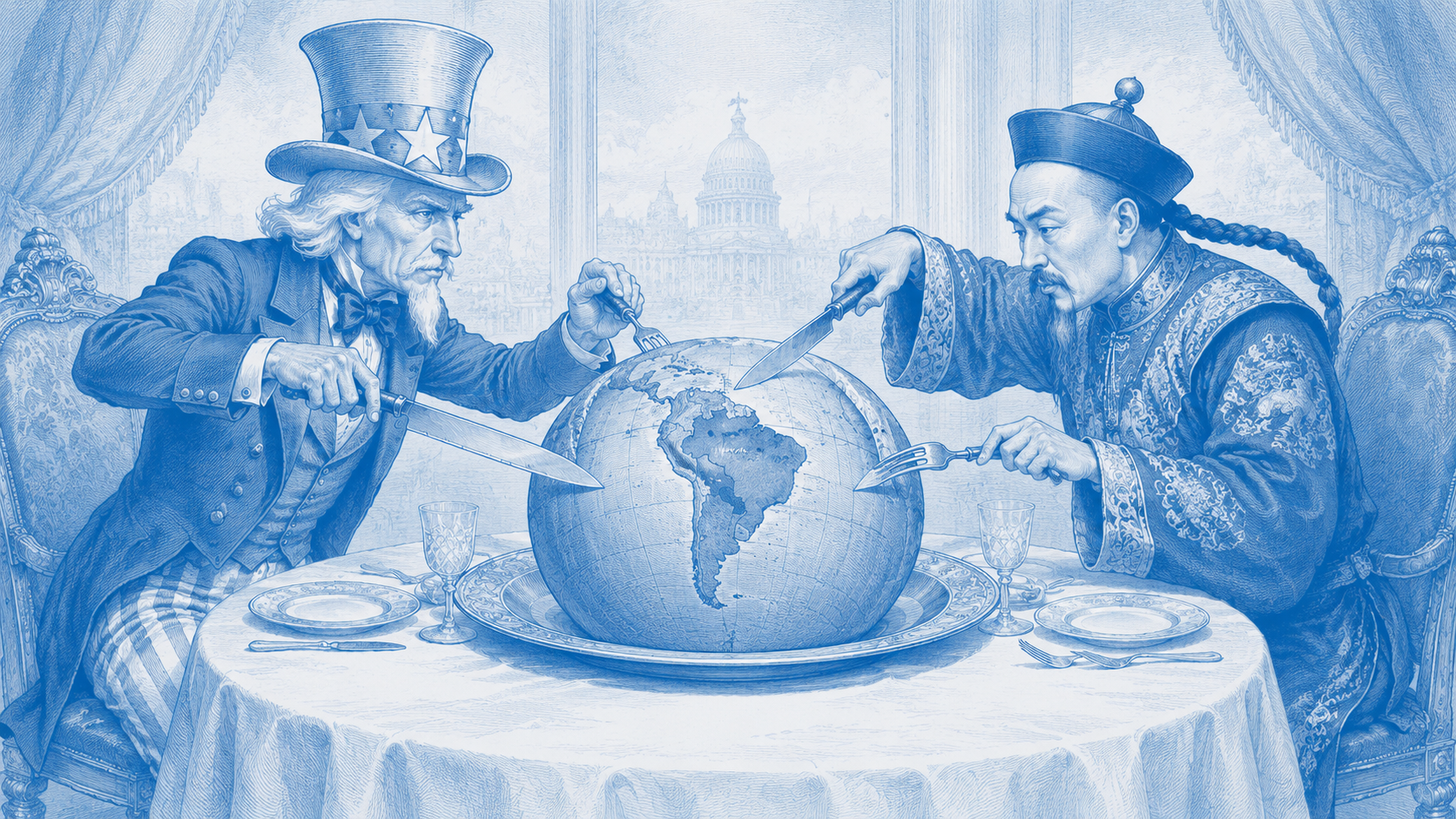
Cipriani 25 Broadway, in New York, was more than the address of a business gathering last Monday, May 11. It was a room of power. Inside the luxury event space housed in the historic Cunard Building, during Brazil Week — the week of business meetings surrounding the traditional Person of the Year award — part of Brazil’s economic future seemed to be discussed far from Brazil, in an informal court of American capitalism.
At the center was Donald Trump Jr., the eldest son and business-and-political heir to Donald Trump, the current president of the United States, alongside Wesley Batista, of J&F, and André Esteves, of BTG Pactual. In different tones, the three defended closer ties between Brazil and the United States amid the global competition with China. The image was telling: Brazil’s business elite appeared to be endorsing not an autonomous national strategy, but a new form of coupling with Washington’s interests.
Trump Jr. presented the American thesis in its most direct form. Global supply chains, he argued, had been captured by countries that do not share U.S. values, and Brazil could emerge as a natural ally in mining, agribusiness and strategic resources. The vocabulary is that of friendshoring. For a peripheral economy, the translation may be less flattering: supplying minerals, protein, grains, energy and rare earths to the power trying to reorganize its sphere of influence in response to China’s rise.
The support from Wesley Batista and André Esteves is the political fact of the scene. One represents one of Brazil’s most internationalized business groups, built on animal protein, global scale and a strong presence in the United States. The other leads one of Brazil’s most active financial institutions, used to turning capital flows, privatizations, infrastructure and commodities into investment theses. Both speak the language of global markets. Neither, however, speaks from the position of a core economy.
That is the uncomfortable point. Brazil’s elite is more global, financial and mobile than the country that sustains it. It can live in the U.S., raise capital in dollars, operate with international funds and move through the same circles as America’s political and business elite. But Brazil’s economic base still enters the equation as a low-cost supplier. The sophistication of the elite does not erase the peripheral position of the productive structure.
There is something old in this scene dressed up as something new. Brazil was once more dependent on the United States, before China became its largest trading partner and redirected the external destination of iron ore, soybeans, oil, meat and pulp. What appeared in New York was not a historical rupture. It was almost a restoration: the desire to exchange one dependency for another, now presented as geopolitical pragmatism.
The criticism does not require nostalgia for China or sympathy for Beijing. Brazil is already, to a large extent, a commodities platform for China. What was offered in New York was less a development alternative than a proposal to change the destination. Instead of selling the same primary basket to China, sell more of it to the United States. Instead of Asian dependency, hemispheric dependency. Instead of autonomy, alignment.
The alternative is not to swap Beijing for Washington, nor to pretend that Brasília can arbitrate the global order. Peripheral economies do not control the game between great powers, but they can negotiate their position within it more intelligently. Brazil has food, iron ore, energy, oil and critical minerals. That should be bargaining power, not a vocation for dependency. The problem begins when the elite treats foreign alignment as a national strategy, rather than as a transaction to be priced dearly.
The short-term thesis may be profitable. Meatpackers, miners, energy companies, logistics groups and investment banks know how to monetize geopolitical realignments. But there is a difference between capturing spreads and building development. Brazil may gain flows, tactical premiums and headlines about strategic opportunity. It may also end up merely changing the flag of the final buyer, without moving up the value chain.
The destination flag changes, but Brazil’s place in the chain does not. That is the central risk. Brazil wants to be indispensable, but seems willing to accept being instrumental. The dispute between the United States and China opens a real window for the country. Without industry, technology, state coordination, a defense of national interest and the ability to capture more value within supply chains, that window becomes just another export counter.
The meeting in New York exposed that ambiguity. For Washington, Brazil is useful. For Brazil’s elite, alignment can be profitable. For the country, the harder question remains: will it become a strategic partner, or merely the premium supplier of whichever power happens to need it next?

Leave a Reply