
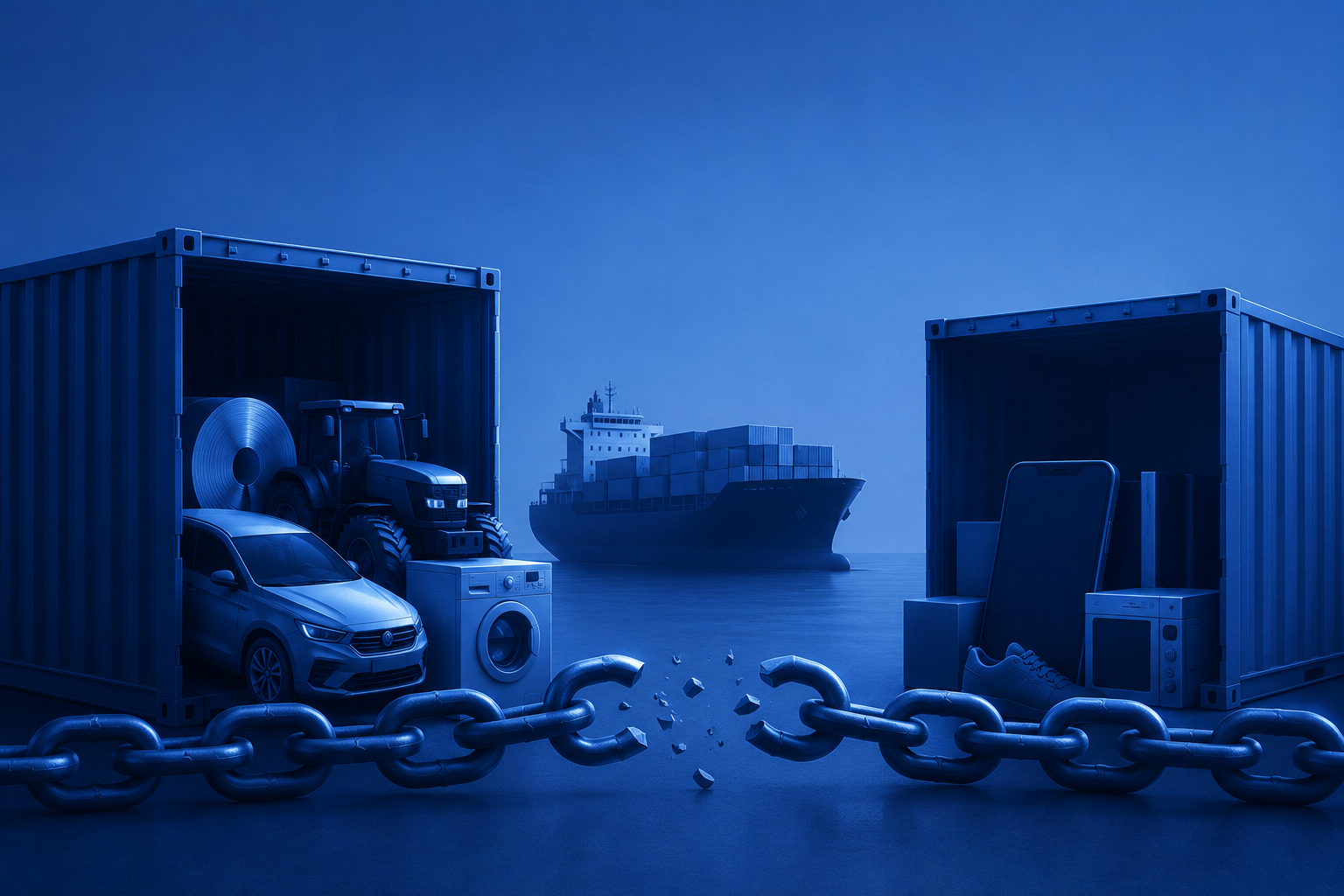
Brazil is at risk of losing, for the first time in three decades, the position that mattered most in its relationship with Argentina: being the main supplier to its neighbor’s economy.
When Mercosur was created in the early 1990s, it redrew trade routes across the River Plate basin and gave Brazil an advantage that seemed almost natural. Argentina bought from Brazil not only because the two countries were neighbors, but because regional integration turned Brazilian industry into an extension of the Argentine market. Cars, auto parts, machinery, chemicals and intermediate goods crossed the border as part of a broader promise: to replace the old Brazil-Argentina rivalry with a regional production chain.
That advantage is now being tested. China had already overtaken Brazil as Argentina’s top supplier during the pandemic, when logistics shocks, depressed regional demand and disrupted industrial supply chains scrambled global trade flows. It did so again in a single month, in September 2025. What makes 2026 different is the sense of continuity. China’s advance no longer looks merely like a crisis-driven anomaly, but like the start of a more permanent contest for the market that Mercosur, South America’s customs union, had effectively reserved for Brazilian industry.
In the first four months of the year, China accounted for 23.7% of Argentine imports, ahead of Brazil’s 21.6%. Brazil still led as a destination for Argentine exports, with 12.6%, compared with China’s 7.9%. In total trade, Brazil is still holding on. But the most sensitive part of the relationship — who supplies the Argentine economy — has already shifted.
That matters more than it may appear. The Brazil-Argentina relationship was never just about soybeans, wheat or beef. For Brazil, Argentina has long been the closest thing to a domestic market abroad: nearby, protected, governed by common rules and dependent on a regional industrial chain. When China starts leading Argentine imports, it is not simply selling more goods. It is occupying space that traditionally belonged to Brazilian industry.
The explanation does not fit neatly into a romantic narrative about political distance between Brasília and Buenos Aires, or the lack of warmth between Luiz Inácio Lula da Silva and Javier Milei. Argentina is not simply moving away from Brazil. It is buying on the basis of price, scale and efficiency. Argentina’s economic opening has lowered barriers and exposed local manufacturers — as well as Brazilian suppliers — to global competition. China is the country best equipped to fill that space: it has the scale, the product range and the export discipline of the world’s industrial machine.
Auto parts show how the mechanism works. Argentina’s sector, historically integrated with Brazil, has been hit by a wave of cheaper imports. Argentine purchases of Chinese auto parts rose by more than 80%, while local production fell in early 2026. Brazil remains a major player in that market. But it is no longer competing only with Argentine or American companies. It is competing with China’s ability to produce at continental scale and export with almost unlimited aggression.
The same pattern applies to electronics, electrified vehicles, smartphones, machinery, equipment and capital goods. These are precisely the segments gaining weight in Argentina’s new import basket. China offers a global shelf of products. Brazil offers a regional supply chain. In a country facing fiscal adjustment, pressured consumers and a search for disinflation, the cheaper shelf has obvious political and economic appeal.
There is also a shift on Argentina’s export side. The recent improvement in its external accounts has come less from the old Mercosur industrial economy and more from agriculture, energy, mining, oil and lithium. With fewer factories, Argentina needs fewer regional industrial suppliers. In return, it exports what China wants to buy: food, natural resources and critical minerals.
Lithium is the clearest symbol of this new era. China is not interested only in selling smartphones or cars to Argentina. It also wants to secure inputs for batteries, electric vehicles and energy storage. Argentina, with its mineral reserves and ambition to become a lithium powerhouse, fits more naturally into China’s global supply-chain logic than into Brazil’s regional integration model.
That is why the threat to Brazil is bigger than a statistical fluctuation. China does not need to replace Brazil everywhere. It only needs to capture the margin of growth. Brazil may remain important in Argentina’s exports and still lose strategic centrality if Argentina begins buying from China the industrial goods that once sustained Mercosur’s logic.
That is the uncomfortable point. Mercosur turned geographic proximity into an industrial advantage for Brazil. But proximity is no longer enough when China can deliver what Argentina wants.
For decades, Brasília treated Argentina as a natural market. China treats it as a contestable one. The difference is decisive: natural markets are defended by memory, institutions and agreements; contestable markets are won through price, scale and execution.
Brazil has not lost Argentina yet. But China has already shown that Mercosur alone is no longer enough to keep it.


Leave a Reply