
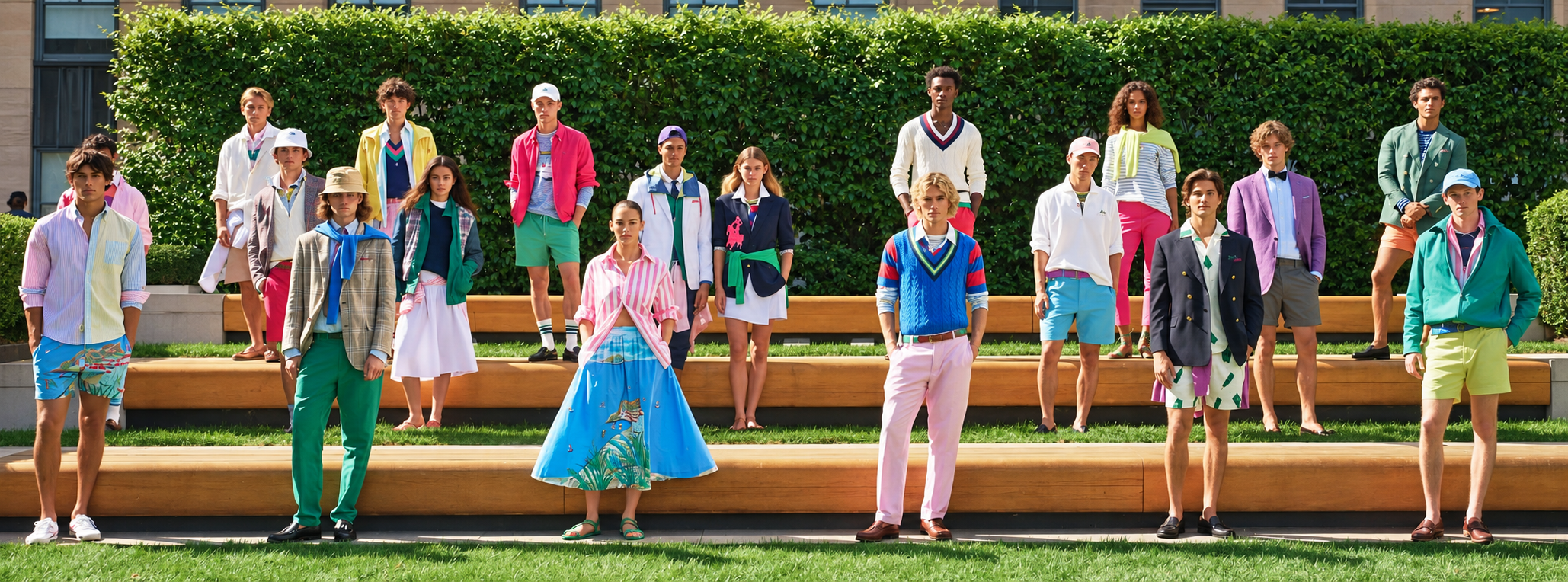
Brooks Brothers returned to the official New York Fashion Week calendar with its Spring/Summer 2027 collection, presented at Radio Park. (Credit: Brooks Brothers/Handout)
By Rodrigo Uchoa, special for Brazil Stock Guide
At some point during his travels through the United States in the 1830s, Alexis de Tocqueville noted something that would have surprised many Europeans of his time: Americans lived in a relatively egalitarian society and, even so, seemed remarkably well put together — without the aristocratic display he knew from France, but also without the sloppiness much of the Old World expected to find in a young republic. There was a kind of democratic elegance at work, built less on titles and more on habits. By the time Tocqueville landed, Brooks Brothers, founded by Henry Sands Brooks in 1818, had already been selling clothes for over a decade. Today, 208 years after its founding, it’s an anomaly in a market where brands disappear about as fast as trends are born.

(reproduction social media)
That’s what made the return of Brooks Brothers to the official New York Fashion Week calendar worth noticing. On September 10, the brand presented its Spring/Summer 2027 collection at Radio Park, a hidden garden perched above Rockefeller Center — its first official appearance since 2018, and creative director Michael Bastian’s debut presentation for the brand at New York Fashion Week.
Plenty of people have never set foot in a Brooks Brothers store, but almost every man has worn a button-down collar shirt or some version of a formula the brand helped popularize. Few companies are this influential and this absent from the contemporary conversation about fashion.
Bastian didn’t mince words: “It’s time we got back in the conversation.” The collection was built almost entirely from the brand’s own archive — the button-down collar shirt, created in 1900; sack suits; seersucker fabric; colorful madras; the playful embroidery that helped define decades of American preppy style — all rearranged under a palette that evoked Monaco in the early 1980s. Brooks Brothers is trying to use nostalgia not as a refuge, but as a sales pitch: reminding the public that much of what they wear today was born there.

Before it was a heritage label, Brooks Brothers was an uncomfortably innovative company for its time. In 1849, it helped popularize something that sounds banal today — ready-to-wear clothing, in a country where most people still depended on a tailor or seamstress for anything more elaborate than the basics. The timing wasn’t an accident. American territorial expansion, the California gold rush, and the rapid urbanization of the Northeast created an entire middle class of men who wanted to look respectable without waiting weeks for a bespoke suit. Brooks Brothers solved that problem decades before Europe would coin the same idea as prêt-à-porter.

That commercial ambition also had an uglier side. The company later supplied uniforms to the Union Army during the Civil War and was accused of using low-quality wool, mixed with recycled rag scraps, to keep up with demand — an episode that sits awkwardly next to the respectable image the brand was cultivating at the same time it dressed Abraham Lincoln. Decades later, John F. Kennedy would help turn the Ivy League look into a national language, cementing Brooks Brothers as a fixture in American political iconography, embraced by Republicans and Democrats alike.

The company’s most visible invention, though, came from a much smaller observation. In 1896, John Brooks noticed English polo players pinning down their shirt collars so they wouldn’t flap during matches. In 1900, Brooks Brothers officially launched the button-down collar shirt — now one of the most copied garments in the history of menswear, copied so often that most people who wear it have no idea where it came from.
Over the course of the 20th century it became a centerpiece of the Ivy League look, then of preppy style, and finally of the corporate wardrobe — and plenty of the brands that reproduced it ended up getting more cultural credit than the one that invented it.
The clearest case is Ralph Lauren, who started his career selling ties at Brooks Brothers before founding his own label and becoming, for a global audience, the go-to visual reference for WASP, Ivy League and East Coast style. Brooks Brothers spent years looking like a watered-down version of Ralph Lauren — when the historical record points exactly the other way around.

The troubles of recent years weren’t just about image. In July 2020, the company filed for bankruptcy protection, a slow-building strain that the pandemic simply accelerated: the decline of formal corporate dress, the rise of athleisure, and years of unclear positioning had already eaten away at its relevance. Months later, it was bought by a partnership between Authentic Brands Group and Simon Property Group for $325 million, and went through a broad restructuring that placed it under what is now Catalyst Brands, alongside names like JCPenney and Eddie Bauer.
The generation that turned the navy blazer into a badge of professional success is retiring, and younger executives now show up to meetings in minimalist sneakers and Italian sweatshirts, wearing shirts that will never see an iron. Against that backdrop, the return to Fashion Week isn’t an attempt to look disruptive — it’s a bet that there’s still commercial value in reminding the world who invented the things everyone already wears. Whether that bet turns into sales, nobody knows yet. But Brooks Brothers, at least, is back in the conversation.
For anyone interested in how fashion shapes behavior and history, the podcast “Articles of Interest” has a seven-episode series on American Ivy style — well worth the full binge: https://open.spotify.com/episode/5qRZfBYlAcB3MzUvIoTb9y


Leave a Reply