

By Rodrigo Uchoa*, special for Brazil Stock Guide
Stop on any given day along Avenida Faria Lima in São Paulo — a major avenue that became shorthand for Brazil’s financial elite, much like Wall Street in New York or the City in London — near Pátio Malzoni, and you only need five minutes to see that the sneaker has won. A 28-year-old investment banker glides past in spotless white Vejas; a 45-year-old follows in the same informal uniform (and with the same sense of urgency). Then comes the shoe of the moment: a pair of Ons, with soles that look as if they were sketched by an aeronautical engineer fresh out of ITA, one of Brazil’s top engineering institutes.
Curiously, when it comes to On, the Faria Lima pitch — as the district is commonly called in business shorthand — doesn’t always begin with cushioning, heel-to-toe drop, or any detail a runner would actually argue about. It starts with a more local shortcut: “It’s the Lemann-and-Sicupira sneaker.” The Swiss brand does, in fact, count heavyweight Brazilian investors on its cap table — and knowing that is the password that lets you into the conversation.

For women, the Adidas Samba still rules as if it were a lifetime appointment. But like every lifetime appointment in fashion, it now lives with succession whispers. Some look at the Samba the way they look at wallpaper: correct, but already seen. Enter the “tech runners” — Asics, New Balance — which make the foot look ready for a jog even when the day’s most intense cardio will be crossing the lobby. An occasional yellow Onitsuka Tiger still flashes by, punctuating the scenery like a reminder of when it counted as “different”. Golden Goose, with its conspicuously scuffed luxury, has missed the timing: in an environment that likes to look efficient, paying dearly to look careless reads like an inside joke.
A timeline helps explain how we got here. Twenty years ago, sapatênis — a Brazilian hybrid between sneakers and dress shoes — began colonising this territory. They were the middle way for a generation that wanted comfort without quite abandoning the idea of formality. Then they became cringe, like anything that tries to be a compromise for too long. New waves arrived, new silhouettes, new rationalisations (“athleisure”, “smart casual”, “hybrid”). And Faria Lima, a metonym for Brazil’s dealmakers, bankers and asset managers, normalised the sneaker as though it were the only possible answer to a question called “work”.

But that answer now seems to be losing its air of inevitability. This isn’t just a pedestrian’s impression. There is a market case — with meaningful numbers — suggesting the sneaker supercycle may be behind us. A broad Bank of America analysis led by Thierry Cota argues the sector enjoyed a roughly 20-year bull run, taking sneakers from under a quarter of global footwear sales to “at least half”, peaking in the pandemic, when working from home turned comfort into a kind of domestic public policy.
The point is not that people will resurrect the patent-leather Oxford — the old “German chrome”, as the more seasoned will remember, a Brazilian nickname for ultra-polished formal shoes once associated with status, shoe-shine rituals and corporate respectability. The debate is more interesting when it avoids that false contrast. What analysts are pointing to is structural deceleration: if the sporting-goods industry grew at an average of roughly 9% a year since 2007, future growth could slip to 4% or 5%. In the market, the provocation had tangible effects: Adidas took the rare hit of a “double downgrade” in the report, and the shares fell as much as 7.6% on the day before clawing back part of the loss.

And, as always, there is the chorus of sceptics. Even those who dispute the “end of the boom” note that sneakers still account for around 60% of footwear sales in the US. Perhaps the best way to read this moment is less apocalyptic and more sociological: casual doesn’t end; it settles. And when it settles, it makes room for other ways of looking “appropriate”.
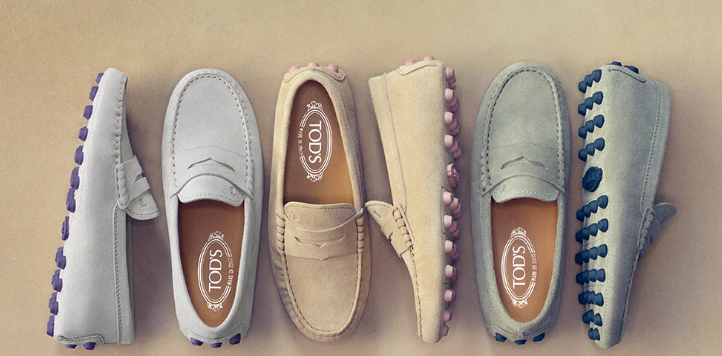
That’s where the conversation gets good, because “going back to shoes” doesn’t have to mean going back to the past. In Brazil, the return has been selective — almost curatorial. For men, the minimalist loafer (and, with it, the suede loafer) has become an unlikely winner of recent prestige: cleaner, less “old corporate”, often in smooth leather or suede, with a lighter, less imposing sole. ELLE Brasil, which rarely misses a street-level thermometer, has singled out the minimalist loafer as a strong candidate for “trend shoe” status in the coming years.
Suede has surged precisely in that sweet spot of “classic + desire”. It offers an elegance that looks less effortful — and therefore more compatible with an era that hates looking like it tried. Updated loafers and moccasins work with a blazer, with cool-wool trousers, with dark denim, with linen — and they show up in sturdier versions (lug soles), pared-back minimalist takes, or even high-shine finishes for anyone who still enjoys a visual semicolon.

For women, the movement is similar: shoes that pull an outfit together without demanding sacrifice. The slingback — that “office heel”, updated — has become the polish wildcard. It makes everything look more grown-up without insisting on real height. ELLE has listed slingbacks as a strong trend too, including more “ladylike” versions, but without excess nostalgia. And the Mary Jane — the doll shoe that once meant “cute” — returns as a styling piece: straps, a firmer sole, a different toe, a low heel. The “elegant low heel” has cultural clout because it solves the comfort-versus-posture dilemma without turning Friday into penance.
In this landscape, Faria Lima — meaning both the physical avenue and the financial culture that surrounds it — asks the question it always asks: what does it mean? This is not quite the return of “German chrome” in its caricatured form, that shoe so glossy you could fix your hair in the reflection. Today’s return is less mirror-like: a formality filtered through comfort, an attempt to look put-together without looking like you belong to another century.
And perhaps there’s a good piece of news here, beyond the irony: if loafers and their relatives really gain ground, it could offer a modest breath of relief for Brazil’s footwear industry — which knows how to do leather, lasts and finishing with a competence that doesn’t always make it into financial-district small talk. Unless, of course, you’re a Faria Lima regular — shorthand for someone embedded in Brazil’s high-finance ecosystem — hopelessly addicted to Tod’s: in that case the loafer is less a trend than a commitment — almost a stable relationship, with rubber soles and euro-denominated invoices.
* The Skeptical Hedonist’s Handbook: https://www.instagram.com/theskepticalhedonist
Leave a Reply