

By Rodrigo Uchoa*, special for Brazil Stock Guide
From the sixth floor of a building that sat empty for more than twenty years on Rua Amaral Gurgel, the Minhocão looks almost bearable. On weekdays, the elevated expressway that cuts through central São Paulo is the city’s most unloved piece of infrastructure — a brutalist slab of concrete that roars with traffic and casts a permanent shadow over the streets below. But on Sundays, when it is closed to cars and given over to cyclists, children and dog-walkers, the view from the rooftop terrace of Cora restaurant — a Michelin Bib Gourmand, in the heart of the Vila Buarque neighbourhood — is something close to lovely. The city always hummed, in one way or another. What feels different now is that the hum has a new pitch.

This is not merely atmospheric. It shows up in investment figures, construction cranes and, with some historical irony, in the very neighbourhood where it is happening. The triangle linking the Copan building, Vila Buarque and the Campos Elísios district was, in the 1870s, São Paulo’s attempt to build its own Champs-Élysées — tree-lined boulevards, eclectic mansions, a coffee-exporting elite that wanted to feel European. A century later, the same area became a laboratory for Brazilian modernism: Oscar Niemeyer’s Copan tower (1966) and Oswaldo Bratke’s Edifício Renata Sampaio Ferreira (1950s) turned it into an icon of urban ambition. Then came the sprawl. The city’s upper middle class fled to garden suburbs to the south-west, the grand mansions of Campos Elísios were subdivided into overcrowded tenements, the open-air crack cocaine market known as Cracolândia took root near the central railway station, and the Minhocão — built in the 1970s as a traffic solution — functioned as a knife through the urban fabric, severing neighbourhoods, depressing property values and accelerating the exodus of anyone with the means to leave.
What is happening now, in the first decades of this century, is a concerted attempt to reverse that cycle using a technique known as retrofit: the comprehensive modernisation of existing buildings, preserving their structure and — where there is heritage worth protecting — their facades and their history, while gutting and rebuilding the interiors. It is less renovation than reinvention. Architects prefer the word “resignification.”
The Renata and its neighbours

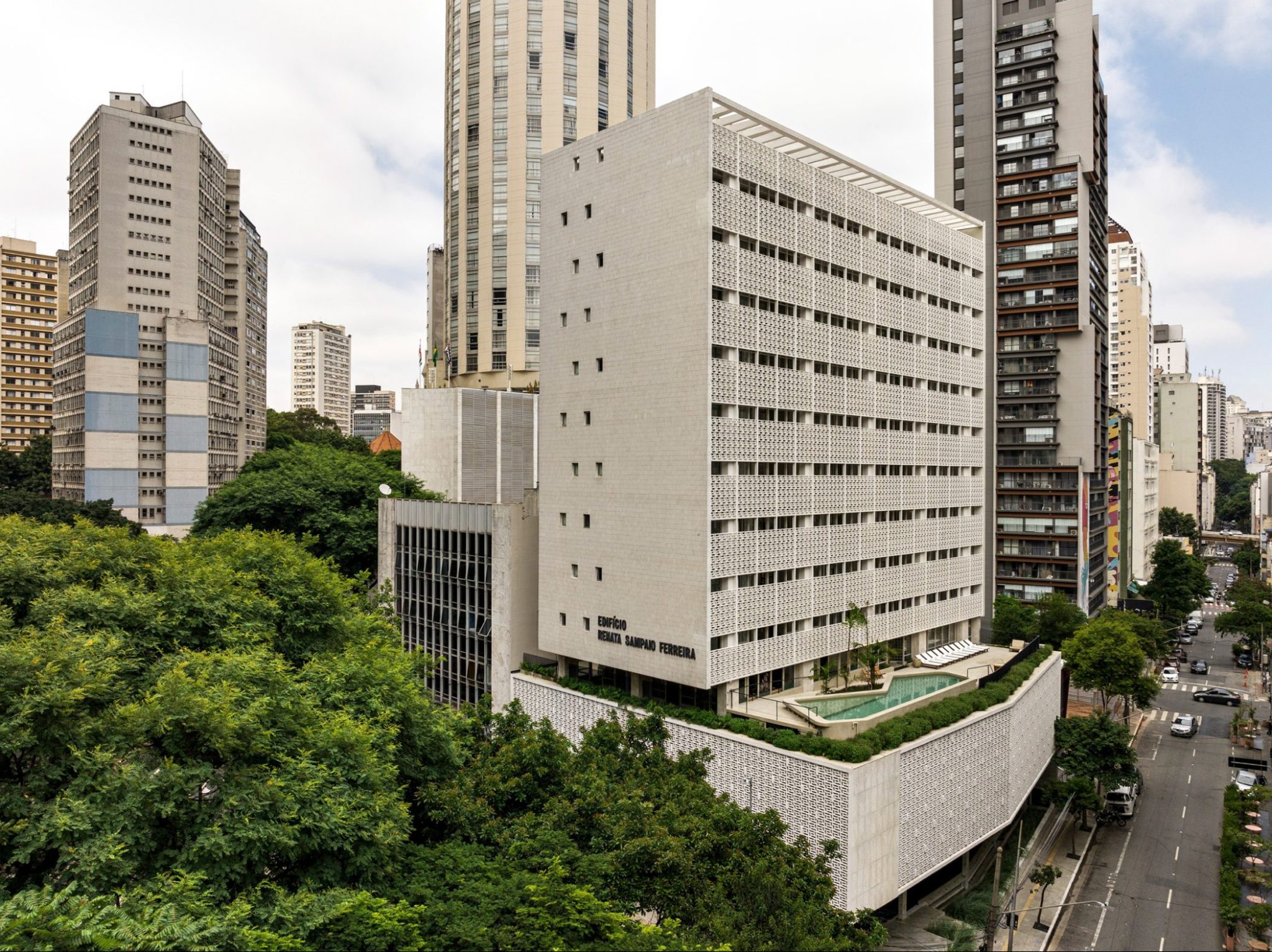
The Edifício Renata Sampaio Ferreira spent decades as one of those modernist buildings the city seemed to have simply forgotten. Designed by Bratke and listed for heritage protection in 2012, it sat underused until the developer Planta.inc transformed it in 2023 into a mixed-use complex that has since become something of a benchmark for the sector. The address then turned into a deal: the Renata was the most emblematic asset in a portfolio of five buildings that Planta sold to the global asset manager Brookfield Asset Management for R$250m (around $45m) in 2024. “Central São Paulo has always been on our radar as a culturally and gastronomically relevant hub with assets that have real potential for the multifamily segment,” said André Lucarelli, Brookfield’s senior vice-president for investments, at the time of the acquisition. “Demand for quality housing in the area far exceeds supply.”
That the Renata now also hosts the Lágrima Bar — an intimist 40-square-metre listening bar tucked into the back of the building, with a vinyl curation programme and cocktails with Japanese inflections — says something about the kind of life returning to the centre. The same Vila Buarque neighbourhood that houses the Domo Bar (named Revelation of the Year by Veja São Paulo magazine in 2023, its original tile floor from its previous life as a shoe shop still intact, its sound system designed by acoustic specialists Audithorium Technologies) and the Caracol, which pioneered the listening-bar concept in the city back in 2018, is the same neighbourhood where a generation of young professionals has discovered the pleasures of living without a car — something that once seemed to require being in Amsterdam or Copenhagen.

The nightlife did not arrive in isolation. Cora, run by Argentine chef Pablo Inca, occupies that sixth floor above the Minhocão, its terrace a destination in its own right, and has become a symbol of the gastronomic reoccupation of the centre. In the Carlos Rusca building, in the República district, the Matiz bar operates from a rooftop with views of the Copan. In the Galeria Formosa, near the Vale do Anhangabaú, the Formosa Hi-Fi opened in 2025 in a gallery basement that had been shuttered for more than fifty years, its design by the architecture firm Metrópole, its music programme moving between jazz, MPB and early electronic. And Casa do Porco, Jefferson Rueda’s pork-focused restaurant on Rua Araújo — repeatedly listed among the world’s fifty best — has for years demonstrated that the centre does not need anyone’s permission to be excellent.
Basílio 177 and the question of scale

If the Renata was the symbolic turning point, the Basílio 177 project is the bet on scale. Metaforma, a developer that has made retrofit its core business, is transforming the former headquarters of Telesp — once the state telephone company — into a complex with three towers, 274 apartments across 112 different floor plans, and a ground-floor food hall called Ramal. The main building is a commanding art deco structure from 1939, designed by the firm Ramos de Azevedo & Severo Villares — the same practice responsible for São Paulo’s Municipal Theatre and its landmark covered market. Ceiling heights of 4.5 metres and oversized windows, features that made practical sense in an era before air conditioning, have become selling points. Around 60% of units sold before the building’s delivery, expected in 2025. XP Investimentos, one of Brazil’s largest independent investment banks, came in as a financing partner in 2024 — a clear signal that the segment had begun attracting capital that had previously been confined to the city’s financial district further south.
Rio: the glory of the past, the ambition of the present
Where São Paulo’s retrofit wave has largely focused on converting obsolete commercial buildings into housing, in Rio de Janeiro the movement has taken on a more overtly symbolic dimension. The Hotel Glória — opened in 1922 for a national exhibition marking the centenary of Brazilian independence, the country’s first five-star hotel and reportedly the first reinforced concrete building in South America — is being transformed by the Opportunity real estate fund and SIG Engenharia into 266 high-end residential apartments. The architectural project is by the firms Cité Arquitetura and Afonso Kuenerz; interiors are by Patrícia Anastassiadis; landscaping is by the Burle Marx office, the studio founded by Roberto Burle Marx, Brazil’s most celebrated landscape architect. Total investment is estimated at R$400m. Completion is expected in 2026. The smallest unit, at 70 square metres, starts at R$1.2m. The projected total sales value of the development is R$700m.


Across town, on the Praça Mauá waterfront, the Edifício A Noite — designed by Joseph Gire, the same architect behind the Copacabana Palace hotel and the Hotel Glória itself, and inaugurated in 1929 as the first reinforced concrete skyscraper in Latin America — was purchased by the São Paulo developer AZO Inc. in 2023 for R$36m, after decades of sitting vacant. The building, which once housed broadcasts of the Rádio Nacional and the evening newspaper of the same name, will re-emerge with 447 residential units, retail space, a restaurant on the 23rd floor and a public viewing platform on the roof. Its art deco facade, listed by Brazil’s national heritage institute Iphan, is being carefully restored. The project won the ADEMI 2025 award in the Retrofit category.

More recently, BTG Pactual, Brazil’s largest investment bank, declared publicly its intention to expand a strategy of so-called Branded Residences in Rio — high-end residential buildings designed in partnership with luxury furniture and décor brands such as Ornare and Artefacto. In the bank’s target areas, the price per square metre rose from around R$5,500 to R$9,500 between 2024 and 2025, a gain of 42%. The underlying institutional motor for much of this activity is the city’s Reviver Centro programme, launched in 2022, which offers tax incentives and planning flexibility to developers converting commercial buildings in the city centre into housing. More than fifty projects have been submitted since its launch, according to the city government.
Belo Horizonte: catching up fast
Brazil’s third city has moved to join the trend with its own legislative framework. Municipal Law 11.783/2024, regulated by Decree 19.151/2025, created a special incentive regime for the hypercentre — the dense commercial heart of Belo Horizonte: exemption from property transfer tax on acquisitions for retrofit purposes, exemption from municipal property tax during construction, waiver of parking requirements, and relaxed rules on ventilation and accessibility standards. In exchange, projects must include at least one element of what the law calls “urban civility” — active ground-floor retail, publicly accessible open space, or a rooftop terrace open to the public.

The first construction permit issued under the law went to the Edifício Maranhão, a 1948 art deco building on Rua dos Tupinambás, one block from the city’s central Praça Sete, designed by architect Raphael Hardy Filho. Currently commercial, it will be converted into 124 residential apartments. Behind the scenes, the city government is preparing a broader initiative — an Operação Urbana Simplificada titled “Regeneração dos Bairros do Centro” — that would extend incentives to ten strategic surrounding neighbourhoods.
Why now?
The obvious question has an answer that is not simple but is reasonably clear. First: buildable land in the centres of Brazil’s major cities has effectively run out. Constructing from scratch where there is already infrastructure — subway lines, established commerce, public services — has become economically unviable. Second: the incentive legislation passed by São Paulo, Rio and Belo Horizonte between 2021 and 2025 reduced the legal uncertainty and fiscal cost of projects that had previously been difficult to underwrite. Third: the Caixa Econômica Federal, Brazil’s state-owned savings bank and the dominant force in domestic property lending, announced in February 2025 a dedicated credit line for retrofit projects, advancing up to 50% of funds to the developer at the outset. Previously that figure was 10%, which made cash flow management on large projects extremely difficult. Fourth: ESG criteria have given institutional investors a narrative to accompany the numbers. Reusing existing structures, avoiding demolitions and improving energy efficiency have become portfolio arguments rather than simply marketing language. Fifth, and perhaps most significant for the recent acceleration: large capital has arrived.
Within a period of sixty days in the second half of 2024, Brookfield and XP both made their first moves into the São Paulo retrofit segment, in transactions that together, by market estimates, exceeded hundreds of millions of reais. Jive Investments, a distressed-asset specialist, holds retrofit projects in São Paulo, Rio, Salvador and other cities as part of a portfolio of R$8.2bn under management. CIX Capital, with R$2.8bn in assets and experience in US retrofit deals, entered the Rio market in 2025 in partnership with Fator Realty, a developer with sixty-nine years of history and more than sixty thousand units delivered across fourteen Brazilian states.
The aggregate figures are beginning to speak for themselves. According to ABRAINC, the Brazilian association of residential developers, the southern region alone saw a 14% increase in the total sales value of retrofitted properties in the first quarter of 2025 compared with 2023. In São Paulo, the municipal retrofit programme has committed R$1bn in subsidies to cover up to a quarter of construction costs, with forty-seven buildings already in the process of urban requalification — among them the Martinelli tower, São Paulo’s first skyscraper, and the Copan itself.
What must not be forgotten
There is, however, a risk that urban economists have been naming with increasing urgency: that gentrification, understood purely as physical improvement, produces nothing more than social displacement. That low-income residents who never actually left the centre — who never abandoned the neighbourhoods that the market now describes as “degraded” — will be quietly pushed out by the very process of valorisation that their continued presence helped to make possible.
Central São Paulo was never empty. The area around Cracolândia contains flows of informal commerce, precarious housing and networks of mutual aid that exist entirely independently of any property development agenda. The tenements of Campos Elísios were, for decades, the only affordable housing option for workers who needed to live near their jobs. Academics such as Raquel Rolnik, the urban planning professor at the University of São Paulo and a former UN Special Rapporteur on the right to adequate housing, have long argued that revitalisation programmes without robust housing policy tend to relocate vulnerable populations to more distant peripheries — producing segregation while selling the language of cohesion.

The Caixa Econômica Federal appears, at least in its public statements, to be conscious of the tension. Inês Magalhães, the bank’s vice-president for housing, was pointed when presenting the new credit line: “We have no interest in producing apartments at R$30,000 per square metre.” The bank finances 100% of construction costs for projects within the subsidised Minha Casa Minha Vida programme — the government’s mass social housing scheme — and already has forty projects under analysis, with contracts signed in Rio, João Pessoa and Cubatão. In Belo Horizonte, the former headquarters of the national social security institute on Rua dos Caetés is being converted, with R$21m in federal funds, into housing for eighty-eight families from grassroots housing movements — a social retrofit in the middle of a hypercentre that the market has suddenly decided is prime real estate.
The Belo Horizonte city council was, in its own way, direct when it voted on the amendments to the retrofit bill. One clause requires that the law must “promote the production of sustainable and inclusive housing, with guaranteed dignified housing for diverse social groups” and “combat practices of social exclusion.” Fine words. Brazil’s track record in translating good legislation into practice is, to put it diplomatically, uneven. That caveat matters here.
The speed with which institutional capital is moving in this direction suggests that the window of opportunity is real and, for now, open. The question that remains — and that no investment fund will answer on its own — is whether Brazil’s cities can ensure that the return on that capital is also, and genuinely, a return for the people who never went anywhere.
Leave a Reply