
By Rodrigo Uchoa, special for Brazil Stock Guide
Paris’s Marché aux Puces de Saint-Ouen has always sold the same intoxicating promise: that destiny is not random, merely poorly indexed. Turn up early enough, squint at enough brass candlesticks, and you may go home with a perfectly imperfect treasure—and the pleasing sense that you have earned your consumption through mild cardio. The market’s own literature calls it the world’s largest antiques-and-secondhand bazaar, attracting more than five million visitors a year; guides routinely add that it hosts over 2,000 sellers spread across a sprawling patchwork of sub-markets.
The timing, however, is newly delicious. Luxury’s primary market has stopped sprinting. Bain’s latest numbers put personal luxury goods at €364bn in 2024, with a forecast of €358bn in 2025—a 2% “erosion”, the consultant’s equivalent of clearing one’s throat before delivering bad news politely.

And yet, in the corner of the room, the secondhand segment keeps smiling serenely. Bain estimates the secondhand luxury goods market at about €50bn in 2025, still expanding 4–6% a year, and increasingly dominated by hard luxury (watches and jewellery). In other words, when new luxury hesitates, used luxury behaves like it has a diversified portfolio and excellent posture.
A global movement, now with better tailoring
Secondhand luxury is no longer the thrifty cousin at the family wedding. It is the elegantly dressed aunt who quietly points out that the bride’s gown is “very brave”. In London, this sensibility has a postcode: Notting Hill, where Portobello Road remains the canonical place to rummage for antiques and vintage is now packaged as an experience rather than a habit. In Amsterdam, the Waterlooplein Market—formalised as a day market in 1885—still offers the democratic thrill of finding something odd and insisting it is “design”.
Japan has long treated secondhand as a parallel economy with unusually high standards. A recent Financial Times report cites research that estimates “unused, resellable household items” in Japan—so-called “lifestyle assets”—at around $580bn in secondhand value, aided by careful preservation, original packaging and a weak yen that flatters visiting shoppers. The country’s major resellers, such as KOMEHYO and Brand Off, have turned “used” into something closer to “certified, curated, politely disinfected”.
This is, of course, also about money —just wrapped in moral language. BCG and Vestiaire Collective’s 2025 work (based on a survey of 7,800 resale-engaged consumers) notes that secondhand is firmly mainstream, with price and value leading the motivations, while sustainability provides the socially acceptable garnish. Vestiaire’s own framing puts the broader resale market at roughly $210–$220bn, with projections up to $360bn by 2030.
Where aspiration meets arithmetic
Brazil’s story is not the same as Europe’s—and that is precisely why it matters. In mature markets, secondhand luxury is increasingly narrated as a sustainability-forward choice: fewer new products, lower waste, a cleaner conscience. In Brazil, the narrative is often more straightforward: access, status, and value retention in a country where full-price luxury can be a feat of taxes, exchange rates and sheer commitment.
Supply is rising fast because new luxury has been rising fast. Bain estimates Brazil’s luxury market reached R$98bn in 2024, growing 12% a year since 2022, with a projection of R$150bn by 2030. More new luxury today means more future inventory for curated resale tomorrow. Brazil, in effect, is manufacturing the raw material for its own luxury secondhand boom.
At the mass end of recommerce, corporates have already done the spreadsheets. When Lojas Renner bought Repassa, coverage of the deal cited Renner’s estimate that Brazil’s secondhand apparel market already moved around R$7bn in GMV (gross merchandise value — the total value of goods sold on a platform, before fees, returns and other deductions) per year, with potential to reach R$31bn by 2025. This is not all “luxury”, but it normalises the behaviour: buying used online, trusting someone else’s curation, and accepting that the best wardrobe may be distributed across many owners.
When the mall invests in the “pre-loved” aisle
Luxury resale in Brazil gained an unmistakable stamp of legitimacy when Iguatemi—the polished temple of first-hand aspiration—bought 23.08% of Etiqueta Única for R$27m, with an option to become controller within three years. If luxury malls are cathedrals, Iguatemi has effectively installed a tasteful side chapel for secondhand saints.
Globally, the same instinct has spread through boardrooms. Kering (Gucci, Saint Laurent, Balenciaga) disclosed taking a 5% stake in Vestiaire Collective as part of a €178m financing round—positioning resale as both growth channel and reputational hedge. Richemont (Cartier, Van Cleef & Arpels, Jaeger-LeCoultre) moved earlier in watches, acquiring Watchfinder in 2018—an admission that value retention is part of the luxury product story, whether brands like it or not.


Portable prestige, preferably in leather
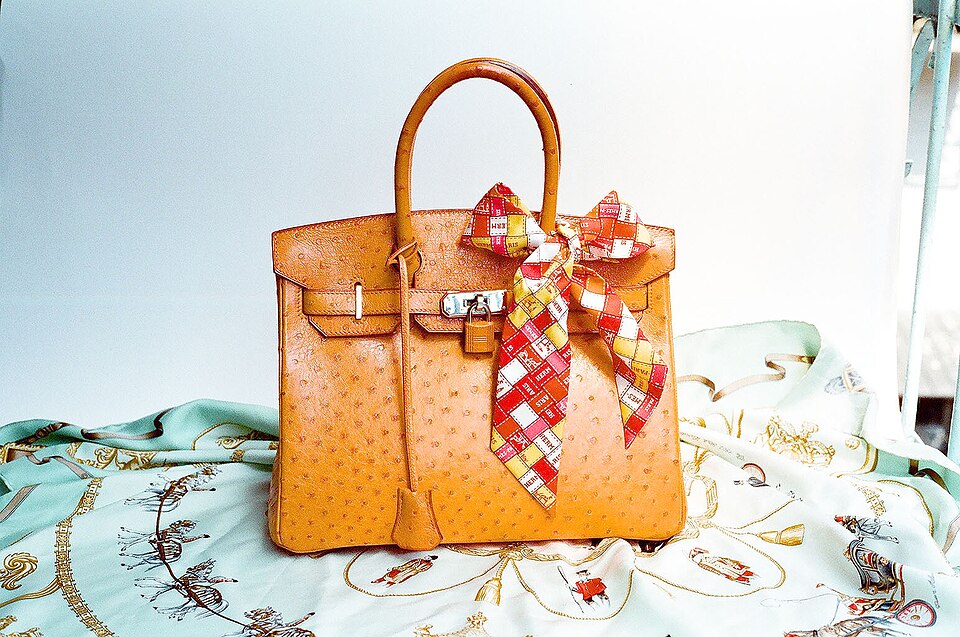
Demand remains reassuringly predictable: handbags, watches, and the sort of logos recognisable from across a restaurant. The RealReal’s 2024 report lists its most searched brands as Louis Vuitton, Chanel, Prada and Gucci. Brazilian luxury resale signals rhyme with that global playlist. Etiqueta Única explicitly highlights brands such as Chanel, Louis Vuitton, Prada and Louboutin among the labels circulating on its marketplace.
The physical footprint is also widening beyond the traditional Rio–São Paulo axis. PrettyNew lists store operations in Brasília, São Paulo and Curitiba, a small but telling sign that luxury secondhand is learning to speak fluent Centro-Oeste. In Brasília, Comadres positions itself as a luxury secondhand specialist offering brands including Gucci, Dior and Chanel. In Goiânia, Bazar D’Luxo—complete with an address on Avenida Goiás—illustrates how the category is following purchasing power into fast-growing regional hubs. And in São Paulo, the ecosystem increasingly includes physical touchpoints and collection/returns infrastructure; even Etiqueta Única’s move into a shopping-centre format has been reported as part of this retail thickening.
“Peripheral” markets write sequels
The world’s luxury resale markets are not identical. Paris wants provenance and theatre. Tokyo wants immaculate condition. London wants a story. Amsterdam wants a bargain. Brazil wants all of the above—plus the practical satisfaction that today’s purchase might still be worth something tomorrow.
So yes: “pre-loved luxury” is now global, professionalised and oddly moral. But if the industry still treats Brazil as peripheral, it may be misreading the plot. In a year when new luxury is learning to tread carefully, Brazil is growing the customer base—and, by extension, quietly expanding the future supply of luxury for resale. Which is a reminder, really, that in luxury—as in geopolitics—the margins have a habit of becoming the main text. And sometimes, the sequel is better dressed than the original.

Where to Buy Someone Else’s Dream (and Call It “Curated”) ✨👜
Brazil (online) 🇧🇷
- Etiqueta Única 🏷️ — https://www.etiquetaunica.com.br
- Gringa 👠 — https://gringa.com.br
- Pretty New ♻️ — https://www.prettynew.com.br
- Cansei Vendi 🔁 — https://canseivendi.com.br
International (online) 🌍
- Vestiaire Collective 💼 — https://www.vestiairecollective.com
- The RealReal 👜 — https://www.therealreal.com
- Fashionphile 👛 — https://www.fashionphile.com
- Rebag 🔒 — https://www.rebag.com


Leave a Reply