By Rodrigo Uchoa*, special for Brazil Stock Guide
In the age of cheap flights and expensive attention, the museum has become a paradox: a temple built for slow looking that now functions, at peak hours, like a transport hub. The world’s biggest institutions are discovering that the real curatorial problem is not what to hang on the wall, but how to keep the wall visible behind the crowd.
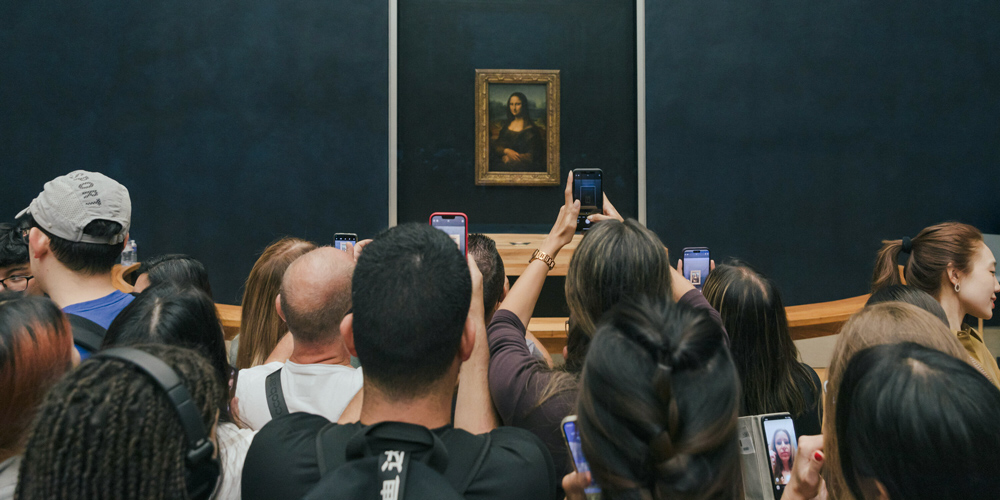
The Louvre—still the planet’s most visited museum—registered 8.7m visitors in 2024. Much of that demand concentrates into a single bottleneck: the pilgrimage to Leonardo’s Mona Lisa. The French state’s answer is architectural triage. President Emmanuel Macron backed a major “Nouvelle Renaissance” renovation that would give the painting a dedicated gallery and separate access, explicitly designed to relieve pressure on the museum’s main arteries.
That is also where the politics begin. A “separate experience” sounds suspiciously like a “separate charge”, and reporting around the plan has framed it as a way to monetise the crush—through differentiated pricing and, potentially, an additional ticket for the Mona Lisa. Inside the Louvre, staff unrest has sharpened the critique: unions and commentators argue that headline projects risk diverting money and management attention from the museum’s more basic problems—maintenance, staffing, security and day-to-day working conditions—made painfully visible by strikes and a string of recent incidents. Even the design process has generated friction, with coverage in France describing tensions over how the new space is being conceived and who gets to shape it.
Madrid’s Prado offers the opposite instinct: not expansion, but refusal. After welcoming a record 3.5m visitors in 2025, director Miguel Falomir said the museum does not need “a single visitor more”—a remarkable statement in a sector long trained to treat attendance as virtue. The Prado’s worry is not only comfort; it is mission drift. A museum that feels like “the Metro at rush hour” (Falomir’s comparison in press coverage) risks turning masterpieces such as Velázquez’s Las Meninas into mere background for circulation. The response has been managerial rather than monumental: tighter controls on entry points, groups and in-gallery behaviour, alongside renewed emphasis on “quality of visit” over raw headcount.
The Prado and the Louvre are simply the clearest symptoms of a wider pattern. Other giants are also operating near (or at) capacity: London’s British Museum drew 6.5m visitors in 2024, while the Vatican Museums reported 6.8m in 2024. When institutions of this scale clog up, they export the same stresses seen in over-touristed cities: queues that colonise public space, pressure on staff, and a subtle downgrade of everyone’s experience—locals and foreigners alike.
Why now? Partly because demand has become more concentrated and more ritualised: travellers “must do” the Mona Lisa, the Sistine Chapel, the Rosetta Stone, Las Meninas. Social media intensifies the funnel. The visit is no longer only to see; it is to be seen seeing. That changes dwell time and flow. In Florence, the Uffizi moved to restrict selfie behaviour after a visitor damaged a painting while posing for a photo—an incident that became a neat allegory for the collision between cultural heritage and content culture.

Brazil, at first glance, looks like it should be spared. Total international arrivals were 6.6m in 2024 and rose to 9.29m in 2025—huge numbers for Brazil, but still comparable to (or even smaller than) annual footfall at a single global museum. The Louvre alone nearly matches Brazil’s entire inbound tourism in 2024. That comparison is not a boast; it is a unit of measure for the pressure that “one building + one city” can absorb.
Yet the Brazilian picture is shifting, especially in São Paulo, where museum-going has become a mass habit rather than a niche one. The newly restored Museu Paulista (Museu do Ipiranga) has reached 2m visitors since reopening in September 2022, and university reporting put the average at roughly 2,000 visitors per day over parts of that period. Anyone who has tried to walk in on a free day has felt the practical corollary: time slots sell out, lines form, and “come back another day” becomes a policy by default.
The Pinacoteca, also in São Paulo, has seen a similar surge. It received 880,000 visitors in 2023 (up sharply year-on-year, per Brazilian press coverage), and the institution itself now speaks of roughly 800,000 visitors a year across its growing campus. The crowding may still be mild by European standards, but the operational consequences already appear. As Pinacoteca collection curator Yuri Quevedo has observed, the increase is visible enough to shape exhibition design—fewer sculptures placed in circulation paths, more attention to how bodies move through rooms, more “museum choreography” than the public realises.

Rio de Janeiro offers a case study of the selfie economy spilling into cultural infrastructure. At Parque Lage—an art school inside a postcard setting—local reporting described how the constant stream of visitors seeking photos around the reflecting pool became disruptive for students and staff, fuelling pressure for restrictions on how the space is used. It is not hard to imagine similar “anti-selfie” lines hardening elsewhere: first a cordon, then a timed lane, then a rulebook—until the world’s most famous faces (Mona Lisa, Las Meninas) are viewed, literally, from behind crowd-control.
Museums have always been machines for converting crowds into meaning. The difference now is that the crowd has become the main exhibit. The next era of museum reinvention will be judged less by the grandness of the façade and more by the unglamorous mathematics of flow: entrances, exits, time slots, group caps—and the courage, occasionally, to say what the Prado has already said out loud: enough.
* The Skeptical Hedonist’s Handbook: https://www.instagram.com/theskepticalhedonist


Leave a Reply