
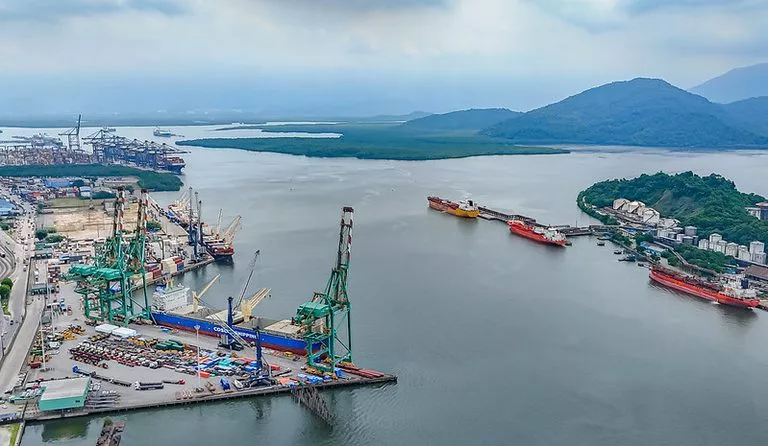
By Brazil Stock Guide – Two construction groups — Spain’s Acciona SA (ANA.MC) and Portugal’s Mota-Engil SGPS SA (EGL.LS) — have submitted bids to build and operate the immersed tunnel connecting Santos and Guarujá, on the coast of São Paulo state. The information was first reported by O Globo. The auction is set for Friday, April 5, when the winning bid will be announced.
The project, estimated at R$6.8 billion ($1.3 billion), will become Latin America’s first submerged tunnel and is billed as the largest work under Brazil’s Growth Acceleration Program (PAC). The concession will last for 30 years, with the winner determined by the highest discount offered on the monthly fee to be paid by the federal and state governments.
Project scope and financing
The tunnel will span 1.5 kilometers, including an 870-meter immersed section under the channel. It will link Vicente de Carvalho in Guarujá to Macuco in Santos, near the port. The design includes three lanes in each direction, one adaptable for light rail, as well as a bike path and pedestrian walkway.
Funding will come equally from the federal and São Paulo state governments, each committing R$2.57 billion, with the remainder covered by private investment. Despite political tensions between President Luiz Inácio Lula da Silva’s administration and São Paulo Governor Tarcísio de Freitas, both sides have emphasized “partnership and alignment” over the project.
Logistics and tolling
The tunnel is expected to ease congestion on the Cônego Domênico Rangoni Highway (SP-055) and improve freight flow to the Port of Santos, Brazil’s largest container hub. Once operational, the concessionaire will charge tolls. The government initially projected R$6.15 per crossing for passenger vehicles in 2024, with adjustments for inflation until the tunnel opens, expected in 2029. Pedestrians and cyclists will be exempt.
The concessionaire is projected to collect R$3.16 billion in toll revenue over the life of the contract, in addition to potential ancillary income from advertising and other commercial activities.
Engineering challenges and resettlement
The project will rely on six prefabricated reinforced-concrete modules, each built in dry dock and floated into position before being sunk to a depth of at least 21 meters. Installation will be carried out without disrupting maritime traffic.
Construction is slated to begin in 2026 and take around three years. To clear the way, authorities plan to expropriate 776 households, mostly in Guarujá, along with 645 irregular homes in Vicente de Carvalho. Municipal and state governments will oversee resettlement and urban redevelopment in affected areas.


Leave a Reply