
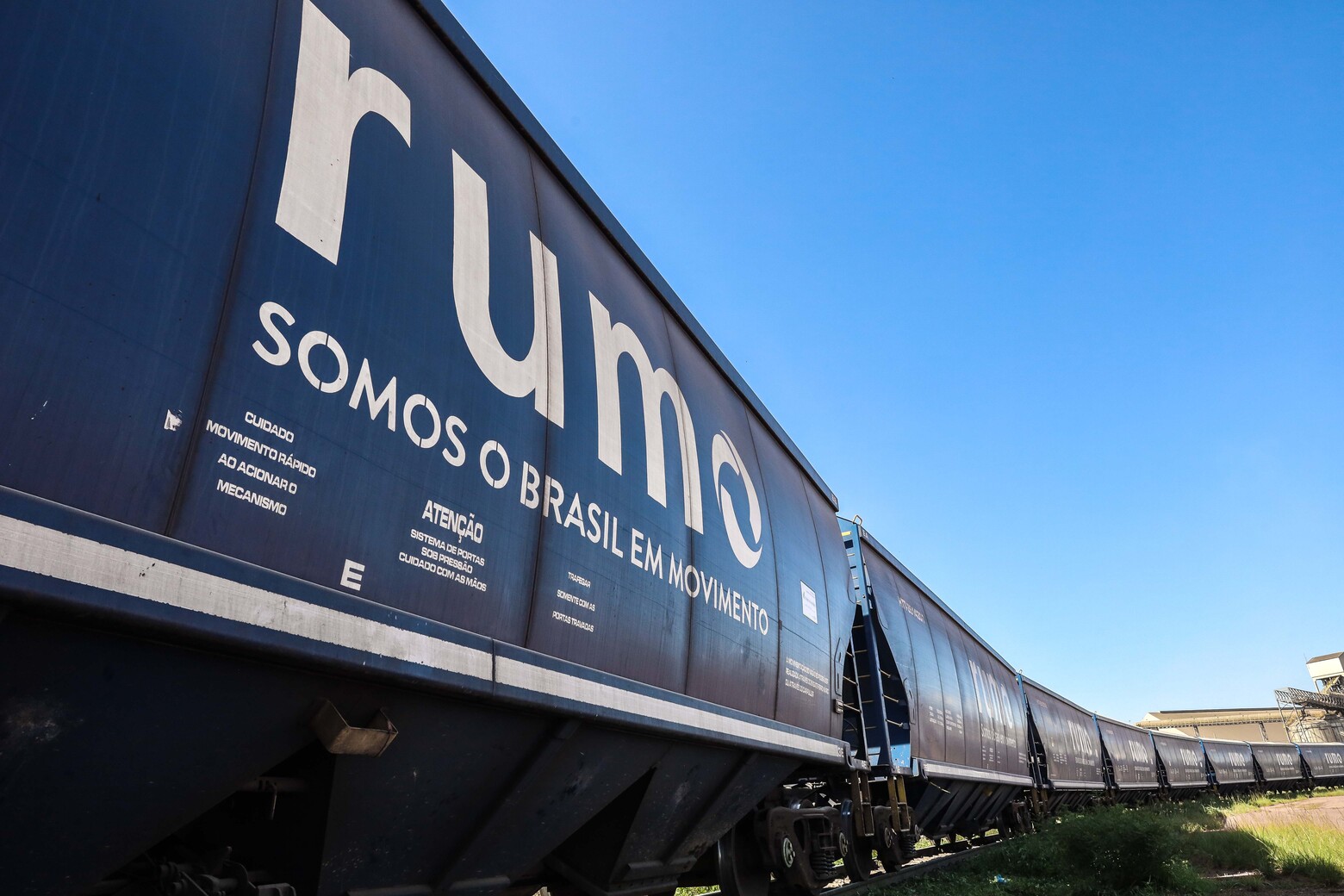
By Brazil Stock Guide – Rumo’s latest operating data suggests that Brazil’s largest rail logistics company is entering the second half of the year with more momentum than investors had expected.
The company transported a record 8.2 billion ton-kilometers (TKU) in May, up 8% from a year earlier and surpassing the previous monthly record set in October 2025. The result comes at a critical moment for Rumo, whose shares have struggled amid concerns over grain pricing, crop uncertainties and the heavy capital spending required to expand its network.
The numbers tell a different story. Rumo’s Northern Corridor — the company’s flagship route connecting Mato Grosso to export terminals — moved 7.0 billion TKU during the month, also a record. More importantly, average daily volumes reached 227 million TKU, suggesting the corridor is operating close to practical capacity even before the peak corn season begins.
That matters because corn remains one of the biggest earnings catalysts for the second half. Unlike soybeans, which dominate shipments in the first half of the year, corn volumes typically ramp up after harvest and tend to generate attractive incremental margins. BTG Pactual notes that May’s record performance occurred without meaningful corn transportation, indicating additional upside may still be ahead as contracted volumes begin moving through the system.
Later this month, Rumo is expected to inaugurate the first phase of its Lucas do Rio Verde logistics project, one of the most important infrastructure expansions in Brazil’s agricultural frontier. The project extends the railway deeper into Mato Grosso, reducing trucking distances and potentially strengthening Rumo’s competitive position against road transport.
For years, investors questioned whether the company could fill the massive capacity being built in the region. Recent volume data suggest demand may be arriving faster than expected.
Agricultural products remained the backbone of the operation, accounting for roughly 6.7 billion TKU in May. Soybean meal shipments jumped nearly 27% year-over-year, while fertilizer transportation more than tripled, reflecting both strong farm activity and the strategic importance of inbound cargo for network efficiency.
The Southern Corridor also delivered a solid performance, with volumes rising 6.5% from a year earlier. While smaller than the Northern operation, the asset has proven more resilient than many investors anticipated, helping diversify revenue streams and reducing dependence on a single crop cycle.
Grain prices remain far from ideal, and weather risks associated with El Niño continue to hover over agricultural forecasts. Yet the company’s ability to capture market share, improve asset utilization and fill new infrastructure appears to be offsetting many of those concerns. BTG argues that volumes and margins remain the main value drivers for the stock this year.
That helps explain why analysts remain constructive despite a difficult share-price performance. BTG maintained its Buy recommendation and R$23 target price, implying upside of more than 70% from current levels. The stock currently trades around 6x 2026 EV/EBITDA, a valuation the bank considers discounted relative to the company’s growth profile.
Investors will still be watching several variables closely: grain contracting trends, the ramp-up of new terminals such as BR-070 and STS11, regulatory discussions surrounding the Malha Oeste concession, and weather-related impacts on Brazilian crop production


Leave a Reply