
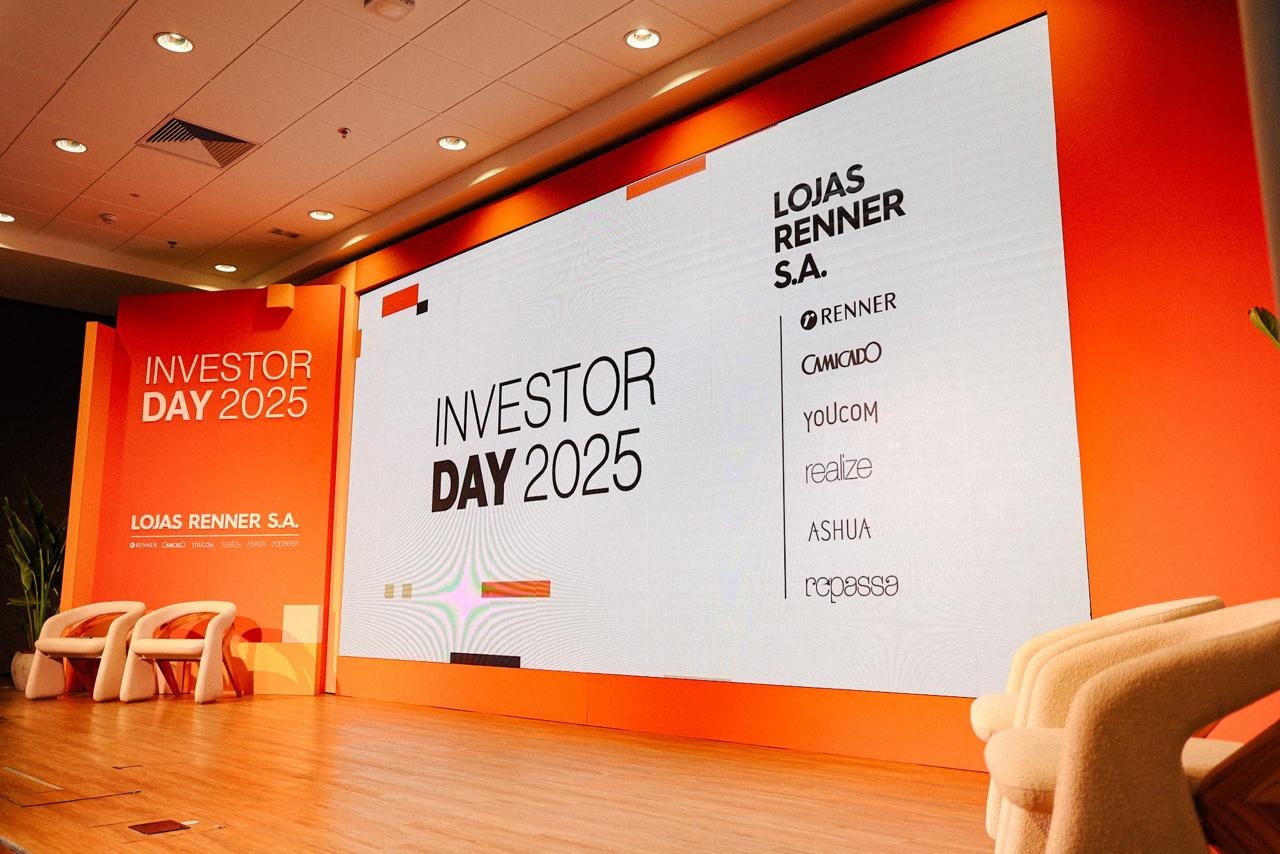
By Brazil Stock Guide – Lojas Renner S.A. (LREN3) unveiled at its Renner Day a new long-term strategy that formally shifts the group into a high-return growth cycle for 2026–2030, anchored on selective physical expansion, a now-profitable digital operation, and the Realize financial arm as a core engine for credit and loyalty.
The company targets annual net revenue growth of 9% to 13%, EBITDA margins of up to 20%, and return on invested capital near 20%, alongside a payout of 50% to 80% of earnings through dividends, interest on equity and share buybacks.
Management reinforced the shareholder-led focus at the opening of the event. “We announced a new share buyback program and a new distribution of interest on equity. These are examples of the confidence we have in our company and in the value generation we deliver to our shareholders,” said Fabio Faccio, CEO.
According to Faccio, Renner has completed the heavy investment phase that followed the pandemic and is now entering the stage of operational leverage. “The platform we have today, ready to grow with profitability, was built mainly between 2020 and 2023. Now we are reducing expenses over revenue, improving margins and raising ROE,” he said.
At the core of the new cycle is the company’s 100% SKU-based replenishment system, now fully deployed across the product portfolio with support from the São Paulo distribution center, fully operational since 2024. The model replaced rigid pre-packed assortments and now enables store-by-store, item-by-item allocation.
“This model has already increased in-store availability and led to more than 10% growth in units sold of fashion products,” said Alexandre Aires, Renner’s Supply Chain director. The change also shortened production cycles materially.
“We reduced total production time by 26%,” he said, after direct investments of R$16 million (about $3.2 million) in the domestic supplier base and an additional R$80 million ($16 million) via partners, delivering 25% productivity gains and a 1.5 percentage point margin uplift among key suppliers.
The strategy also strengthens trend responsiveness. “Today, 20% of our production already operates in reactive mode and we aim to reach 30% to 40%,” said Fabiana Taccola, vice president of Product and Operations. According to her, Renner positions itself “before the hype,” testing products at small scale before accelerating winners.
Digital Turns Profit Driver
E-commerce has fully entered its profitability phase. The digital channel now generates more than R$2.4 billion a year—around $480 million—representing 15% of total revenue, with EBITDA growing faster than sales.
“EBITDA is expanding at a much faster CAGR than revenue itself,” Taccola said. Artificial intelligence is now a central pillar of that performance. “When we used AI to humanize children’s product images, we drove more than 60% higher visits and conversion,” she added.
Recommendation engines have become another revenue lever. “We recorded more than 135% growth in revenue driven by recommendation systems,” she said. Renner is also positioning itself for the next digital frontier. “We are already preparing for agent commerce,” she said, noting that the group is currently the most searched fashion brand inside ChatGPT in Brazil.
The financial arm Realize has been fully repositioned since Renner’s 2023 Investor Day and is now entirely focused on supporting the ecosystem. “We understood that our true vocation is to be a financial institution fully oriented toward the ecosystem,” said Paula Mazanek, Realize’s chief executive.
The commercial impact is direct. “Realize customers visit physical stores 50% more frequently and spend 150% more on an annual basis,” she said. Online, the effect is even stronger. “E-commerce spending is 93% higher among cardholders.”
Renner’s next major bet is the launch of a new card in the second half of 2026. “It will be a single, fully branded card with two completely independent credit limits—one for use inside the ecosystem and another for use outside,” Mazanek said. The card will be integrated into Renner’s app, supporting Apple Pay, Google Pay and Face ID authentication.
Expansion Beyond Capitals
Physical expansion is returning to the center of the growth narrative. Renner plans to reach up to 600 stores in Brazil by 2030, with a strategic emphasis on mid-sized cities, where card penetration and credit relevance are higher. “In those cities, card participation is five percentage points above what we see in major capitals,” Mazanek said.
The rollout will be anchored in the Remais store format, which combines self-checkout, circularity and full digital integration. “Physical stores remain a competitive differentiator,” said Gustavo Yuasa, strategy director.
By disclosing a new set of long-term public targets and formally abandoning the previous guidance embedded in its Reference Form, Renner is signaling a new phase to the market. The company is moving from an investment-heavy cycle to one driven by operational leverage, high ROIC expansion and monetization of its customer base through fashion, data and proprietary credit.
Renner is seeking to replicate—at a higher level of return—the expansion cycle that defined the previous decade, when it scaled its national footprint and consolidated its leadership in Brazilian fashion retail. The difference this time lies in the combination of profitable digital scaling, granular supply chain control and embedded financial services, which materially alters the company’s capital efficiency.
If execution remains on track, Renner could enter 2027 with revenue approaching R$25 billion (about $5 billion) and one of the highest ROIC profiles in Brazilian retail. The main stress test will come from the company’s ability to run three complex fronts in parallel: accelerated interior expansion, a digitally dominant commercial model and the scaling of proprietary credit without risk deterioration.


Leave a Reply