
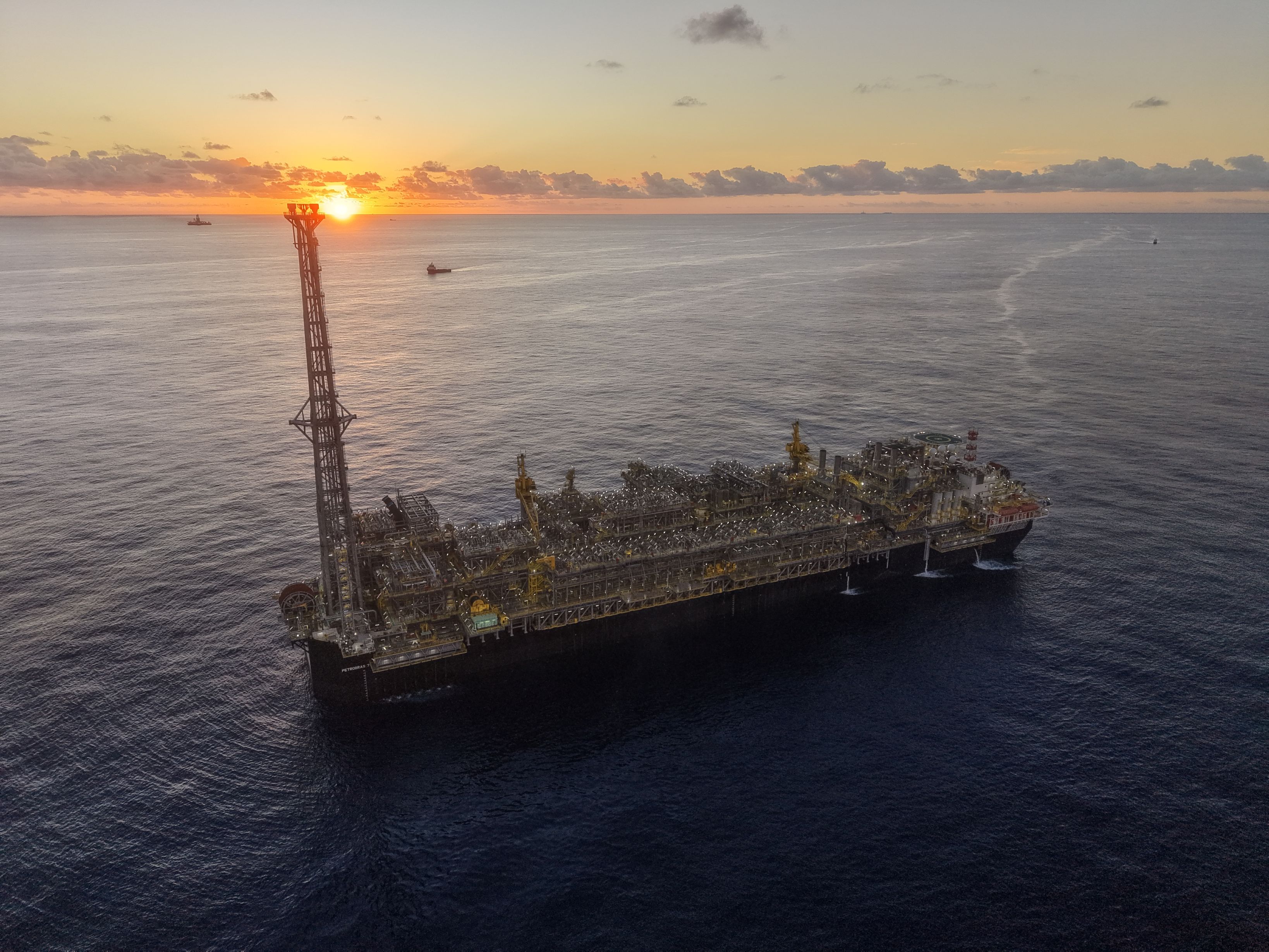
Brazil Stock Guide — Petrobras (NYSE: PBR; B3: PETR3, PETR4) posted record oil and gas production in the second quarter, positioning the Brazilian state-controlled producer to benefit from the surge in crude prices triggered by the US-Iran war.
The company’s total output reached 3.34 million barrels of oil equivalent per day, up 14.1% from a year earlier and 3.4% from the first quarter. Operated production, which includes volumes belonging to partners, climbed to a record 4.87 million boed.
The timing matters. The conflict disrupted global energy flows through the Strait of Hormuz and added a substantial geopolitical premium to crude prices during the quarter. Brent rose sharply as hostilities escalated, although part of that premium was unwound following ceasefire efforts in June.
For Petrobras, the combination of higher production, expanding exports and elevated international prices could translate into a particularly strong quarter for upstream revenue. The precise financial benefit, however, will only become clear when the company releases its earnings, as realized prices, export timing, freight costs and currency movements also affect the result.
The production advance was driven by the ramp-up of the Maria Quitéria, Alexandre de Gusmão and P-78 floating production units, as well as the start-up of the P-79 platform at the Búzios field. Higher operational efficiency added about 70,000 barrels a day compared with the same period last year, according to the company.
P-79 began producing on May 1, three months ahead of the schedule included in Petrobras’s latest business plan and five months earlier than the timetable set a year ago. The platform, the eighth at Búzios, can produce as much as 180,000 barrels of oil a day and lifts the field’s installed capacity to about 1.33 million barrels a day.
Búzios exceeded 1.2 million barrels of daily production in late June, while its average monthly output topped 1 million barrels a day for the first time. Petrobras said the field reached that threshold 8.2 years after its permanent production systems began operating, faster than the 8.8 years required by Tupi, another landmark pre-salt development.
The Almirante Tamandaré platform, also at Búzios, produced an average 253,000 barrels a day in June, retaining its position as Brazil’s highest-producing offshore unit. Mero, meanwhile, averaged about 740,000 barrels a day during the quarter.
Petrobras’s own pre-salt oil production climbed 5% from the previous quarter to 2.30 million barrels a day. Total oil and natural-gas-liquids output rose 15.2% from a year earlier to 2.69 million barrels a day.
The production gains flowed through to the company’s trading operations. Crude exports rose 12.2% from the first quarter and 44.3% from a year earlier to 996,000 barrels a day. Net exports of crude and refined products reached 1.08 million barrels a day, more than double the level recorded in the second quarter of 2025.
The geographic mix shifted sharply as China reduced purchases. The country accounted for 35% of Petrobras’s crude exports, down from 62% in the previous quarter and 51% a year earlier. India’s share rose to 22% from 15%, while Europe’s climbed to 18% from 8%.
Petrobras attributed the Chinese pullback mainly to measures taken by the country to reduce imports in response to international oil prices. The decline was offset by stronger shipments to India, Europe and other Asian markets, with Petrobras adding refiners in Taiwan, Oman, Poland, Sweden and South Africa as new customers.
The war also made Petrobras’s downstream performance more strategically relevant. With international fuel markets under pressure, the company pushed refinery utilization to a record 101.2%, increased domestic production of diesel and jet fuel and sharply reduced its dependence on imported products.
The utilization measure compares refinery throughput with Petrobras’s sustainable reference capacity. It does not mean the plants operated beyond their regulatory, environmental or safety limits.
Refined-product output rose 5.6% from the previous quarter and 10.9% from a year earlier to 1.92 million barrels a day. Production of low-sulfur S10 diesel and jet fuel reached quarterly records of 509,000 barrels and 109,000 barrels a day, respectively.
Higher refinery runs reduced Petrobras’s need for imported fuel at a time of heightened geopolitical risk. Diesel imports fell 63.3% from the previous quarter to 18,000 barrels a day, while crude imports declined 43.3% to 89,000 barrels a day, their lowest level since the pandemic. Total imports dropped 41.8% to 156,000 barrels a day.
Domestic fuel sales were broadly stable at 1.74 million barrels a day. Diesel sales edged up 0.4% and liquefied petroleum gas rose 8.3%, offsetting a 2.2% decline in gasoline as ethanol became more competitive in several Brazilian markets. Jet-fuel sales fell 11.9%, partly reflecting the seasonal boost to air travel in the first quarter.
The production expansion came with higher absolute emissions. Greenhouse-gas emissions from Petrobras’s oil and gas operations rose to 25 million metric tons of carbon dioxide equivalent in the first half, from 23 million tons a year earlier, reflecting increased production, new offshore units and heavier refinery throughput.
Upstream emissions intensity nevertheless declined to 14.4 kilograms of CO₂ equivalent per barrel of oil equivalent from 14.7 kilograms in 2025, suggesting that production grew faster than emissions. Refining emissions intensity increased about 1%, which Petrobras attributed to a change in its calculation methodology.
The figures leave Petrobras entering the second half with greater production capacity, record refinery utilization and a significantly stronger net export position. The financial results will show how much of the oil-price windfall generated by the US-Iran conflict the company was able to capture.


Leave a Reply