
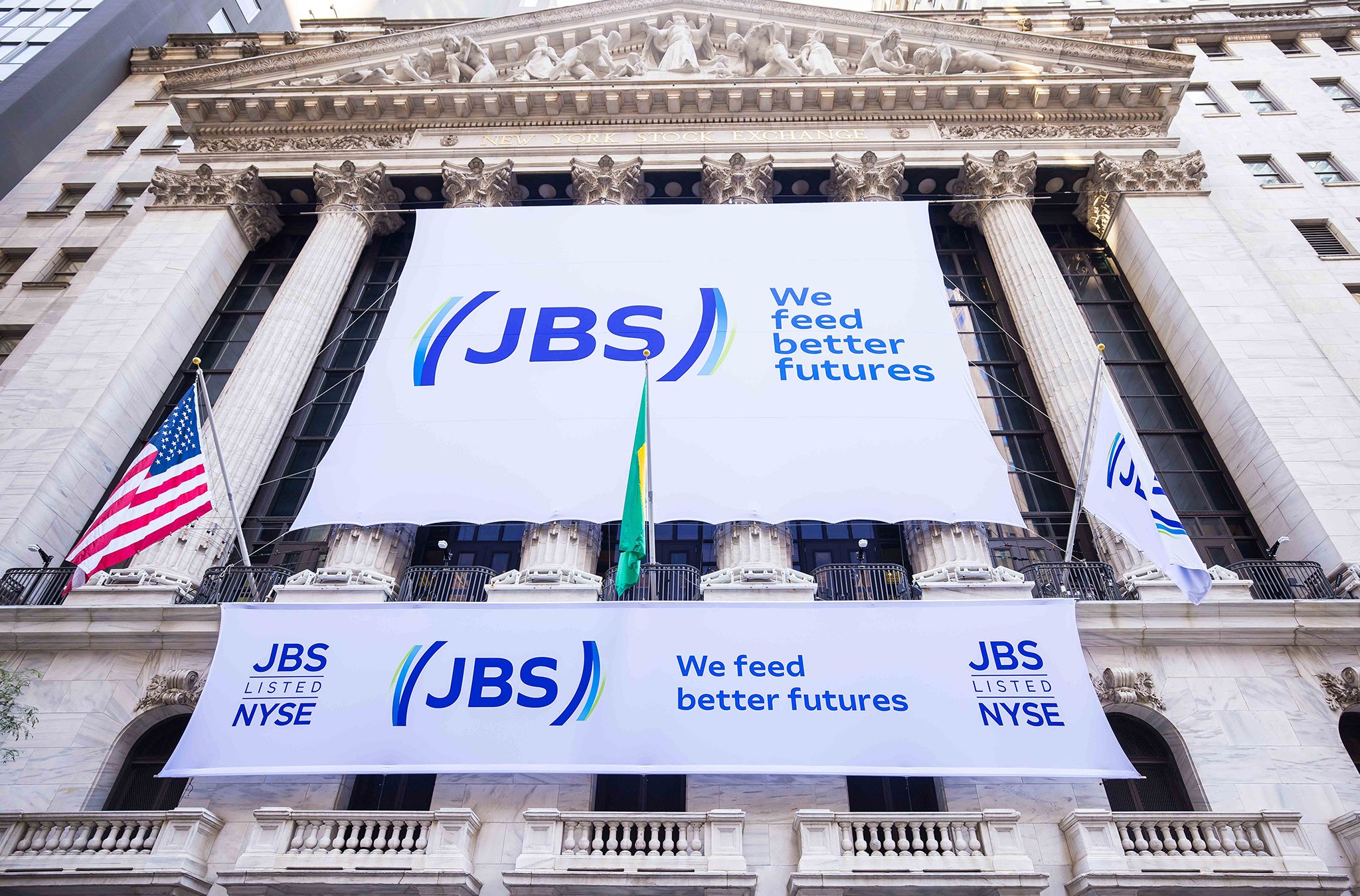
By Brazil Stock Guide – JBS left its Investor Day in New York with a carefully calibrated message for Wall Street: the cycle remains tough, especially in U.S. beef and chicken, but the company says it has enough internal levers to navigate 2026, protect its investment-grade profile and prepare for an earnings recovery in 2027.
For Ricardo Alves, at Morgan Stanley, the recent pullback in the stock does not derail the re-rating thesis. “For investors with patience, JBS screens attractive to us here,” the bank wrote, maintaining an Overweight rating and a $19 price target. JBS shares are trading at US$ 12.20, down 13.7% so far this year.
That constructive tone was shared by other banks, although with varying degrees of caution. For Andrew Strelzik, at BMO Capital Markets, the event reinforced the idea that the downcycle may be near its trough. “We came away with greater confidence 2026 should be the cyclical EBITDA low point,” the analyst wrote, keeping an Outperform rating and an $18 price target.
The most tangible decision was the $400 million cut to JBS’s 2026 capex plan, from $2.4 billion to $2 billion. The reduction was not framed as a cancellation of projects, but as a delay in longer-dated initiatives, including some expansion plans in Australia. Analysts read the move as a sign that JBS is choosing to defend its balance sheet as leverage moves closer to the upper end of the company’s 2x to 3x net debt-to-EBITDA comfort zone.
In credit, Priya Ohri-Gupta and Teresa Tian, at Barclays, also viewed the cut as a sign of discipline. “The company is moderating capex to ensure net leverage stays below 3x,” the analysts wrote, reiterating an Overweight stance on JBS debt and saying they continue to see value in the company’s long bonds.
That was the core message of the event: JBS tried to show investors that it remains a global protein growth platform, but one willing to slow spending when the cycle demands it. For shareholders, that combination matters because the company carries a growth story, a meaningful dividend profile and a valuation discount to U.S. peers.
Isabella Simonato, Peter Galbo, Fernando Olvera and Julia Zaniolo, at BofA, summarized the pitch more directly. “We view JBS as a benchmark in the global protein industry in terms of strategy, capital allocation and strong execution,” the bank wrote. BofA kept a Buy rating, with a $20 price target in NYSE and R$ 100 for the Brazil-listed shares.
U.S. beef was the main focus. The business remains under pressure from a historically low cattle herd, elevated cattle costs and weak packing margins. But JBS laid out a plan to improve its relative margin by 3 percentage points by 2027, with gains coming from commercial execution, operating efficiency, yield improvements and product mix.
For Henrique Brustolin, at Bradesco BBI, this is the most important part of the operational thesis. “U.S. beef remains the main short-term drag,” the analyst wrote, while noting that management still sees room to improve margins through internal initiatives and sector developments. Bradesco BBI kept an Outperform rating and a $22 price target, the highest among the reports reviewed by BSG.
JBS also argued that a recovery in margins does not depend solely on a rebuild of the U.S. cattle herd, a process that could take years. Part of the gap between cattle supply and industrial capacity is already being addressed through plant closures across the sector. Another relevant factor would be the potential reopening of Mexican feeder cattle flows into the U.S., which management said could be equivalent to two to three years of herd rebuilding.
That message changes the nature of the investment case. Instead of asking investors to wait passively for a cyclical recovery, JBS is trying to convince the market that internal measures can reduce the damage until the cycle improves. The integration of cattle-buying structures, a greater focus on patties and ground beef, closer relationships with key customers and the closure of the Souderton plant in Pennsylvania all fit into that agenda.
Still, analysts treated the plan with some caution. The U.S. beef industry remains at the hardest point of the cycle, and efficiency promises will only gain full credibility once they show up in earnings. JBS itself acknowledged that the backdrop remains challenging, while arguing that beef demand has stayed resilient, particularly among the heaviest consumers in the category.
In chicken, the diagnosis was more tactical than structural. Pilgrim’s Pride, controlled by JBS, started 2026 under pressure from excess supply. The industry increased production expecting high beef prices to push consumers toward chicken, but the substitution effect was weaker than expected. Retailers did not meaningfully lower chicken breast prices, restaurants were slower to restart promotional activity, and beef consumption proved more resilient.
Pooran Sharma, at Stephens, said the near-term backdrop still requires caution. “Near-term fundamentals may remain challenged across PPC and JBS Brazil,” the analyst wrote. Even so, Stephens maintained an Overweight Volatile rating and an $18 price target, arguing that the stock remains attractive for longer-term investors.
Management expects conditions to improve in the second half, helped by adjustments in the chicken supply base and a pickup in foodservice promotions. At the same time, PPC continues to reduce its exposure to more commodity-like chicken by moving further into prepared foods, brands, snacks and higher value-added products. The growth of the Just Bare brand in the U.S. was used as an example of the type of business JBS wants to expand: less dependent on spot prices and more directly connected to the end consumer.
In Brazil, Seara stood out as the main investment-capture story. The unit received roughly R$ 10 billion in capex between 2021 and 2025, expanding capacity in pork, poultry and value-added products. The task now is to convert that installed capacity into volume, mix and margins. According to the reports, Seara still has about 8% of volume growth to capture from the investment cycle already completed, before projects coming online in 2026 are included.
Gustavo Troyano, Bruno Tomazetto and Ryu Matsuyama, at Itaú BBA, highlighted the change in scale at the Brazilian unit. “Strong Seara brand and innovation drive market share gains,” the analysts wrote. Itaú BBA kept an Outperform rating and an $18 price target, seeing JBS’s geographic and segment diversification as a buffer against volatility.
Brand strength also played a central role in the narrative. Seara has increased household penetration in Brazil, gained share in categories such as frozen pizza, cold cuts, frozen foods and chicken cuts, and is trying to capture consumer trends around convenience, air fryers and quick meals. Analysts see the unit as not yet fully delivering its potential, but already moving beyond a capex promise into an execution story.
Friboi, meanwhile, was presented as a productivity platform in Brazil. JBS sees room to increase slaughter volumes from around 200,000 to 230,000 head per week with limited additional investment, using existing shifts and assets. The company also argued that Brazil can produce more beef not only through a larger herd, but through genetics, nutrition, heavier carcasses, younger slaughter age and greater use of DDG, a byproduct of corn ethanol.
That view helps offset a near-term risk: the potential exhaustion of export quotas to China. Management indicated that any impact could be handled by redirecting volumes to other markets, without an immediate need to reduce slaughter. For investors, the question is whether that flexibility will be enough if the export window to China becomes more restricted for several months.
Australia was another positive vector. The business combines beef, pork, prepared foods, lamb and salmon, with greater export exposure and an improving cattle supply outlook after rains in Queensland. Analysts noted that JBS sees several more years of favorable supply in the country, as well as a gradual shift toward more grain-fed cattle, which could reduce volatility and bring more predictability to operations.
The event also reinforced the financial story. Since 2019, JBS has returned almost $10 billion to shareholders through dividends and buybacks, more than key peers. Management maintained its ambition to pay around $1 billion a year in dividends, as long as leverage allows. The capex cut, therefore, was read as a way to preserve that equation: growth, balance-sheet discipline and shareholder returns.
The U.S. listing completes the thesis. JBS still trades at a discount to U.S. protein companies, despite its global scale and diversification across regions and categories. Inclusion in indices such as Russell, and eventually a potential path toward S&P indices, is seen as a lever to broaden the investor base, increase passive demand and narrow the valuation gap.
For Bradesco BBI, that disconnect remains meaningful. “The discount does not seem to reflect its re-rating potential, bottom-up operational improvements or normalized earnings power,” the bank wrote. Morgan Stanley reached a similar conclusion, noting that JBS trades at 5.7x estimated 2027 EV/EBITDA, while Tyson Foods trades at a premium of about 28%.
The problem is that the re-rating thesis still needs to pass an earnings test. Some banks see 2026 as the cyclical low for EBITDA, followed by a recovery in 2027. Others still see risk of downward revisions to near-term numbers. The stock already reflects part of that pessimism, but the market is likely to demand evidence that U.S. beef has stopped deteriorating, chicken has turned in the second half and Seara is capturing margins.
JBS tried to deliver exactly that bridge: acknowledge near-term pressure, show concrete cuts to defend the balance sheet and point to growth engines outside the most difficult part of the cycle. The thesis is less about tomorrow’s beef price and more about whether the company can use scale, portfolio breadth and capital discipline to emerge stronger from the trough.
For Wall Street, the Investor Day left a simple question. If 2026 is indeed the bottom, JBS looks cheap. If the U.S. beef cycle takes longer to normalize and chicken remains under pressure, the discount may persist. In the eyes of analysts, the company left New York trying to convince investors that the answer will depend less on the U.S. cattle herd — and more on execution.
Leave a Reply