
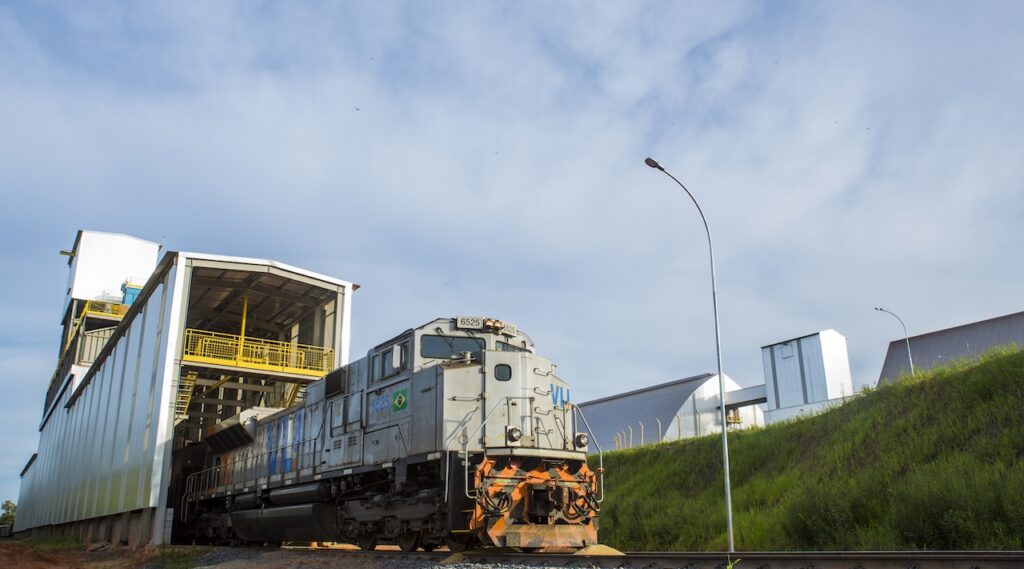
By Brazil Stock Guide – The proposed renewal of the Ferrovia Centro-Atlântica (FCA) concession, currently under review by Brazil’s National Land Transport Agency (ANTT), outlines R$ 28 billion in mandatory investments, according to Infra.
The plan is largely focused on upgrading permanent infrastructure, while a portion will be allocated to rolling stock and sustaining purchases, which includes the acquisition of new operational equipment. The contract extension, if approved, will keep VLI (VLI3.SA) in charge of FCA operations until 2056, sparking a mixture of support and opposition, especially from local governments and lawmakers.
According to the Ministry of Transport, the renewal could generate up to R$ 33.2 billion in total investments, marking one of the largest financial commitments in Brazil’s rail sector history. This includes R$ 1.7 billion that VLI will pay to the federal government, earmarked for resolving urban conflicts along the railway, funding additional unspecified projects, and contributing to a special fund for future railway investments. The government also plans to reinvest R$ 3.4 billion to reverse assets such as locomotives and wagons leased to FCA by VLI.
Leonardo Ribeiro, the National Secretary of Rail Transport, outlined that the proposal has undergone substantial revisions. The original draft allocated only 11% of the capital (R$ 1.4 billion) to infrastructure, with the remaining R$ 11.2 billion set aside for rolling stock. In contrast, the updated plan allocates 74% of the total, or R$ 8.9 billion, for infrastructure, with 26% (R$ 3.1 billion) directed to rolling stock. Ribeiro stressed the importance of these changes, noting that the new investment structure will have a more significant long-term impact on railway operations.
Opposition to the plan comes from local stakeholders, notably Congressman Domingos Sávio (PL-MG), who has voiced concerns over VLI’s decision to return certain railway sections to the government. Sávio argued that the proposal fails to address abandoned infrastructure in Minas Gerais, particularly pointing to “ghost structures” in the state’s rail network. He questioned the fairness of using the R$ 3.6 billion indemnity for the development of the Minas-Bahia corridor, highlighting that most of the returned sections are located in Minas Gerais. “This concession is doomed to fail,” Sávio claimed, criticizing the government’s failure to prioritize local issues.
In response, Ribeiro emphasized that the government remains open to further dialogue and adjustments, suggesting that the renewal process is still in a phase where regulatory evaluations by ANTT are critical. He assured that the proposed investments would benefit the railway network as a whole, with 50% of the total allocated to Minas Gerais, excluding the Minas-Bahia corridor.
Marcelo Cardoso Fonseca, Superintendent of Infrastructure Concessions at ANTT, clarified that while the proposal is still under review, the early feedback suggests the plan is a substantial improvement, particularly regarding the increased focus on infrastructure. “The investment in permanent track creates a virtuous cycle for railway operations,” Fonseca said, although he noted that further technical evaluations are needed before sending the proposal to Brazil’s Court of Accounts (TCU).
VLI, represented by José Osvaldo Cruz, expressed confidence in the revised plan, acknowledging that while certain details are still being reviewed, the updated proposal represents significant value for both the Union and the company. “When comparing to previous negotiations, many adjustments have been made, and the value generated for the Union’s assets is considerable,” Cruz stated.
The process to renew FCA’s concession has been a protracted one, beginning in 2015. After a failed attempt at renewal in 2020, the government and VLI introduced a revised proposal that has undergone scrutiny from various stakeholders. The renewed agreement could significantly impact Brazil’s railway sector, but it still faces hurdles before reaching final approval.




Leave a Reply