
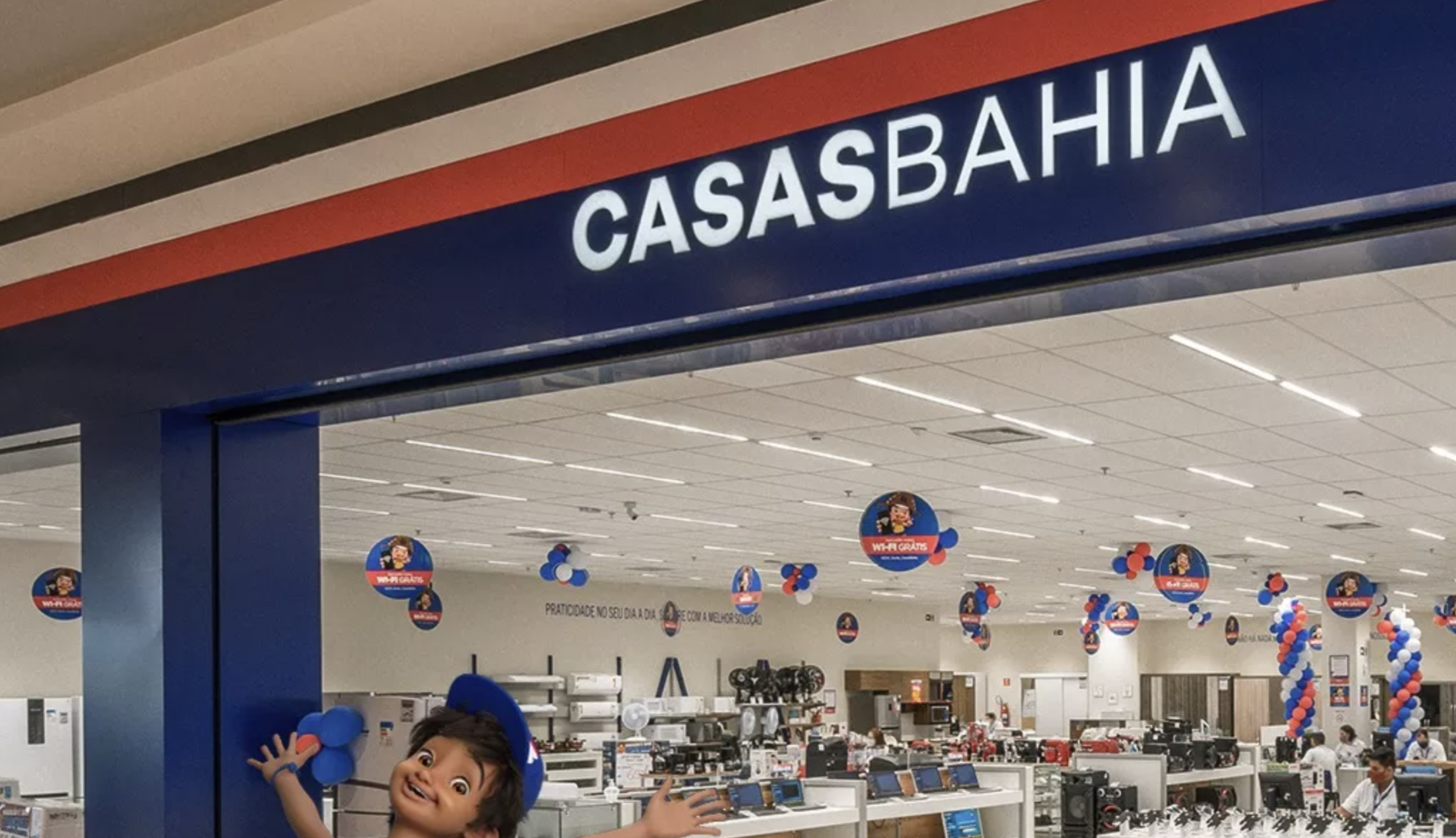

By Brazil Stock Guide – Casas Bahia (B3: BHIA3) used its latest earnings call to frame the partnership with Mercado Livre as a structural move designed to redefine the company’s position in Brazilian e-commerce. Eleven days into the rollout, executives said performance is already running ahead of internal expectations, with early traction not only in GMV but also in pricing discipline, margin capture, operational synergies and brand awareness across channels.
A Structural Digital Pivot
CEO Renato Franklin described the alliance as the moment when a marketplace that had become “too large to ignore” intersected with Casas Bahia’s ability to negotiate a model that lifts contribution margins while avoiding cannibalization of the company’s core channels. After two years of strong marketplace growth in categories where Casas Bahia leads offline but still lags digitally, executives said the partnership finally offers a profitable and scalable entry point into a segment exceeding R$30 billion.
The economics are central to the narrative. Casas Bahia is generating roughly two percentage points more contribution margin on Mercado Livre sales than on its blended channels, supported by a cleaner cost structure. Sales on the platform do not require performance marketing, customer-acquisition spending or financing costs typical of 1P operations. Instead, the model relies on margin, commission and logistics — and that is where the second strategic gain emerges.
Logistics Becomes a Growth Engine
With the reduction of non-core categories, the retailer has significant idle logistics capacity across Brazil. The partnership allows Mercado Livre to use this network for its 1P operation and potentially for third-party sellers. The arrangement dilutes fixed costs, accelerates asset monetization and gives Casas Bahia a more balanced, long-term logistics role that reinforces interdependence between the two companies. Executives stressed that substituting empty capacity for high-utilization flows dramatically improves unit economics.
The alliance also strengthens the retailer’s negotiating position with suppliers. As volume potential expands — including categories where Casas Bahia already holds leading share — industry partners gain visibility into cross-channel performance and pricing benchmarks, allowing more data-driven, favorable commercial terms.
Complementary Audiences and Early Digital Momentum
Renato Franklin emphasized that the marketplace brings a different consumer profile compared to Casas Bahia’s stores and proprietary e-commerce. Instead of cannibalizing traffic, the integration has increased brand visibility and improved performance on the company’s own website and app. Initial results during the 11/11 event were solid on both platforms, even as the marketplace remains a small share of total sales. The company is still adjusting assortment, buy-box conditions, SKU expansion and delivery-time calibration, but expects the partnership to become materially relevant in 4Q.
Future Credit Integration and a Broader Digital Ecosystem
Casas Bahia’s in-house credit engine continues to grow across its proprietary channels but is not yet integrated into Mercado Livre transactions. Executives signaled interest in exploring credit synergies with Mercado Pago, arguing that the marketplace’s user base mirrors the stratification seen between the company’s credit card, PCJ card and traditional crediário. Discussions remain preliminary, but the company sees long-term potential for hybrid credit solutions that better serve lower-income customers.
Competitive Landscape in Physical Retail
Outside the partnership, the Q&A highlighted mixed dynamics in physical retail. Store traffic remains soft, and regional competitors have pushed more aggressive installment terms, including long-dated, interest-free payments. Casas Bahia refuses to follow, saying tests showed that aggressive credit promotions reduce profitability without producing volume gains capable of offsetting the margin sacrifice. Instead, the company is leaning on deeper, healthier inventory, IA-driven pricing, stronger store execution and tighter coordination across commercial, operations, credit and logistics teams — all of which helped it gain share in every region.
Credit Discipline and Inadimplência Control
The retailer is maintaining strict credit underwriting even though demand would allow faster growth. Over-90 delinquency stands at 8.4%, well below market indicators for cheque especial and parcelado, reinforcing the robustness of its credit engine and the relevance of proprietary data and risk models. Executives said they could produce R$100 million more per month “with relative ease” but prefer to preserve asset quality until the macro scenario improves.
Capital Structure Still the Biggest Constraint
Casas Bahia devoted significant time to explaining its ongoing capital-structure cleanup. The conversion of the Series 2 notes, new lines with lower spreads, the latest FDIC for supplier financing and gradual liability management are expected to show fuller impact in 2026. The company disclosed more than R$1 billion in assets with monetization potential, including sale-and-leaseback opportunities, but said improved market sentiment and lower interest rates are needed to maximize value.
The FDIC structures are becoming central, both for crediário funding — allowing a shift from corporate-risk lines to pools backed by granular consumer receivables — and for mitigating reliance on more expensive risk-sacado financing. As new structures mature, the company expects spreads to compress and long-term funding to become more predictable and scalable.
Sazonality, Inventory Health and 4Q Outlook
Executives said the company enters the most seasonal quarter with healthier store inventory, deeper coverage and greater logistical flexibility than last year. October tracked similarly to 3Q, with modest physical-store growth and stronger digital performance. The “Super Black” strategy — live sales directly from stores, integrated marketing and better pricing telemetry — aims to capture high-velocity demand while protecting margins.
A Macro Turn Could Be a Catalyst
Looking ahead to 2026, Casas Bahia expects potential tailwinds from lower interest rates, income-tax relief and World Cup effects, all of which disproportionately benefit lower-income consumers. Given that the company’s core audience is the most sensitive to improvements in credit and disposable income, executives argue that a macro turn could produce outsized operating leverage and accelerate the company’s ongoing transformation.
Leave a Reply