
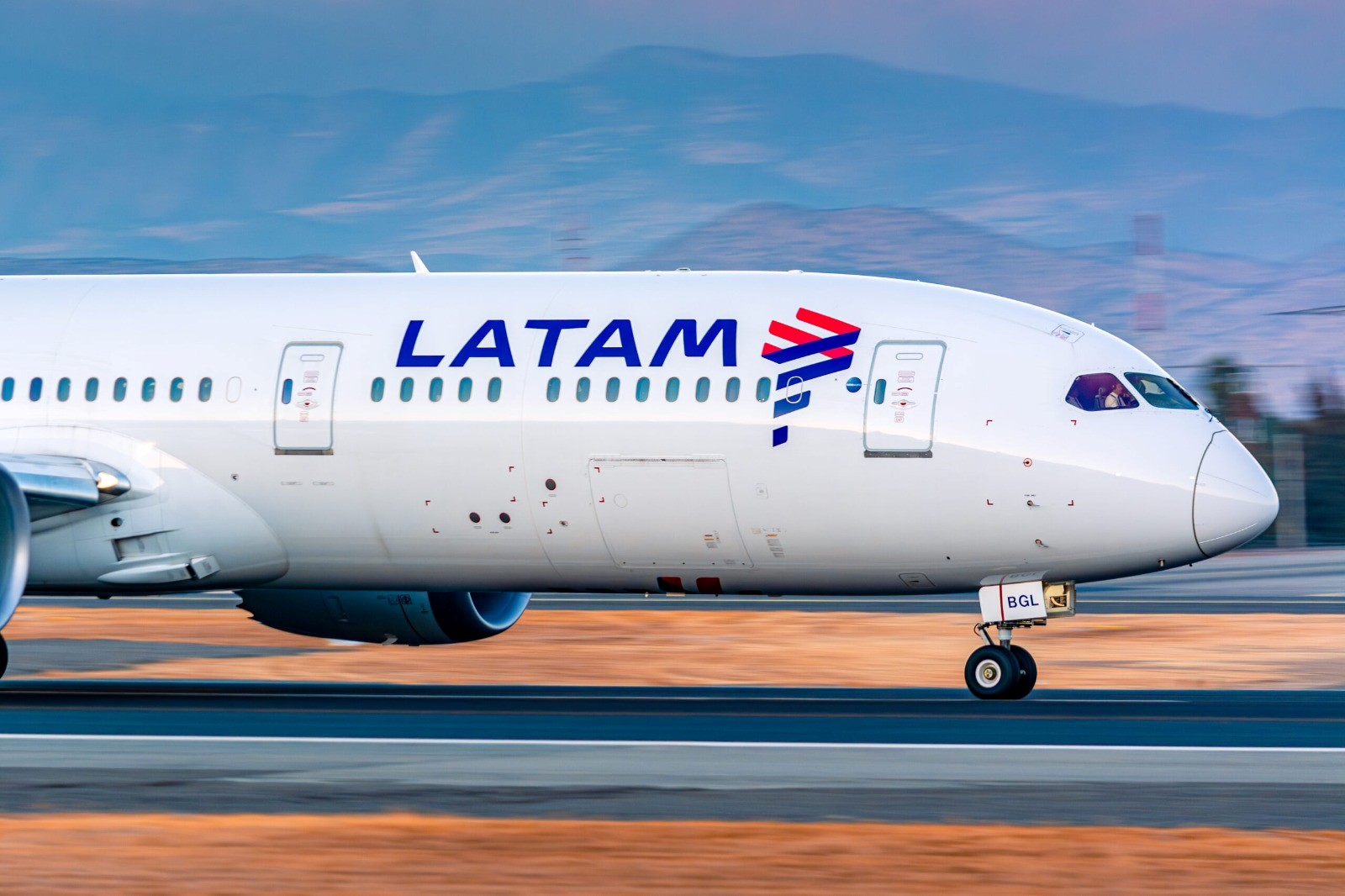
By Brazil Stock Guide – LATAM Airlines Group SA (NYSE: LTM) strengthened its position at key South American airports, prompting BTG Pactual to reiterate a buy rating and forecast 37% upside for the carrier’s US-traded shares.
The bank set a 12-month price target of $72, compared with the $52.56 price used in its July 21 report. Including an estimated dividend yield of 1.9%, the forecast total return rises to 38.9%.
The recommendation covers LATAM’s American depositary receipts, securities that allow investors to trade shares of foreign companies in the US. The airline is listed in New York under the LTM ticker.
Analysts Lucas Marquiori, Fernanda Recchia and Samuel Alkmim said LATAM concentrated capacity growth in markets offering stronger demand, better connections and a more favorable competitive position.
The strategy delivered gains at São Paulo’s Guarulhos International Airport and Brasília’s domestic market. Performance was weaker at São Paulo’s Congonhas Airport, Rio de Janeiro’s Santos Dumont Airport and on international routes from Santiago.
Guarulhos Leads International Expansion
LATAM’s international capacity across Santiago, Guarulhos and Brasília rose 12% from a year earlier in the second quarter. The measure is based on available seat kilometers, an industry indicator that multiplies the number of seats offered by the distance flown.
Growth was concentrated at Guarulhos, where international capacity climbed 17% and passenger traffic increased 11%.
The carrier’s international market share at the airport rose 2.7 percentage points to 39%. LATAM’s capacity growth also outpaced the broader Guarulhos market, which expanded 4%.
The figures made Guarulhos the airline’s strongest international hub in terms of both absolute capacity additions and competitive positioning, according to BTG.
Santiago moved in the opposite direction. LATAM increased international capacity by 9% during the quarter, but passenger traffic declined 5%. Market share fell 0.7 percentage point to 55%.
June data showed a sharper deterioration in the Chilean capital. Capacity dropped 7%, passenger volumes fell 28% and market share declined 1.5 percentage points from a year earlier.
LATAM also reduced its international presence in Brasília. Capacity fell 15% and passenger traffic decreased 6%. Even so, its market share edged up 0.4 percentage point to 18% as the broader airport market contracted more rapidly.
At Lima’s Jorge Chávez International Airport, total passenger traffic was close to 2 million in June. The figure was little changed from a year earlier but fell 9% from May, indicating softer momentum at the end of the quarter.
Brasília Drives Domestic Growth in Brazil
LATAM’s domestic operations proved more resilient. Capacity across Santiago, Guarulhos, Congonhas, Santos Dumont and Brasília increased 7% in the second quarter.
That was broadly consistent with the approximately 6% combined growth reported by the company for its Brazilian and Spanish-speaking domestic markets.
Brasília posted the strongest performance among the Brazilian airports tracked by BTG. Capacity rose 14%, passenger traffic increased 10% and market share gained 2.8 percentage points to 56%.
The airline also strengthened its domestic position in Santiago. Capacity climbed 10% and passenger volumes advanced 6%, lifting market share by 5.2 percentage points to 67%.
The improvement continued in June, when LATAM controlled 68% of Santiago’s domestic market, an increase of 5.7 percentage points from a year earlier.
Domestic performance at Guarulhos was more stable. Capacity increased 1%, while passenger volumes fell 2%. Market share held at about 64% for the quarter, despite a 0.3 percentage-point decline in June.
Congonhas and Santos Dumont Lose Ground
Additional capacity failed to translate into higher passenger volumes at Congonhas. LATAM increased supply by 5%, but traffic declined 2% and market share fell 1.5 percentage points to 43%.
A similar pattern emerged at Santos Dumont. Capacity was unchanged and passenger traffic decreased 2%, pushing the airline’s share down 1.4 percentage points to 35%.
The results underscore a split in LATAM’s domestic network. Brasília and Santiago gained strategic importance, while Congonhas and Santos Dumont faced weaker traffic conversion and greater competitive pressure.
BTG said the data point to a selective network strategy. LATAM directed growth toward airports where it could increase both capacity and market share, while taking a more cautious approach in less supportive markets.
Fuel Costs Threaten Second-Quarter Earnings
The second quarter is expected to absorb most of the impact from higher jet-fuel prices. LATAM management has indicated that additional fuel expenses may exceed $700 million, according to the report.
Prices rose sharply after the escalation of the Middle East conflict, increasing route costs faster than the airline could adjust fares.
LATAM’s average domestic fare in Brazil stood at about 641 reais through May, compared with roughly 620 reais for competitors. The premium reflects stronger pricing power on key corporate routes, but it may not be enough to offset the fuel shock.
Passing the full cost increase to passengers could weaken demand in a more price-sensitive market. That leaves near-term profitability exposed even as the airline retains some ability to raise fares.
Foreign-exchange movements and ticket-price adjustments may partly offset the pressure. BTG nevertheless expects the second-quarter results to reflect most of this year’s fuel-cost impact.
Regional Integration Could Create New Routes
The report also examined an aviation-integration agreement signed by Brazil, Argentina, Chile and Paraguay. The countries created a working group with up to 12 months to develop proposals for a more unified South American air market.
The initiative seeks to expand traffic rights, reduce regulatory barriers and align rules covering operating licenses, passenger protections and airport procedures.
Brazil has taken an initial step by granting seventh-freedom rights in bilateral agreements with Argentina and Paraguay. Those rights allow an airline to carry passengers between two foreign countries without connecting the service to its home market.
LATAM’s presence across several countries could give it greater flexibility to allocate aircraft, feed passengers into major hubs and open cross-border routes.
Lower entry barriers may also increase competition. The near-term effect is expected to be limited because participating countries still need to align their legal and operating frameworks.
Abra’s Embraer Order Raises Competitive Pressure
Competition on regional routes may intensify after Abra Group, the parent of Gol and Avianca, ordered 20 Embraer E195-E2 aircraft. Options and purchase rights could increase the total commitment to 45 planes.
Deliveries are scheduled to begin in the fourth quarter of 2027. The smaller aircraft will give Gol and Avianca greater flexibility to open routes where larger narrow-body jets would offer too much capacity.
LATAM has commitments for as many as 74 E195-E2 aircraft. Abra’s order could erode part of its first-mover advantage in regional expansion, while also supporting a broader maintenance and operating network for the model.
Embraer SA trades under EMBJ in New York and EMBJ3 in São Paulo. The manufacturer confirms both symbols in its corporate disclosures.
BTG Keeps LATAM as Top Airline Pick
BTG maintained LATAM as its top pick in the airline industry, citing the carrier’s ability to shift aircraft and capacity across its multi-country network.
The shares trade at about five times projected 2026 earnings before interest, taxes, depreciation and amortization, according to the bank.
BTG forecasts LATAM will generate $17.21 billion in revenue, $4.03 billion in earnings before interest, taxes, depreciation and amortization, and $1.23 billion in net income in 2026.
For 2027, the bank projects revenue of $19.17 billion, operating earnings on the same basis of $5.10 billion and net income of $1.80 billion. Its 2028 estimates rise to $21.15 billion, $5.58 billion and $2.10 billion, respectively.
Leave a Reply