
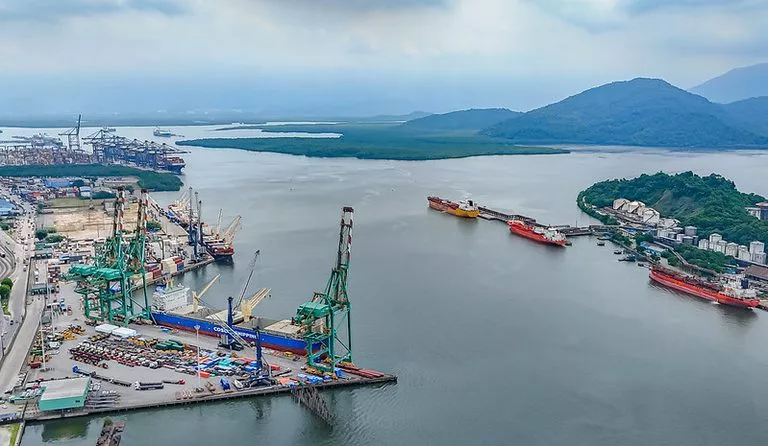
By Brazil Stock Guide – Brazil’s Ministry of Ports and Airports has accepted all recommendations issued by the Federal Court of Accounts (TCU) and forwarded the revamped concession model for Tecon Santos 10, the country’s largest container terminal project, to state-owned Infra SA for final technical adjustments. The move clears a key regulatory hurdle and keeps the government on track to hold the auction as early as March 2026, officials said.
The revised structure introduces tighter safeguards against market concentration at the Port of Santos, Latin America’s busiest container hub. Under the new rules, shipping lines and terminal operators already active in Santos will be barred from participating in the first phase of the auction, with incumbents allowed to compete only in a potential second round if no qualified bids emerge initially. The change reflects a core TCU concern over vertical integration and dominance by global carriers.
Tecon Santos 10 is the largest project in the ministry’s port concessions pipeline, with planned investments of R$6.4 billion. Once operational, the terminal is expected to expand Santos’ container handling capacity by 50%, lifting total annual throughput to 9 million TEUs, alongside 91,000 tons of general cargo. The project includes four new berths designed to accommodate large container vessels.
According to the ministry, the revised model will also incorporate a minimum concession fee (outorga), with the amount and assumptions to be jointly defined by the Ministry of Ports and Airports and the ports regulator Antaq. In addition, following a formal TCU determination, the winning bidder will be required to build an internal rail yard capable of handling at least 900 TEUs per day, a key condition aimed at improving rail connectivity and long-term multimodal integration at Santos.
Infrastructure Minister Silvio Costa Filho said the court’s recommendations strengthen legal certainty and reduce litigation risks. “This is a transformative project for Brazil’s ports and for the national economy. The TCU’s guidance enhances the robustness of the process and mitigates concentration risks,” he said in a statement.
The government expects to publish the final tender documents by the end of January, following an international roadshow early in the year. The concession will run for 25 years, with the auction awarded to the bidder offering the highest concession fee, reinforcing Brazil’s push to attract large-scale private capital while tightening competition rules in strategic infrastructure assets.




Leave a Reply