
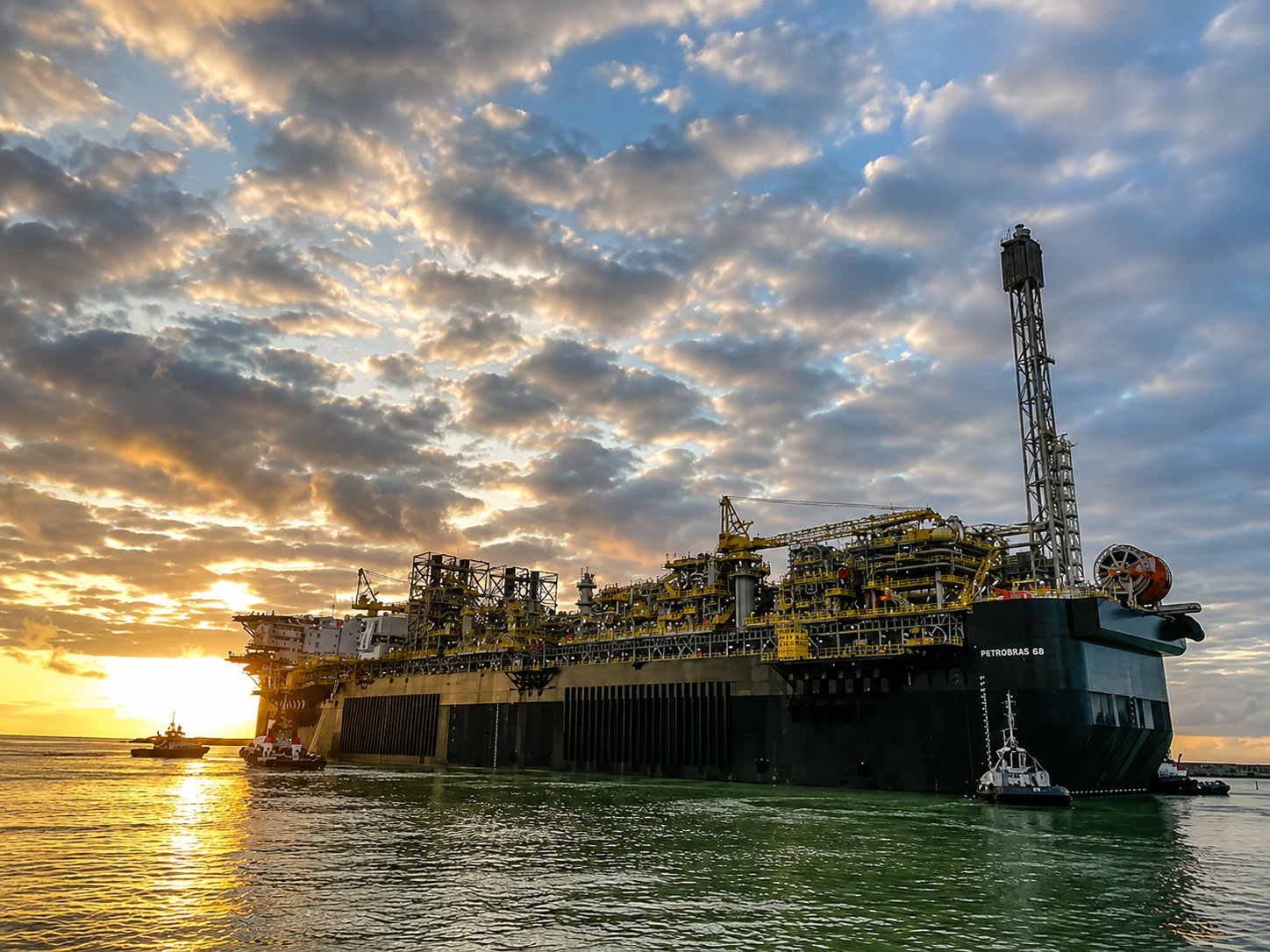
By Brazil Stock Guide – Brazil oil and gas production reached a record 5.64 million barrels of oil equivalent per day in April, reinforcing the country’s position as one of the fastest-growing offshore producers outside OPEC.
The data, released by oil regulator ANP, surpassed the previous record of 5.53 million boe/d set in March. Oil production reached 4.34 million barrels per day, up 2.2% from the previous month and 19.5% from April 2025. Natural gas output rose to 206.7 million cubic meters per day, a 23% increase from a year earlier.
Pre-salt engine
The record was overwhelmingly driven by the pre-salt. Output from the layer reached 4.61 million boe/d, also an all-time high, equivalent to 81.8% of Brazil’s total oil and gas production. Pre-salt wells produced 3.57 million barrels per day of oil and 166.4 million cubic meters per day of gas in April.
That concentration matters. Brazil’s production growth is not coming from a broad revival of the entire industry, but from a small number of highly productive deepwater assets. The pre-salt has become the core of the country’s oil story, with large offshore fields delivering volumes that onshore and mature basins cannot match.
The split is clear. Offshore fields produced 98.1% of Brazil’s oil and 88% of its natural gas in April. In total, production came from 6,118 wells, but only 592 were offshore. The imbalance shows the productivity gap between Brazil’s deepwater assets and its older onshore portfolio.
Santos and Rio
The Santos Basin remained the center of gravity. It produced 4.41 million boe/d in April, including 3.40 million barrels per day of oil and 161.5 million cubic meters per day of gas. The Campos Basin followed with 967,000 boe/d, still relevant but increasingly secondary in Brazil’s production mix.
By state, Rio de Janeiro dominated the map, producing 4.74 million boe/d. That included 3.73 million barrels per day of oil and 159.7 million cubic meters per day of gas. Espírito Santo ranked second in total output, with 344,600 boe/d, followed by São Paulo, with 314,100 boe/d.
The largest oil-producing field was Búzios, in the Santos Basin, with 910,100 barrels per day. The largest gas-producing field was Mero, also in the Santos Basin, with 46.22 million cubic meters per day.
Petrobras center
Petróleo (B3: PETR4; NYSE: PBR) remained the dominant operator. Fields operated by the company, either alone or in consortium, accounted for 88.98% of Brazil’s total oil and gas output in April.
As operator, Petrobras produced 5.02 million boe/d, including 3.84 million barrels per day of oil and 187.5 million cubic meters per day of gas. Other operators remained much smaller by comparison: TotalEnergies EP produced 97,100 boe/d, PRIO 95,100 boe/d, PRIO Tigris 91,100 boe/d, Equinor Brasil 42,400 boe/d and Shell Brasil 37,900 boe/d.
The leading production units also reflected the same pattern. The FPSO Almirante Tamandaré, in the Búzios area, had the highest oil production, with 248,587 barrels per day. The FPSO Marechal Duque de Caxias, in Mero, led natural gas production, with 13.08 million cubic meters per day.
Gas bottleneck
The gas numbers add nuance to the record. Brazil produced 206.7 million cubic meters per day of natural gas in April, but only 63.5 million cubic meters per day were made available to the market. A much larger volume, 119.3 million cubic meters per day, was reinjected.
That is not necessarily a negative operational signal. Reinjection is part of reservoir management and helps sustain oil production in pre-salt fields. But it also shows why record gas production does not automatically translate into equivalent supply for consumers, industries or power plants.
Gas flaring fell to 4.52 million cubic meters per day, down 17.2% from March and 9.3% from April 2025. The gas utilization rate reached 97.8%, a positive efficiency indicator at a time when Brazil is trying to extract more value from associated gas.


Leave a Reply