
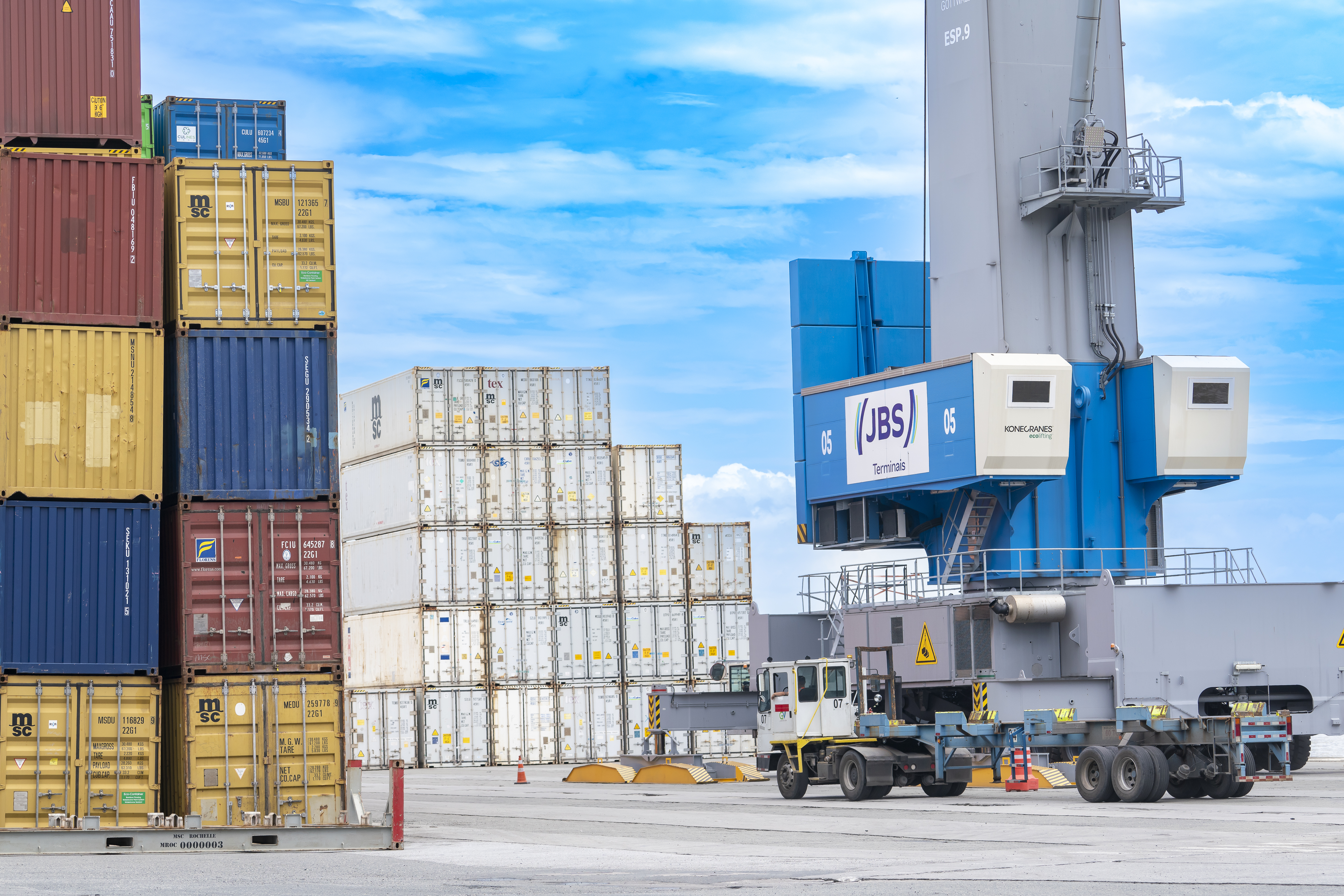
By Brazil Stock Guide — Brazil’s waterway transport regulator, ANTAQ, has opened a public consultation on the definitive long-term lease of the ITJ01 terminal at the Port of Itajaí, in the southern state of Santa Catarina. The project calls for about R$2.6 billion in investment over a 25-year contract. The terminal is currently operated on a transitional basis by JBS Terminals.
The draft tender rules provide for an in-person auction at B3, Brazil’s stock exchange, with the winner selected by the highest concession fee bid. The lease covers a public port area dedicated to the handling and storage of containers and general cargo inside the federally regulated public port area of Itajaí. The total area of the lease will be 295,315 square meters, to be made available in phases. The contract will run for 25 years, with possible extensions at the discretion of the federal government.
The project also provides for fixed monthly payments of R$2.66 million, in addition to variable payments linked to cargo throughput. The draft contract sets a variable fee of R$38.70 per TEU, excluding transshipment and container shifting, and R$19.35 per TEU or per ton for transshipment, shifting and general cargo. The estimated total contract value of R$27.25 billion refers to projected revenue for the future lessee over the life of the contract, not to direct investment.
The auction is the federal government’s attempt to turn a transitional operation into a long-term port contract. JBS took over the terminal in October 2024 after a period in which container operations at Itajaí had been halted. Since then, the company has used the terminal’s operational turnaround as an argument for remaining in place under the definitive lease.
JBS Terminals increased cargo throughput at the Port of Itajaí by 330% over 18 months, handling more than 560,000 TEUs and investing about R$220 million in infrastructure and technology, according to data released in April. The operation added mobile cranes, power plugs for refrigerated containers, reversible access gates and new shipping services.
The new tender, however, puts the company back under the test of competition. The draft rules do not create a prior barrier against operators already active in the region, but they also do not give protection to the transitional operator. In practice, JBS may bid to remain at the terminal, but it will have to submit the best offer in an auction based on the highest concession fee.
The main regulatory concern lies in the competitive design of the auction. The draft rules bar consortia formed by companies from different economic groups that, at the same time, own container-handling facilities in the port complexes of Itajaí, São Francisco do Sul, Imbituba and Paranaguá/Antonina, and also operate regular container shipping services.
That restriction matters because the container market in southern Brazil is shaped by large port operators and global shipping lines. ANTAQ did not decide to bar incumbents, but sought to limit combinations that could reduce rivalry in the bidding process.
The regulator’s competition analysis shows that the Itajaí port complex is heavily specialized in containers. Through August 2025, containers accounted for more than 93% of cargo handled at the complex. The public Port of Itajaí and Portonave together represented about 97% of local throughput.
At the same time, ANTAQ expanded its analysis beyond Itajaí. In the 2025 base case, the technical note defines a regional market in which Itapoá had 35.7% of container throughput, TCP had 33%, Portonave had 22.3%, ITJ01 had 6.9% and Imbituba had 2.1%. The Herfindahl-Hirschman Index, or HHI, a standard measure of market concentration, stood at roughly 2,710 points, indicating a concentrated market.
ANTAQ projects, however, that the expansion of ITJ01 will help dilute concentration over time. By 2034, the terminal would reach 14.9% of the relevant market, while Portonave, TCP and Itapoá would have more balanced shares. By 2037, ITJ01 would reach 18.1%, with the HHI estimated at around 2,360 points, a structure considered moderately concentrated and marked by stronger rivalry among four large terminals.
That diagnosis supports the technical staff’s main conclusion: a new entrant would, in theory, be the best outcome from a competition standpoint, but a victory by an already established operator would not create structural changes large enough to justify prior restrictions on participation. The recommendation is for an open, non-discriminatory auction designed to attract as many qualified bidders as possible.
The same reasoning appears in the analysis of vertical integration. ANTAQ acknowledges that vertically integrated groups can create theoretical risks of market foreclosure, but concludes that, in this case, there is not enough evidence of competitive exclusion to justify broad restrictions on shipping lines in the tender. According to the regulator, a ban could reduce contestability, weaken the attractiveness of the asset and undermine efficiency gains associated with logistics coordination.
The JBS case has its own nuance. The company is not a global container shipping line like Maersk or MSC. It is a major cargo owner and one of the world’s largest protein exporters. That reduces the classic risk of vertical integration between a terminal and ocean shipping, but it still raises a different question: how to ensure that public port infrastructure operated by a major cargo owner and exporter remains open, neutral and efficient for third parties.
The draft contract tries to address that risk through user protections. It guarantees users the right to receive adequate service, free from abuse of economic power, and to use services related to the lease with freedom to choose among providers within the public port area.
There are also operational targets and mandatory investments. The terminal’s dynamic container capacity is expected to rise from 620,000 TEUs in the first phase to 1.55 million TEUs in the final phase of the contract. Required works and equipment include a second rail line for ship-to-shore cranes along berths 1 to 4, construction of a mooring dolphin to allow larger vessels to operate, the acquisition of seven STS cranes and 24 rubber-tired gantry cranes, as well as other equipment and yard upgrades.


Leave a Reply