
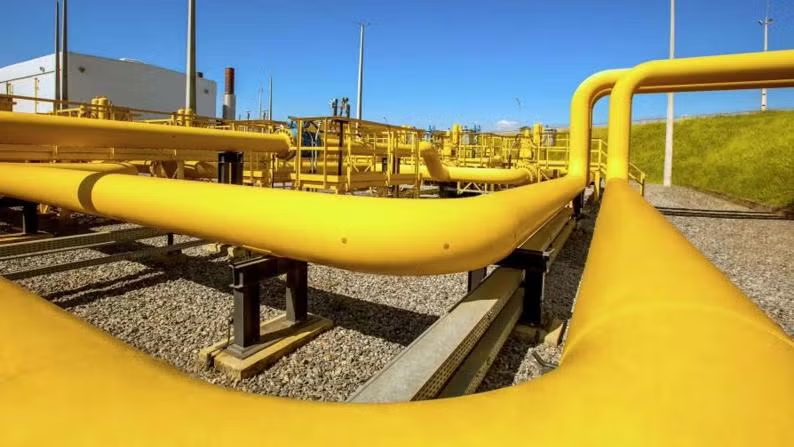
By Brazil Stock Guide – Brazil’s oil and gas regulator unanimously rejected appeals filed by pipeline operators Nova Transportadora do Sudeste, or NTS, and Transportadora Associada de Gás, or TAG, in a key stage of the tariff review for the 2026-2030 regulatory cycle. The decision was taken on Friday (27).
The Agência Nacional do Petróleo, Gás Natural e Biocombustíveis, known as ANP, also denied a precautionary request by TAG to suspend a provision of Resolution 991/2026 that предусматриes the use of the Recovered Capital Method, or RCM, in calculating the Regulatory Asset Base (BRA).
NTS and TAG — which control major gas pipeline networks in Brazil’s Southeast, Northeast and North regions — challenged the potential application of the RCM methodology. The approach estimates the residual value of assets based on historical cash flows, determining how much of the original investment has yet to be recovered.
The RCM is considered stricter than the Historical Cost Adjusted for Inflation method, or CHCI, adopted in previous cycles. By reassessing how much capital has already been amortized under legacy contracts, the model could reduce the asset base used to calculate future returns, potentially lowering pipeline remuneration.
The valuation of the Regulatory Asset Base is a central component of tariff setting and may affect gas transportation costs, including bids from thermal power plants connected to the pipeline network in Brazil’s capacity reserve auctions.
No Concrete Harm, Regulator Says
Reporting director Pietro Mendes argued that the appeals were premature, as the agency has not yet defined the final methodology for the asset base. According to him, ANP has so far only requested operational and financial data from the companies.
“There has been no application of the RCM, no application of methodology, no decision on the BRA, no imposition of financial burden. There has only been a request for data. The absence of concrete harm prevents the appeal from being admitted due to lack of procedural interest,” Mendes said.
He added that regulated companies are expected to cooperate with the review process. “Instead of these appeals, what is expected from the transporters is a collaborative approach, in the sense of properly providing all information necessary for ANP’s decision-making and for public oversight. Because it is the users who pay the natural gas transportation tariffs,” he said.
ANP Director-General Artur Watt warned against using procedural tools to delay regulatory decisions. “One cannot use due regulatory process to prevent regulatory decisions. We have to be careful with that,” he said.
In his vote, Mendes described TAG’s request to suspend the resolution as a “measure aimed at obstructing the progress of the regulatory action [tariff review] in an unjustifiable manner.”
He rejected claims of procedural flaws and said the discussion over capital recovery has been ongoing for years within the gas sector. “This debate has been public for many years, not only formally, but in all natural gas sector events there is discussion about the need to assess how legacy contract payments occurred, the remuneration rate in legacy contracts, what the BRA value is, how much remains, how much needs to be remunerated. It is a debate beyond ANP, and the RCM emerged outside ANP,” he said.
Mendes stated that the process included a 51-day preliminary consultation, followed by regulatory impact analysis, public consultation and hearings lasting more than 60 days, with 42 participants and 39 speakers.
He also cited concerns over potential “double remuneration” of assets under legacy contracts. “Studies attached to the process indicated that the absence of this adjustment could represent the transfer of tens of billions of reais from users to transporters. In this context, incorporating the RCM into the final version of Resolution 991/2026 did not come out of nowhere. It constitutes a direct response by the agency to demands expressed during the participatory process,” Mendes said.



Leave a Reply