
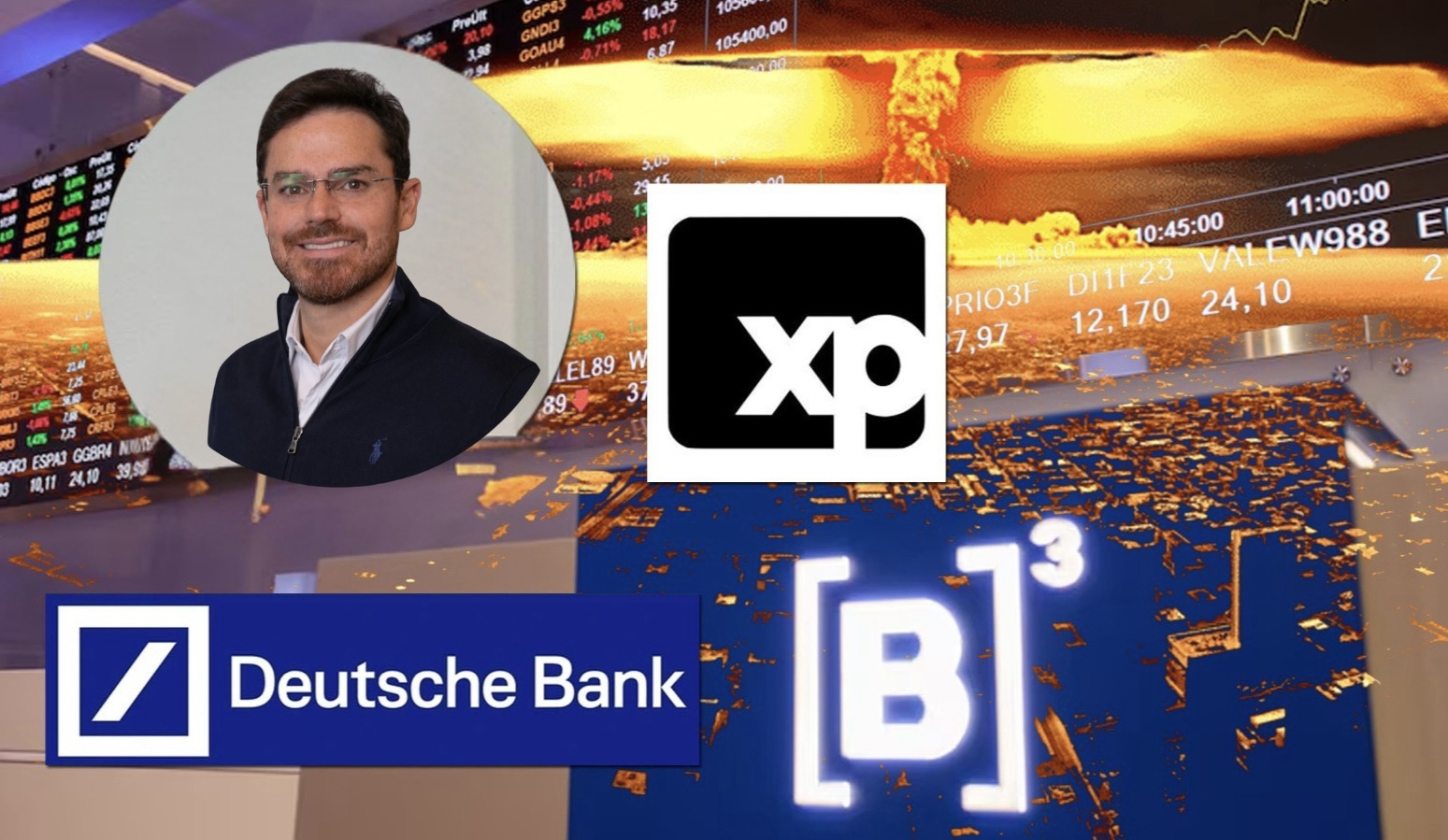
João Arruda, former CFO of Ambipar: dismissal and the collapse of the company’s green bonds. (Credit: reproduction)
By André Vieira
Brazil Stock Guide – João Daniel Piran de Arruda boasts an elite résumé in finance. A graduate in business administration from Fundação Getúlio Vargas (FGV), he spent nearly 15 years at Bank of America (BofA), where he led the Latin American derivatives and corporate debt-structuring desk. Earlier, he worked at Crédit Agricole in São Paulo and London. Known for his ability to craft complex deals, he earned a reputation as a financial engineer capable of turning currency exposure into profit. When he became Ambipar’s CFO in August 2024, at 43, he seemed the ideal choice to take the company to a new level of financial sophistication.
It was this technical reputation that earned him near-total autonomy — and, ironically, enabled the creation of the instrument that would trigger Ambipar’s current crisis. The contract initially appeared routine: just an amendment to a foreign-exchange hedge. But behind its technical façade lay a lethal structure. The crisis erupted when Ambipar transferred its derivatives from Bank of America, paying a R$20 million penalty, and a R$62 million fee to Deutsche Bank in February 2025, believing it was cutting costs and boosting efficiency.
In practice, the operation devised under Arruda’s watch created a mechanism in which the market value of Ambipar’s own bonds dictated how tightly the company’s finances were squeezed with every price swing. The name sounded sophisticated — PIK bonds, or Payment-in-Kind instruments that allow issuers to postpone interest payments by issuing new debt — but the effect was devastating. Each drop in bond prices triggered new margin calls, drained cash, and raised credit risk. The hedge became a trap. When the PIK-bond structure became public, it shattered Ambipar’s financial credibility and led banks to call in loans early.

Before the storm, Ambipar had a symbol of triumph: its green bonds. The previous year, the company — through Ambipar Lux S.à r.l. and Cayman Islands vehicles — had issued its first international sustainable notes, totaling US$750 million and winning LatinFinance’s “Bond of the Year” award. The two issues, Ambipar Green Bonds 9.875% 2031 and 10.875% 2033, were listed on the Luxembourg Stock Exchange (LuxSE) and certified under ICMA’s Green Bond Principles. At the time, they were hailed as milestones for Brazil’s capital markets: ESG-certified debt tied to carbon-reduction and circular-economy targets. Ironically, those same bonds — which Arruda had helped structure years earlier at BofA — became the foundation for the hedge that would later bring Ambipar down.
Brazil Stock Guide has followed Ambipar’s unraveling since the crisis broke a month ago. Over recent weeks, the newsroom interviewed more than a dozen people directly or indirectly involved in the negotiations — executives, lawyers, analysts, and creditors — and reviewed hundreds of pages of documents. Together, they reveal how a protective hedge morphed into a high-risk bet — and how a contractual tweak turned a corporate success story into a case study in leverage and financial manager failure.
Ambipar’s Peak — The Green Champion
Founded in 1995 by Tercio Borlenghi Junior, Ambipar began as a small industrial waste collector. Three decades later, it had grown into a multinational operating in more than 40 countries, employing some 25,000 people directly and 100,000 indirectly. Its business model split into two complementary fronts: Ambipar Environment, focused on waste management and circular-economy solutions; and Ambipar Response, which specialized in chemical and industrial disaster response. Growth came through an aggressive acquisition spree.

Between 2020 and 2023, after its listing on Brazil’s B3 exchange (ticker AMBP3), the group bought dozens of companies in the U.S., Canada, the U.K., and Latin America, including Allied International Emergency, One Stop Environmental, and PERS – Professional Emergency Resource Services. In 2023, its Response division listed on the NYSE American (ticker AMBI) after merging with the SPAC HPX Corp., in a deal led by Arruda while still at BofA — giving Ambipar the aura of an emerging-market ESG pioneer. In Brazil, its stock joined B3’s Green Index, certified by S&P, and was held up as a symbol of “regenerative capitalism.”
Foreign investors — including fund managers from the U.S., U.K., and Scandinavia — became major shareholders. At the height of the ESG boom, Ambipar’s shares surged more than 800%. Its market capitalization topped R$44 billion (around US$8.4 billion) by the end of 2024, according to Elos Ayta Consulting, with revenue nearing R$7 billion. For a time, Ambipar embodied a national ideal: a modern Brazil exporting sustainable solutions — a homegrown multinational born from industrial waste.
Governance Overhaul — The New CFO and the Hedge Trap
Arruda’s arrival stemmed from old ties. He had known Borlenghi for nearly a decade, dating back to BofA’s role advising Ambipar’s international fundraising, IPO, and follow-on. The invitation came over dinner in late 2023. Borlenghi wanted someone who could “speak the language of New York, Faria Lima, and Leblon” — and Arruda seemed to fit perfectly.
As a condition for taking the job, he demanded — and received — carte blanche to overhaul the finance, governance, compliance, legal, HR, tax, communications, and marketing departments. Soon after taking over in August, he dismissed several senior executives in those areas. The board, trusting his expertise, approved the shake-up. “He spoke with confidence, brought technical guarantees,” recalls a former board member. “But that supposed expertise soon turned into overconfidence.”

In February, Ambipar moved its FX-derivatives book from Bank of America to Deutsche Bank. The new deal promised tighter spreads and greater efficiency. To close the previous position, the company paid around R$20 million in penalties to BofA — internally spun as part of a ‘financial optimization.’ What looked like progress quickly became peril. The structure signed with Deutsche, reinforced months later by the August addendum — the so-called PIK bond — fundamentally reshaped Ambipar’s risk profile, concentrating collateral at the German bank and adding another R$62 million in obligations. A hedge meant to reduce exposure instead deepened the company’s dependency and financial strain.
From March through August, the hedge ran quietly. But once the addendum took effect, it turned explosive. The green bonds’ price slid from 100 to 60 cents on the dollar. In the week before Arruda resigned, Deutsche demanded tens of millions daily in margin deposits — R$170 million in five days. On September 16, three additional margin calls arrived the same day, totaling R$70 million.
The Financial Meltdown
The breakdown took shape in mid-September. On Thursday, September 18, Arruda called a meeting in New York with international bondholders for the following Monday — a chance to explain the deteriorating bonds and the Deutsche addendum.
But the crisis moved faster. On Friday, September 19 — the last business day before the meeting — Arruda shocked colleagues by emailing his resignation to the board at 10:30 p.m., skipping the September 22 session. “Everyone was going to be there — American, European, Brazilian funds — and he vanished,” said one participant. The gesture was seen internally as the definitive rupture: confirmation that the very hedge built to protect Ambipar had turned against it.
Over the weekend, law firms in London and New York began questioning Deutsche about its collateral enforcement and possible disclosure breaches in the green-bond documentation — marking the start of the legal phase of the crisis.

When markets opened Monday, September 22, Ambipar’s hedge collapsed. Derivatives spiked, bond-backed securities were forcibly liquidated, and margin calls drained cash as foreign banks executed guarantees. Within days, Ambipar’s bonds traded at 16 cents on the dollar. Investor confidence vaporized. In just a month, the company’s shares — once at R$26 — plunged 97%, to less than R$0.40. “It was Brazil’s Big Short. Only this time, the subprime was green,” said one trader.
Globally, Ambipar’s credit risk played out in real time. When S&P cut its rating from “AA” to “D,” its credit-default swaps (CDS) — insurance against default — spiked, implying a default probability above 50% within a year. The CDS became a crisis barometer: each margin call pushed premiums higher, and each spike sent bond prices lower. The feedback loop echoed the “margin spiral” described by economists Markus Brunnermeier and Lasse Pedersen (2009) — a chain reaction in which successive margin calls deepen liquidity stress. That’s exactly what happened: prices fell, CDS spreads widened, and Deutsche demanded more collateral.
Retail Investors Caught in the Blast
The debt implosion upended perceptions of safety among retail investors who bought products tied to Ambipar’s green bonds. Broker XP marketed structured notes — known in Brazil as COEs — promising “IPCA + 11.75%” and “no FX exposure,” sold as if they were fixed-income securities. Distributed via XP’s advisors and digital platforms, they bore appealing labels: COE ESG Brasil Verde, Ambipar Global Environment, Green 2031 Performance. The pitch worked: about R$900 million flowed in, much of it from conservative individual investors.

In reality, these credit-linked instruments were bets against Ambipar itself. Behind the fixed-return promise, retail investors financed the losing side of a CDS that paid off as Ambipar’s debt worsened. The addendum forced the company to post daily collateral whenever its bonds fell — a liquidity-draining cycle that sped the collapse. On the other side, international funds collected full coupon payments — a setup that only made sense if default was both expected and profitable.
When bond prices crashed and cross-default clauses were triggered, the retail COEs were wiped out: every real invested was worth pennies. Hundreds of clients received notices that their notes had hit the “total loss trigger.” The promise of protection evaporated in a single afternoon. “They told me it was green, safe. I lost everything,” wrote one investor on the consumer-complaint site Reclame Aqui — one of dozens voicing similar grievances.
Roughly 4,200 individuals are believed to have been affected. The case has prompted class-action suits and a possible CVM probe into “material transparency failures” and “conflicts of interest between origination and distribution.” XP is reportedly setting up a dedicated fund to help investors recover part of their losses if Ambipar stabilizes.
Turning to the Courts
Facing collapse, Ambipar sought court protection. On September 24, it filed in Rio de Janeiro’s 3rd Business Court for temporary relief from creditors. Banks objected. The injunction halted debt acceleration and enforcement for 30 days, extendable. In its petition, Ambipar cited “abuse of contractual power” and “distortion of the hedge’s purpose.”
Controller Tercio Borlenghi Junior also published a letter to the board on October 10, accusing Bradesco and Opportunity of selling his shares in violation of a court injunction. He said the trades cut his stake from 73.48% to 67.68%, wiping out R$20 billion (US$3.4 billion) in market cap. Opportunity responded that it was merely a minority investor in the Everest FIP fund with no enforcement powers. Bradesco has not commented.

A formal bankruptcy-protection filing is seen as imminent and could come within weeks. The move would give Ambipar breathing room, preserve jobs, and allow its emergency-response and waste-management operations to continue while creditors negotiate a restructuring.
The Ambipar saga has now moved beyond finance. The company has filed a criminal complaint in São Paulo state court against João Arruda and two other executives, alleging forgery, fraud, and misrepresentation in the Deutsche Bank hedge.
Arruda declined to comment. In a statement, his attorney David Rechulski said the police inquiry represents “yet another erratic move” by Ambipar, part of a pattern of attempts to assign undue blame to Arruda. According to him, the company attributed to his client documents that were in fact signed by other executives — including a transfer agreement between Bank of America and Deutsche Bank “signed by the controller’s own son, a statutory director,” and the Deutsche addendum “initialed by statutory directors Thiago Silva and Luciana Barca.”
Rechulski added that messages exist from controller Borlenghi to Arruda “celebrating the signing of the Deutsche Bank addendum they now claim to have been unaware of.” “False narratives will not withstand evidence,” he said. No supporting documents were shared with Brazil Stock Guide, and the lawyer did not comment on the role or potential liability of the company’s own financial manager, who is the target of the ongoing police investigation.
In the end, Ambipar’s promise of global governance ended up in court — and the company’s experiment with green bonds became an example of the risks of financial innovation gone wrong, involving João Daniel Piran de Arruda, Deutsche Bank and XP.
Read more: Engineered Comfort


Leave a Reply