
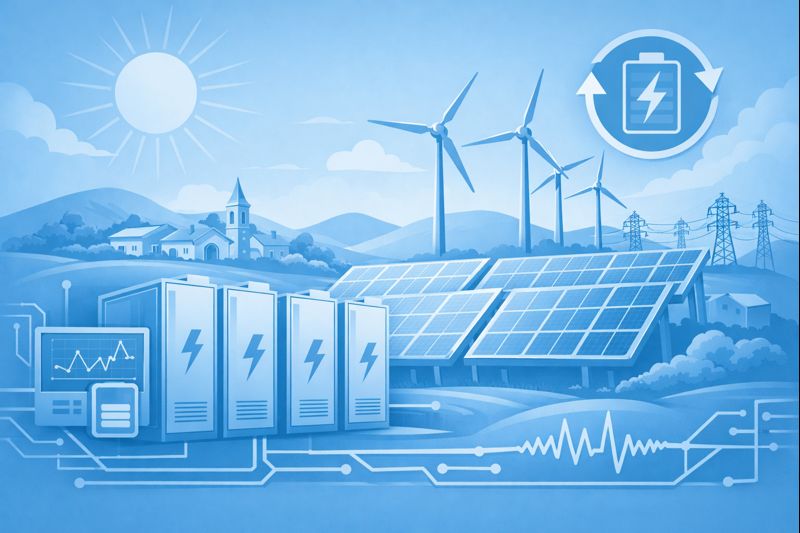
Brazil’s smallest city has become a test case for the biggest challenge of the energy transition. Located about 250 kilometers from Belo Horizonte, Serra da Saudade, home to just over 800 people, has inaugurated an “anti-blackout” system that combines solar generation with battery storage, providing up to 48 hours of electrical autonomy. Delivered by Enerzee in partnership with WEG, Cemig, and the government of Minas Gerais, the project solves—on a micro scale—what national power systems still struggle to address at scale: turning intermittent generation into reliable energy.
The case matters because it exposes the core imbalance of Brazil’s electricity sector. In recent years, the country has rapidly assembled one of the world’s largest wind and solar fleets, particularly in the Northeast. But generation has expanded far faster than transmission and, crucially, storage. The result is the growing prevalence of curtailment: wind turbines and solar panels are forced offline during periods of excess supply to protect system stability. Power is produced, but wasted. In systems with high renewable penetration, electricity without storage ceases to be an asset and becomes a liability.
A decade ago, then-president Dilma Rousseff was widely mocked for talking about “storing wind.” She was right. That unfilled gap is precisely where today’s corporate bets begin to take shape. WEG, for instance, has little interest in competing over battery cell manufacturing, where Asian competition relentlessly squeezes margins. Instead, it focuses on integrated solutions—power electronics, inverters, transformers, energy-management software, control systems, and grid integration. In short, operational reliability. As global subsidies are rolled back and artificially low prices fade—as China has recently shown by cutting support—value tends to migrate toward those who deliver stability, long asset life, and predictability.
The risk in this strategy is not technological, but temporal. Energy storage remains a small, fragmented market, still dependent on regulatory frameworks that move slowly. Yet WEG’s history suggests a comfort with waiting. Transformers, too, were once peripheral before becoming a pillar of earnings. Serra da Saudade sends a simple message: the solution already exists. Those who learn to store value—quite literally—will arrive first.


Leave a Reply