
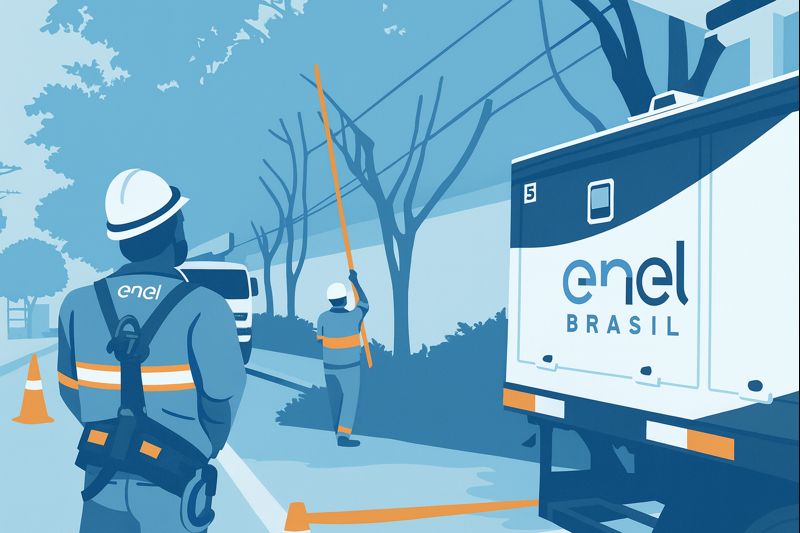
Zero tolerance has become the official mantra surrounding Enel’s electricity distribution business in São Paulo. Presidents, ministers, the state governor, the city’s mayor and even the regulator now agree on the diagnosis: recurring blackouts, slow service restoration and structural failures in an essential public service. Yet the company remains firmly in place. Successive crises have left more than 2 million customer units without power in repeated events, some lasting up to five days, without triggering a decisive contractual consequence.
Forcing Enel to comply with its obligations has proven difficult because Brazil’s regulatory model punishes without constraining. Since 2020, the distributor has accumulated R$374 million in fines imposed by federal and state regulators, but has paid only R$29 million, roughly 8% of the total. The remaining 92% — about R$345 million — is tied up in administrative appeals or court proceedings. The result is a system in which sanctions exist on paper but fail to affect cash flow, governance or decision-making in the short term. Litigation has become a predictable operating cost rather than a deterrent.
This stands in contrast to established regulatory practices elsewhere. In the UK, the regulator Ofgem combines financial penalties with direct restrictions on dividends, mandatory capital injections and short-cycle performance targets, sharply limiting companies’ ability to delay enforcement through litigation. In the United States, state public utility commissions can impose mandatory investment plans, reduce allowed tariffs as a penalty, and, in extreme cases, reallocate service territories without disrupting supply. In Italy, regulated by ARERA — notably Enel’s home market — continuity indicators are monitored with greater granularity, customer compensation is automatic, and repeated failures can directly affect the operating licence, not merely the balance sheet. The key difference is not legal severity, but the regulator’s control over timing and outcomes.
Removing Enel altogether is even harder. Contract termination is treated as a measure of last resort, requiring accumulated proof of breach based on annual continuity indicators, full due process, a collegiate regulatory decision and strong legal insulation. Even an event affecting more than 30% of the concession area, as recently occurred, is insufficient if annual thresholds have not yet been formally breached. Faced with the risk of judicial reversal, large indemnities and operational disruption, regulatory inaction often appears institutionally safer than decisive enforcement.
The paradox becomes more acute as Brazil enters a broad cycle of electricity concession renewals, with contracts that may be extended for up to 30 years. Companies seeking extensions are watching the Enel case closely to assess whether poor performance produces real consequences or whether systemic tolerance still prevails in the name of contractual stability. Decree 12,068 promises tougher rules, fewer exclusions for extreme weather and clearer triggers for termination. Its credibility, however, will depend less on legal text than on regulatory resolve.
The lessons are uncomfortable but clear. A fine that is not paid does not regulate. Repeated failure without escalation teaches non-compliance. And when the state does not control the clock, concessionaires do. Zero tolerance for poor service may dominate the rhetoric. In practice, in Brazil’s electricity sector, it remains conspicuously — and expensively — tolerated.


Leave a Reply