
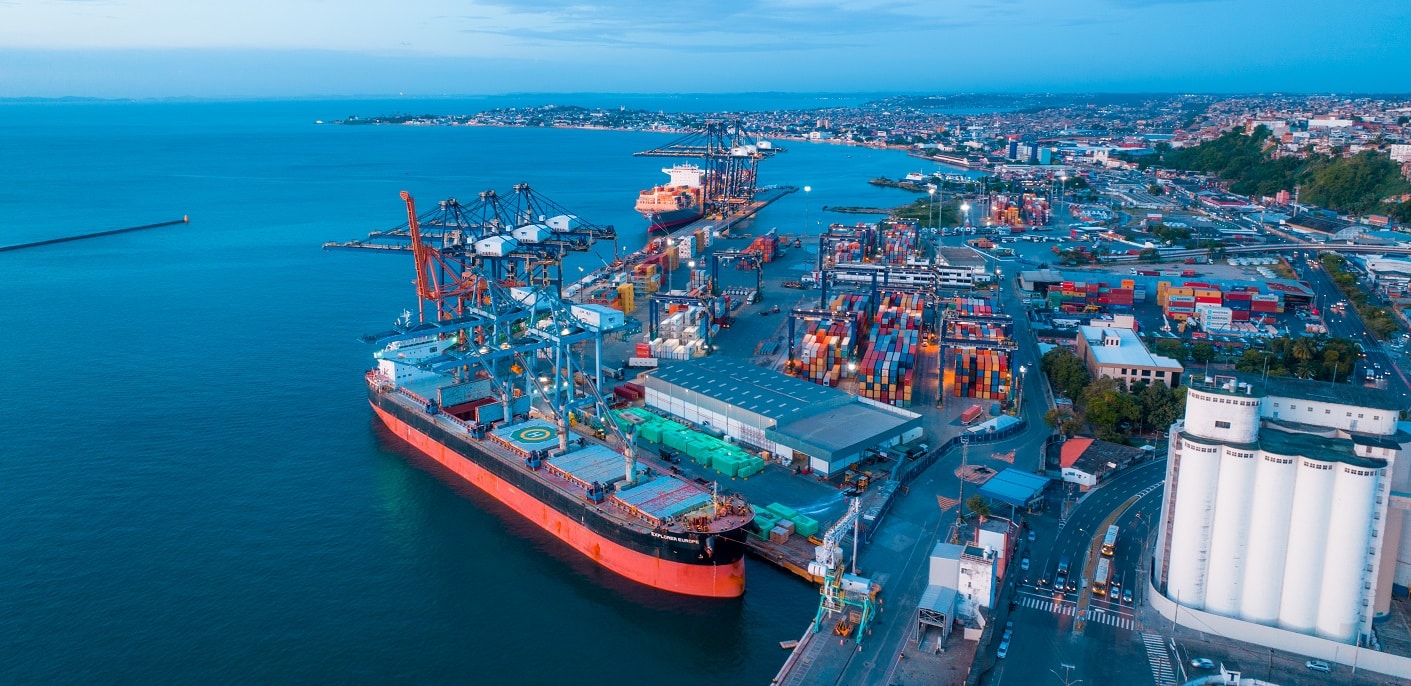
By Brazil Stock Guide – Brazil’s ports ministry sent revised guidelines for the Tecon Santos 10 auction to the country’s waterway transport regulator, opening a new stage in a dispute over how much competition should be allowed in one of the country’s most closely watched port concessions.
The move follows a warning from Brazil’s federal audit court, known as the TCU, that the government cannot change projects already approved by the court and take them to auction without a new review, Agência iNFRA reported. The Ministry of Ports and Airports said on Wednesday (20) that it will be up to Antaq to assess whether the requested adjustments amount to a new auction model.
The revised guidance, issued by the presidential chief of staff’s office, points to a more open bidding process than the structure approved last year by Antaq and reviewed by the TCU. It would allow incumbent operators at the Port of Santos to participate in the auction from the outset, provided they formally submit an irrevocable and irreversible sale of their current position to the competent authorities, conditional on winning the tender.
Under the model previously approved by Antaq, current operators at the port would be barred from participating in the first phase of the auction and would only be allowed into a second round if the first phase attracted no bidders. The regulator had argued that the divestment model raised by its technical staff could create risks for the process.
Ports and Airports Minister Tomé Franca said the government has a single position on the matter and had forwarded the documents to Antaq because the issue is primarily regulatory.
“So the government’s position is to present these elements to the regulatory agency. Since this is essentially a regulatory matter, we forwarded it to the regulatory agency so that it can carry out the proper study, give it the proper treatment and make the referrals it deems necessary,” Franca told reporters after taking part in a public hearing at Brazil’s lower house.
The ministry is the granting authority and is responsible for setting auction guidelines and submitting privatization and concession projects to the TCU. In the document sent to Antaq, however, the ministry’s National Ports and Airports Secretariat did not expressly state a policy position, limiting itself to forwarding the chief of staff’s office guidance for “analysis and measures.”
Franca acknowledged that a more substantial change to the Tecon Santos 10 auction model would likely require the process to return to the TCU. He said Antaq will determine the extent of the changes and whether they alter the project enough to trigger a fresh review.
Asked whether the regulator could decide not to follow the government’s guidance, Franca said Antaq “has its independence and will carry out the studies.” He then referred the question to Antaq Director-General Frederico Dias, who also attended the hearing at the Chamber of Deputies’ Transport Committee.
“The agency plays a technical-regulatory role. It will receive public policy guidance and, if it is public policy guidance, the agency will combine it with Antaq’s own technical-regulatory analysis in order to structure the auction,” Dias said.
Dias said the debate now centers on how to incorporate possible adjustments without undermining the legal and competitive security of the auction. If the reassessment leads to a significant change from the previously approved model, the process may be sent back to the TCU, he said.
The question has drawn attention because the original format would keep the world’s three largest container shipping groups out of the first phase of the bidding process. Mediterranean Shipping Co., or MSC, and A.P. Moller-Maersk A/S (CPH: MAERSK-B) are partners in a terminal at Santos, while CMA CGM SA controls another terminal at the port. MSC and CMA CGM are privately held.
The TCU reviewed the auction model in December and recommended that restrictions on participation be expanded to include shipping companies. The new guidance from the chief of staff’s office has shifted the discussion to whether allowing incumbents to bid with a conditional divestment commitment represents a new auction framework or merely an adjustment to the definition of incumbency.
At the same hearing, Franca said the government had resolved internal disagreements that temporarily halted federal contributions to the Santos-Guarujá tunnel project in São Paulo state. He said he sees no risk of new interruptions in the transfer of funds and reaffirmed the government’s expectation that the project will be delivered in 2030.
The main dispute concerned governance over federal funds allocated to the project, especially the role of the Santos Port Authority, known as APS, the state-owned company responsible for the federal share of the public-private partnership. APS had sought a larger role in monitoring how those funds would be used.
Franca said the government had created a specific governance flow for the project, including a linked account for federal contributions and oversight and monitoring mechanisms involving the port authority.
In March, the TCU issued an injunction blocking the federal transfer to the project. In early May, the court approved the release of the funds but made the final disbursement conditional on formal governance and transparency instruments.
With the understanding reached among the federal government, São Paulo state and regulatory bodies, the administration expects the tunnel project to proceed without further obstacles and enter operation in 2030.





Leave a Reply