
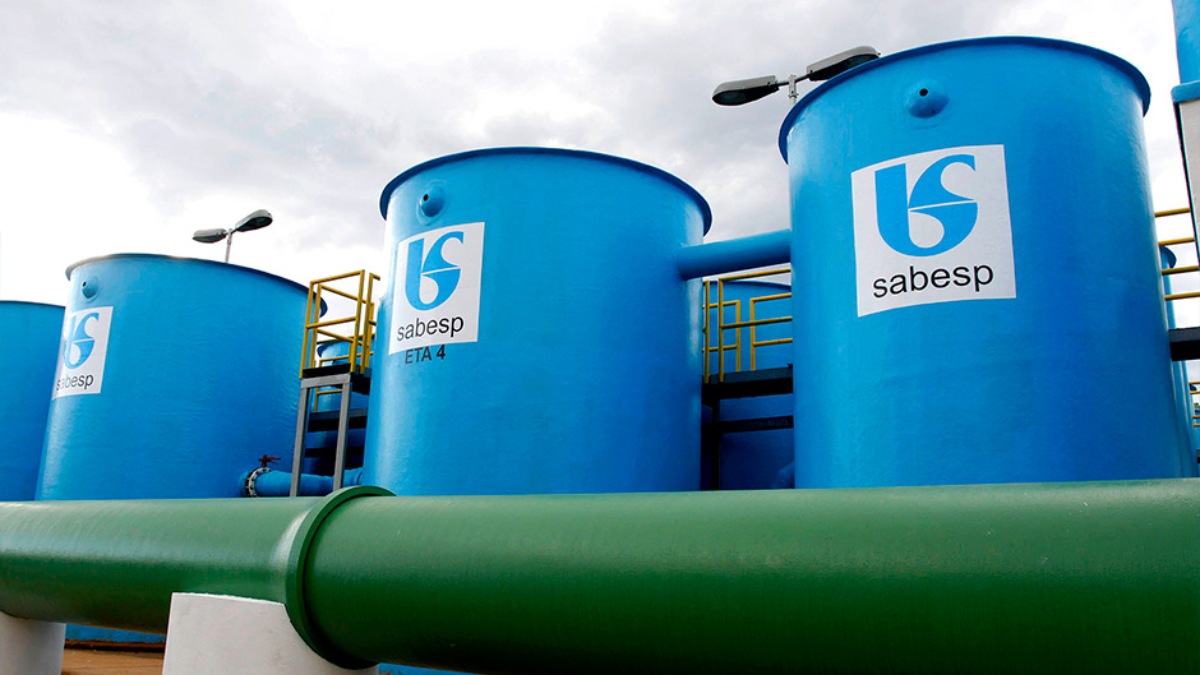
By Brazil Stock Guide – Sabesp (B3: SBSP3) reported a net income of R$2.16 billion for the third quarter of 2025, down 65% from a year earlier, still reflecting accounting adjustments from its 2024 privatization. Adjusted earnings per share rose to R$1.88, from R$1.72 in 3Q24, supported by volume growth and operational efficiency gains.
The utility approaches year-end on the eve of its annual tariff review, scheduled for December 2025, when São Paulo’s state regulator ARSESP is expected to approve a new adjustment to water and sewage rates — likely effective from January 2026. Sabesp has already submitted the technical and financial data, and the process is under regulatory analysis. Market projections suggest a potential 3% to 12% increase, depending on the validation of cost and investment factors under the concession model.
The company’s 2024 results were inflated by a one-off accounting event: the “financial asset bifurcation”, recorded after signing the new concession contract with URAE-1 (Regional Water and Sewage Unit 1), which replaced Sabesp’s previous statewide framework. URAE-1 is the regional governance structure created under privatization, grouping 375 municipalities across São Paulo state under a single regulatory bloc overseen by ARSESP.
Before that change, Sabesp’s infrastructure investments were classified solely as intangible assets amortized over the life of the concession. Under the new model, part of these investments are now recognized as financial assets, representing values to be indemnified by the granting authority at the end of the concession in 2060. This reclassification generated R$8.82 billion in extraordinary revenue and R$5.28 billion in additional net income in 3Q24 — a purely accounting effect. In 2025, the residual impact was minimal — R$154 million in revenue and R$92 million in profit — explaining the sharp year-on-year decline in net income despite stronger operating results.
Adjusted EBITDA rose 15% to R$3.2 billion, driven by cost control, lower energy expenses, and gains from migration to Brazil’s free electricity market. CFO Daniel Szlak said the quarter “closed with another solid performance,” noting that the company invested a record R$4 billion, the highest quarterly figure in its history. “It reinforces our commitment to universalization and to delivering high-quality infrastructure for millions of Brazilians,” he said.
CEO Carlos Piani said Sabesp had already provided drinking water to 616,000 new households, exceeding the full-year target, and connected 733,800 new sewage links, meeting 100% of its 2025 goal. Sewage treatment reached 948,900 new connections, or 92% of the year’s target. “These milestones show our ability to execute with purpose and scale,” Piani said. “We’re expanding access to essential services and investing in infrastructure that delivers lasting social impact.”
The company also reinforced its drought-response measures, as São Paulo’s rainfall has remained below average since August. Sabesp intensified the interconnection of major water systems — such as Cantareira–Paraíba do Sul and Alto Tietê–Guarapiranga — expanded its industrial reuse program (now supplying 1,000 liters per second to large users), and advanced its loss-reduction target, lowering overall losses to 28.9%, the lowest in company history. The emergency plan also includes the optimized use of strategic reservoirs to ensure water security through the 2026 wet season.
Net debt rose to R$25.6 billion, but leverage improved to 2.3× EBITDA, from 2.5× in the previous quarter, supported by strong operating cash flow of R$3.17 billion. Year-to-date, Sabesp has invested R$10.4 billion, with 80% of its 2025 CAPEX already contracted, and projects R$14 billion in investments in 2026, driven by the new tariff cycle and expanded sanitation and resilience projects.




Leave a Reply