
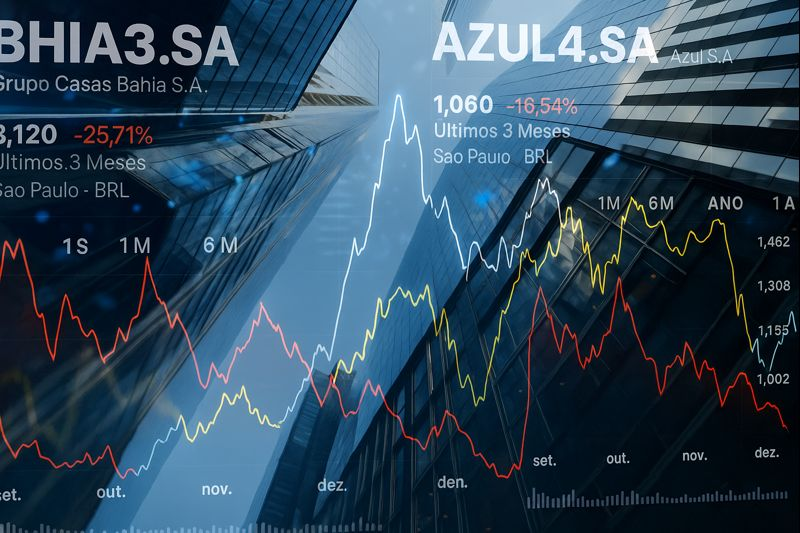
Brazil Stock Guide – The dilution of minority shareholders has ceased to be an exceptional outcome and has become part of the survival playbook for companies listed on Brazil’s stock exchange, B3. In an environment marked by high interest rates, tight credit and strained balance sheets, financial restructurings are increasingly redistributing value explicitly among shareholders, creditors and new investors. Azul Linhas Aéreas and Casas Bahia now stand as the most visible examples of a process still unfolding.
At Azul (AZUL4), dilution took on definitive form at the end of this 2025, when the airline secured court approval for its reorganization plan under Chapter 11 in the United States. The ruling by the US Bankruptcy Court for the Southern District of New York unlocked the execution of a restructuring launched in May and confirmed the transfer of the company’s economic control to creditors.
At the core of the plan is a large-scale debt-to-equity conversion. First-lien creditors are expected to emerge holding roughly 97% of the company’s equity, while subordinated debt holders would account for about 3%, before any additional capital increases or incentive programs. For existing shareholders who do not exercise their pre-emptive rights, the dilution is severe and effectively resets the company’s ownership structure.
Beyond the debt conversion, Azul plans a capital increase of up to $950 million, backed by anchor investors under previously disclosed backstop agreements. United Airlines and American Airlines have each committed $100 million, subject to regulatory approvals. The new shares are expected to be issued at a meaningful discount to the equity value defined in the plan, further deepening dilution on a fully diluted basis.
Casas Bahia (BHIA3) is following a similar path, albeit outside a formal court-supervised restructuring. Since 2023, the retailer has carried out successive capital increases, renegotiated liabilities and increasingly relied on convertible instruments as the backbone of its deleveraging strategy. The process intensified through 2024 and 2025 as the company sought to stabilize liquidity after a prolonged period of operational deterioration.
The most sensitive point lies in its 11th debenture issuance, which allows for up to R$3.95 billion in convertible notes. If fully converted at R$3.71 per share, the company’s share count would more than double, implying dilution of over 65% for current shareholders. Even under more conservative assumptions, dilution is estimated to range between 30% and 50%, depending on the pace of conversion.
Together, these cases illustrate a broader phenomenon that has reshaped Brazil’s equity market between 2023 and 2025. “In a context of scarce financing, dilution has come to be seen as a legitimate adjustment tool rather than a last resort,” an asset manager told Brazil Stock Guide.
Aviation has provided the most extreme examples. Gol, which filed for Chapter 11 protection in 2024, carried out a symbolic-price recapitalization in 2025 that virtually wiped out the economic relevance of its legacy shareholders. As a consequence, the company plans an initial public offering of its parent company, ABRE, in the United States, alongside the cancellation of its Brazilian listing.
Cosan (CSAN3), controlled by Rubens Ometto, illustrated a different strand of this new normal, combining balance-sheet repair with the entry of new co-controlling shareholders. Heavily indebted after an aggressive expansion across multiple sectors — which even included a failed attempt to gain control of mining giant Vale — the holding executed a two-stage capital increase, raising R$10.5 billion.
The first phase brought in anchor investors such as BTG Pactual, led by banker André Esteves, and Perfin, followed by a second offering with pre-emptive rights for existing shareholders. The share count jumped from roughly 1.87 billion to 3.97 billion, resulting in dilution of about 53% for investors who did not follow the capital raise. The most lasting consequence was the entry of new co-controlling shareholders, reshaping the balance of power within the company while accelerating deleveraging at the holding level.
Oncoclínicas (ONCO3) also fits this pattern. Since 2023, the healthcare group has relied on repeated capital injections to support its balance sheet after an aggressive acquisition cycle. The combination of high leverage, the exit of key shareholders — including Banco Master, later liquidated by Brazil’s central bank — and creditor pressure led to meaningful dilution of minority investors. Not because of imminent insolvency, but due to a structural reassessment of an overly leveraged growth model.
The power sector followed a similar route. Light filed for judicial recovery in 2023 and, in 2024, structured a plan centered on debt-to-equity conversion. Oi, upon exiting its long-running restructuring in 2023, consolidated years of conversions and share issuances that effectively erased the original shareholder base.
In retail, beyond Casas Bahia, Americanas — in a case marked by accounting fraud — approved a court-supervised restructuring plan in 2024 that included a multibillion-real capital increase led by reference shareholders and creditors. While minority investors formally retained shares, the economic dilution was severe, with value implicitly transferred and control preserved by the founding group led by Jorge Paulo Lemann.
For minority investors, the shift is structural. “Evaluating a Brazilian stock now requires not only an operational assessment, but also an explicit estimate of future dilution risk,” the asset manager said. In a market shaped by fragile balance sheets, understanding leverage and the likelihood of further equity issuance has become central to equity analysis — not only because of what has already happened, but because of what may still lie ahead.
Minority Shareholder Dilution — Brazil (2023–2025)
| Company | Ticker | Year(s) | Main mechanism | Estimated / final dilution |
|---|---|---|---|---|
| Azul Linhas Aéreas | AZUL4 | 2023–2025 | Chapter 11 restructuring, debt-to-equity conversion, capital increase | ≈ 80%–95% |
| Casas Bahia | BHIA3 | 2023–2025 | Convertible debentures (11th issuance) and capital increases | ≈ 30%–65% |
| Gol Linhas Aéreas | GOLL4 / GOLL54 | 2024–2025 | Chapter 11, symbolic-price recapitalization | ≈ 99%+ |
| Cosan | CSAN3 | 2025 | Two-stage capital increase (BTG Pactual / Perfin) | ≈ 53% (final) |
| Oncoclínicas | ONCO3 | 2023–2025 | Recurrent equity injections after acquisition cycle | ≈ 35%–55% |
| Americanas | AMER3 | 2024 | Capital increase under court-supervised restructuring | ≈ 70%–90% (economic) |
| Light | LIGT3 | 2023–2024 | Judicial recovery with debt-to-equity conversion | ≈ 80%–95% |
| Oi | OIBR3 / OIBR4 | 2023 | Conversions and share issuances at exit from restructuring | > 90% |
| Infracommerce | IFCM3 | 2022–2024 | Successive capital increases to support liquidity | ≈ 40%–60% |
| Sequoia Logística | SEQL3 | 2023–2024 | Capital injections to sustain operations | ≈ 40%–55% |
| Aeris | AERI3 | 2023–2024 | Capital reinforcement and debt renegotiation | ≈ 30%–50% |


Leave a Reply