
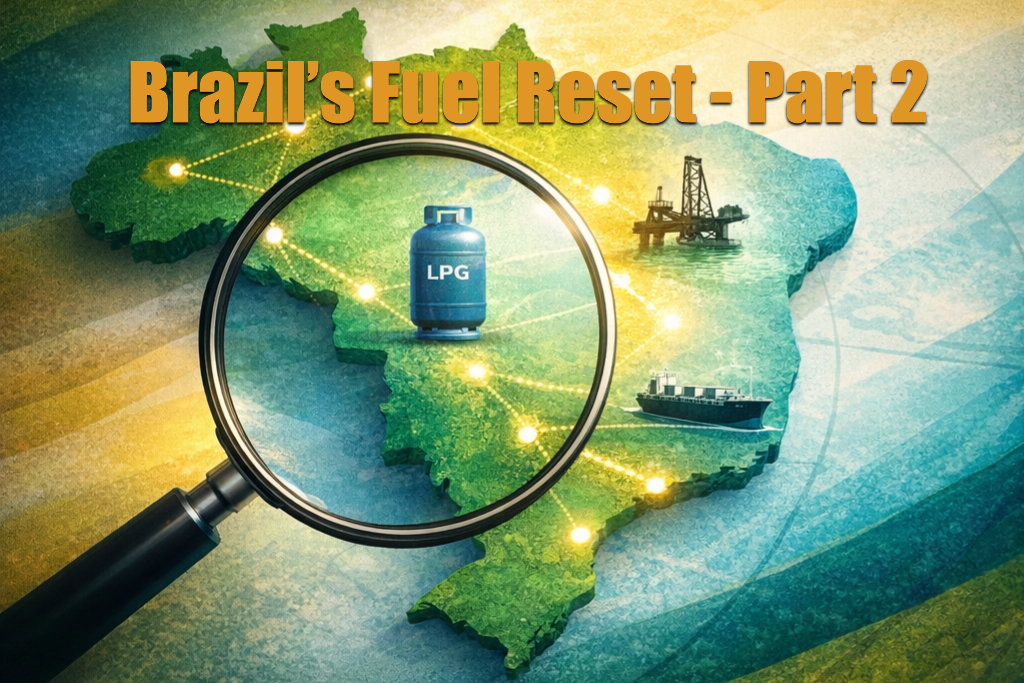
By Brazil Stock Guide – After mapping structural inefficiencies across Brazil’s fuel markets, the government’s reform blueprint turns to one of the most politically sensitive segments: liquefied petroleum gas (LPG). Widely used by households and central to energy access, the LPG market combines high concentration, logistical fragility and strong social impact — making it both a priority and a challenge for policymakers.
Residential consumption dominates the market, accounting for roughly 79% of total LPG demand, with the standard 13-kg cylinder (P-13) serving as the backbone of household energy use. Industrial and commercial segments represent a smaller share, but the residential market is where pricing and access issues are most acute.
At the supply level, Petrobras (PETR3; PETR4) remains the dominant player, controlling a significant share of domestic production and imports. The refining structure is also concentrated, with key assets such as Replan (São Paulo) and Reduc (Rio de Janeiro) accounting for a large portion of output. Imports — largely from the United States and Argentina — supply roughly a quarter of domestic demand, reinforcing the system’s exposure to external dynamics.
Further down the chain, the distribution market is highly concentrated. Ultragaz (Ultrapar – UGPA3), Supergasbras (SHV Energy), Copagaz (Itaúsa – ITSA4) and Nacional Gás (Edson Queiroz Group) together control close to 90% of volumes, creating an oligopolistic structure that limits effective competition despite a formal regime of free pricing.
The result is a pricing structure in which distribution and retail margins account for a substantial share of the final price paid by consumers. In global comparisons, Brazil ranks among the most expensive LPG markets, reflecting not only international price trends but also domestic inefficiencies.
Structural bottlenecks
The reports identify a set of recurring constraints that shape the LPG market:
- limited storage capacity, often covering only a few days of demand
- logistical bottlenecks in transportation and regional supply
- high concentration across supply and distribution
- reliance on imports in periods of tighter supply
- weak competitive pressure along the value chain
These factors create a system that is efficient in scale but rigid in structure — with limited flexibility to absorb shocks or reduce costs.
Energy poverty dimension
Unlike other fuel segments, LPG sits at the intersection of energy policy and social policy.
The federal government subsidizes consumption through the Auxílio Gás program, which benefits around 5.5 million low-income households by covering the cost of a cylinder every two months. While essential, the reports indicate that the program does not fully guarantee access, as the cash transfer can be diverted to other household expenses.
As a result, policymakers are evaluating alternatives, including direct distribution of cylinders — a model that would ensure that subsidies translate into actual energy consumption.
Reform proposals
The CNPE studies outline a series of measures aimed at addressing structural inefficiencies:
- reducing barriers to entry for new distributors
- improving third-party access to infrastructure
- revising supply allocation mechanisms in deficit regions
- expanding storage capacity and logistics investments
- increasing transparency in primary supply contracts
One of the more sensitive proposals involves revisiting restrictions on LPG use in industrial processes and power generation. While this could unlock new demand and improve energy efficiency, it also raises concerns about potential supply tightness and upward pressure on residential prices.
Market implications
For incumbent players, the reform agenda presents a mixed outlook.
On one hand, increased competition and regulatory adjustments could pressure margins for distributors such as Ultragaz (UGPA3) and Supergasbras, which benefit from scale and established logistics networks. On the other, infrastructure expansion and improved supply conditions could support volume growth and reduce operational risks.
For Petrobras (PETR3; PETR4), the implications are equally nuanced. As the dominant supplier, any shift toward greater market openness or changes in allocation mechanisms could alter its role in balancing domestic production and imports.
Political constraint
The LPG market is where the broader reform agenda most directly collides with political reality.
Because of its central role in household consumption — particularly among low-income populations — any perception of rising prices can quickly become a political issue. This sensitivity tends to increase in the run-up to elections, limiting the government’s room to implement structural changes.
At the same time, the current system already embeds inefficiencies that ultimately feed into higher costs. The challenge for policymakers is to address these distortions without triggering short-term backlash.
What comes next
The LPG segment encapsulates the broader dilemma highlighted in the CNPE reports: structural reform is necessary, but politically sensitive.
If implemented, the proposed measures could enhance competition, strengthen supply security and improve long-term efficiency. If delayed, the current model — concentrated, rigid and socially exposed — is likely to persist.
This is Part 2 of the series “Brazil’s Fuel Reset.”
Next: aviation fuels — where cost structures, distribution dynamics and regulation shape the economics of flying in Brazil.


Leave a Reply