

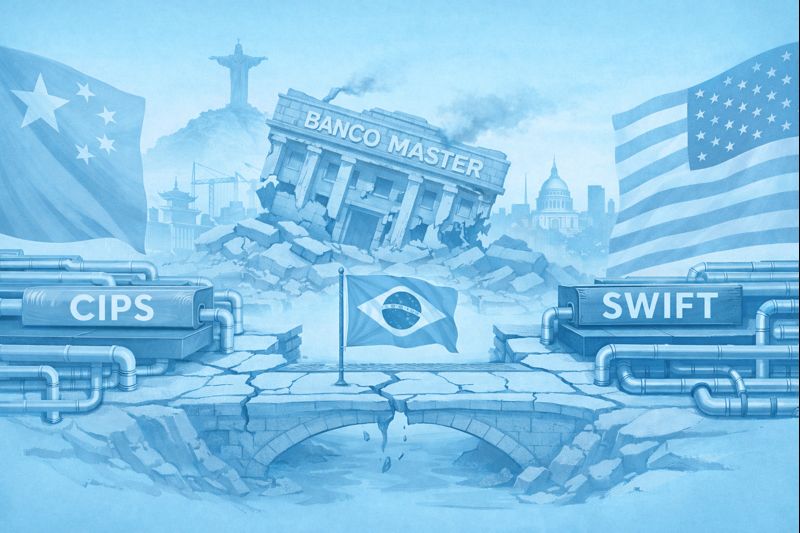
The collapse of Banco Master, a midsize Brazilian lender, described on Tuesday (Jan 13) by finance minister Fernando Haddad as potentially “the largest banking fraud in Brazil’s history”, revealed far more than a string of governance and supervisory failures. The episode tests the country’s institutional resilience — from the autonomy of the Central Bank to the capacity of the deposit insurance fund — and exposes political pressure, the cautious response of some large banks and the patience of investors who, in many cases, believed the promise of high returns offered by the Master’s bank-issued certificates of deposit, sold under the control of Daniel Vorcaro.
The bank’s liquidation, however, left something less obvious in limbo: Master’s attempt — and, by extension, Brazil’s — to gain access to an alternative architecture for global payments. Shortly before the Central Bank vetoed its proposed sale to Banco de Brasília, Master announced its connection to the Cross-Border Interbank Payment System (CIPS), China’s cross-border payments infrastructure designed to reduce reliance on the dollar. This was no trivial move. Master was the only bank in Latin America with functional access to CIPS, an alternative track to the SWIFT, now a core instrument of US sanctions policy.
The global backdrop helps explain the weight of that decision. Since 2012, SWIFT has been deployed as a geopolitical pressure tool — first against Iranian banks, later against Russian institutions following the invasion of Ukraine. In response, sanctioned countries and their partners have turned to parallel channels such as CIPS to keep financial flows outside the dollar’s orbit. According to market accounts, Banco Master was among the few intermediaries capable of structuring sensitive cross-border transactions in this environment, including financing linked to the import of refined petroleum products during sanctions regimes.
The dilemma therefore goes well beyond the failure of a single bank. As a member of the BRICS, Brazil has been deepening financial ties with China while remaining structurally dependent on infrastructure dominated by the United States. Joining CIPS offers a degree of autonomy — but comes with regulatory, reputational and geopolitical risks. Sticking exclusively with SWIFT provides predictability — and entrenches dependence. With the US on one side and China on the other, Brazil has so far navigated this terrain with the traditional caution of its diplomacy. The problem is that, in the payments systems now shaping the global economy, the path is no longer neutral. It has become a line of friction. The question is whether, after the Master episode, any Brazilian bank will be willing to take the risk of crossing it.



Leave a Reply