
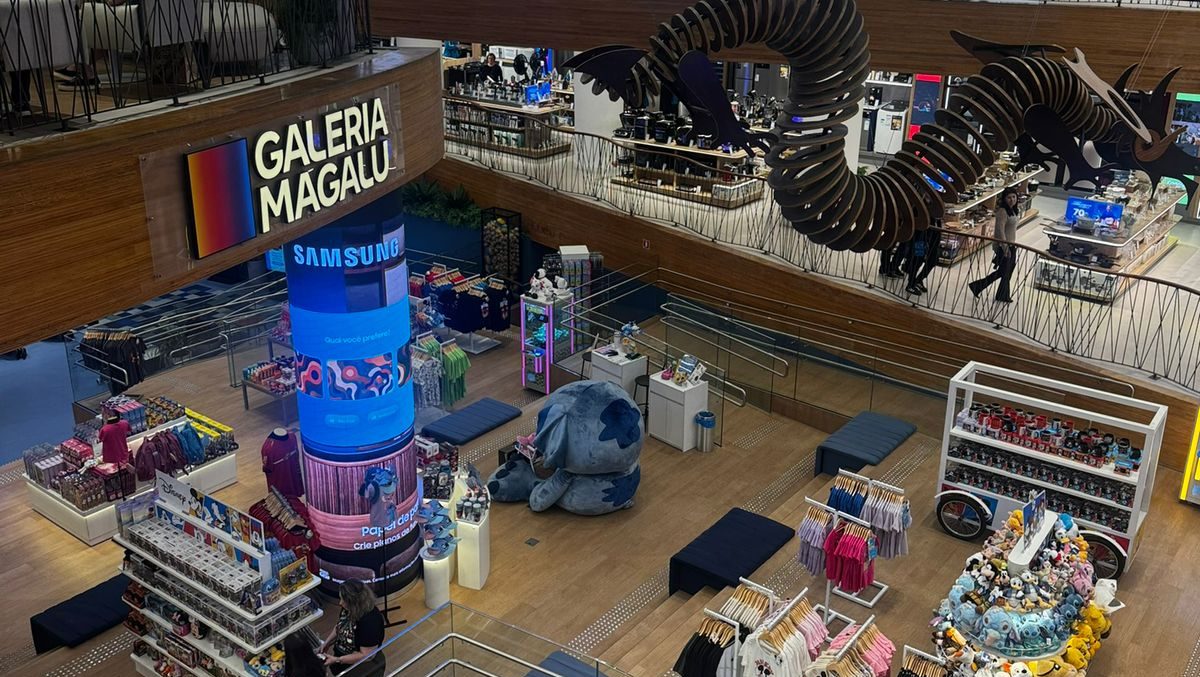
By Brazil Stock Guide – Magazine Luiza (MGLU3), one of Brazil’s largest retailers, reported adjusted net income of R$124.7 million for the fourth quarter of 2025, marking a return to profitability as stronger performance in physical stores and improved cash generation helped offset persistent pressure in its online business.
Net revenue rose 3.4% from a year earlier to R$11.15 billion, while adjusted EBITDA reached R$867.3 million, translating into a margin of 7.8%. On a reported basis, net income totaled R$131.6 million. The results suggest that the company’s multi-year restructuring and cost discipline are beginning to stabilize profitability, even as growth remains uneven across its business lines.
Physical Stores Lead Recovery
A closer look at sales trends shows a clear divergence between channels. Total gross merchandise volume (GMV) declined 1.1% year-on-year to R$18.2 billion, reflecting weakness in digital operations. Physical stores, however, expanded strongly, with sales rising 8.7% and same-store sales up 8.4%.
By contrast, e-commerce GMV fell 5.3% in the quarter. First-party online sales declined 1.0%, while the marketplace segment dropped 11.7%, highlighting the ongoing challenge of reigniting growth in the digital operation that once drove the company’s expansion strategy.
The shift underscores a broader recalibration underway at the retailer. During the pandemic, Magazine Luiza rapidly scaled its digital ecosystem and marketplace platform. Now, in a more normalized retail environment and with higher financing costs, the physical store network has regained importance as a driver of sales and customer engagement.
Margins Stabilize
Operational profitability also showed modest improvement. Adjusted gross margin held roughly stable at 30.0%, supported by better merchandise margins and a more disciplined promotional strategy.
Operating expenses remained under control, with general and administrative costs declining slightly as a share of revenue. Management attributed the stabilization partly to tighter cost management and improved contribution from financial services.
Even so, the company continues to operate in a challenging environment for discretionary consumption. Brazil’s high interest rates have dampened demand for consumer electronics and appliances—core categories for the retailer—forcing companies across the sector to focus more on efficiency and profitability rather than aggressive expansion.
Cash Generation Strengthens
One of the most positive aspects of the quarter was the company’s cash generation. Operating cash flow reached about R$2.2 billion in the quarter, reflecting improved working-capital management.
Inventory levels declined by roughly R$291 million during the period and by about R$430 million over the past year, while inventory turnover improved to 80 days from 91 days a year earlier.
Magazine Luiza ended the year with total cash of R$8.0 billion and an adjusted net cash position of around R$3.1 billion, even after repaying R$1 billion in debentures during the quarter. The stronger balance sheet has become a central pillar of the company’s strategy after years of heavy investment in logistics, technology and acquisitions.
High Rates Still a Drag
Despite the operational improvements, financing costs remain a major burden. Adjusted net financial expenses totaled R$572.5 million in the quarter, equivalent to 5.1% of net revenue.
The company attributed the increase largely to Brazil’s interest-rate environment. The benchmark Selic rate rose from 10.75% at the start of the fourth quarter of 2024 to 15% during the same period in 2025, significantly raising the cost of debt and consumer credit.
For retailers dependent on installment payments, such rates can directly affect sales volumes and margins, making the pace of monetary easing a key variable for the sector’s outlook.
Financial Services Support
Magazine Luiza’s financial-services arm also helped support profitability. Luizacred reported adjusted net income of roughly R$271 million in the quarter, with its credit-card portfolio reaching R$20.8 billion.
The company’s digital payments platform, MagaluPay, processed about R$28.2 billion in total payment volume in the quarter and expanded its consumer credit portfolio to R$1.8 billion. The services ecosystem—spanning payments, credit, logistics, advertising and cloud infrastructure—has become increasingly important as the company diversifies beyond traditional retail.
AI Bet and Next Phase
Management has also been emphasizing artificial intelligence as the next stage of its platform strategy. The company recently integrated its virtual assistant, Lu, into WhatsApp, allowing customers to search for products and complete purchases through conversational interfaces.
According to the company, the service already has about 3 million unique users and conversion rates roughly three times higher than standard search within the app.
Whether that initiative will meaningfully accelerate growth remains uncertain. For now, the 4Q25 results suggest a retailer that has regained financial discipline and liquidity—but still faces the challenge of reigniting digital growth in a high-interest-rate economy.






Leave a Reply