
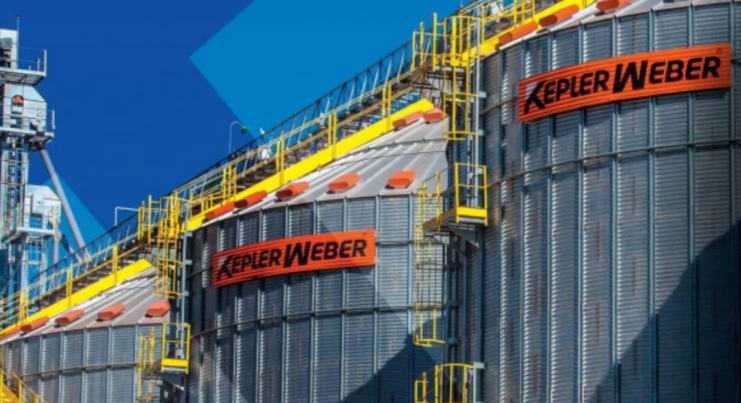
By Brazil Stock Guide – Kepler Weber (B3: KEPL3) said its proposed business combination with A-AG Topco, Limited (“GPT”), parent of the GSI brand, has expired after a key voting commitment was not secured — abruptly ending a transaction that had been presented as a strategic bet on Brazil’s structural grain storage deficit.
Formally, the offer lapsed because GPT conditioned execution of the merger agreement on two items: board approval — which was granted — and a binding voting commitment involving Trígono Capital, which holds 15.3% of Kepler Weber’s shares.
The shareholder alignment did not materialize before the deadline, causing the proposal to expire.
The acquisition would have strengthened its footprint in South America, where demand for storage and logistics infrastructure has grown alongside record soybean and corn harvests. Brazil, the world’s largest soybean exporter, still faces structural storage deficits.
With GPT’s withdrawal, the company said the transaction will not proceed and reiterated its “strong economic, financial and operational resilience,” even amid a softer industry cycle.
Governance Tensions
Behind the scenes, however, the deal had already been strained by governance frictions and regulatory sensitivity, according to sources.
The original structure reportedly included differentiated pricing for key shareholder blocs — Trígono and the Heller family, which together own 26.9% of the company. While minority investors would receive R$ 11 per share, those blocs could have received between R$ 14 and R$ 15. The arrangement drew criticism from investors and raised concerns under Novo Mercado governance rules, which require equal treatment of shareholders.
Although Brazil’s securities regulator, the CVM, did not formally intervene, the prospect of regulatory scrutiny and potential legal challenges added risk to the transaction. The structure was later revised: all shareholders would receive R$ 11 per share, plus a R$ 1 earnout tied to judicial contingencies and payable in installments over up to ten years.
The adjustment reduced regulatory exposure but altered internal incentives. Removing preferential pricing weakened initial alignment and introduced uncertainty ahead of the shareholder meeting. Market sources had pointed to resistance from the Heller family, which holds 11.6%, while Trígono’s support alone would not have guaranteed approval given the nearly 70% free float.
Faced with that backdrop, GPT sought certainty through a formal voting lock-up — which ultimately was not secured.
Founded in 1972 in Illinois, GPT has grown into what it describes as the world’s largest manufacturer of steel grain-storage bins and related systems, generating roughly $1 billion in annual revenue. Backed by private-equity firm American Industrial Partners (AIP), the company viewed South America as a strategic expansion platform amid record soybean and corn harvests and persistent storage bottlenecks.
Strategic Reset
Kepler Weber, founded in 1925 in southern Brazil, exports to more than 50 countries and is widely regarded as a barometer of capital spending cycles in Brazil’s agricultural sector.
Management reaffirmed its commitment to the KW 2030 strategic plan, focused on sustainable growth, operational efficiency and innovation — signaling that, for now, Kepler Weber returns to a stand-alone path as investors reassess its strategic options.



Leave a Reply