
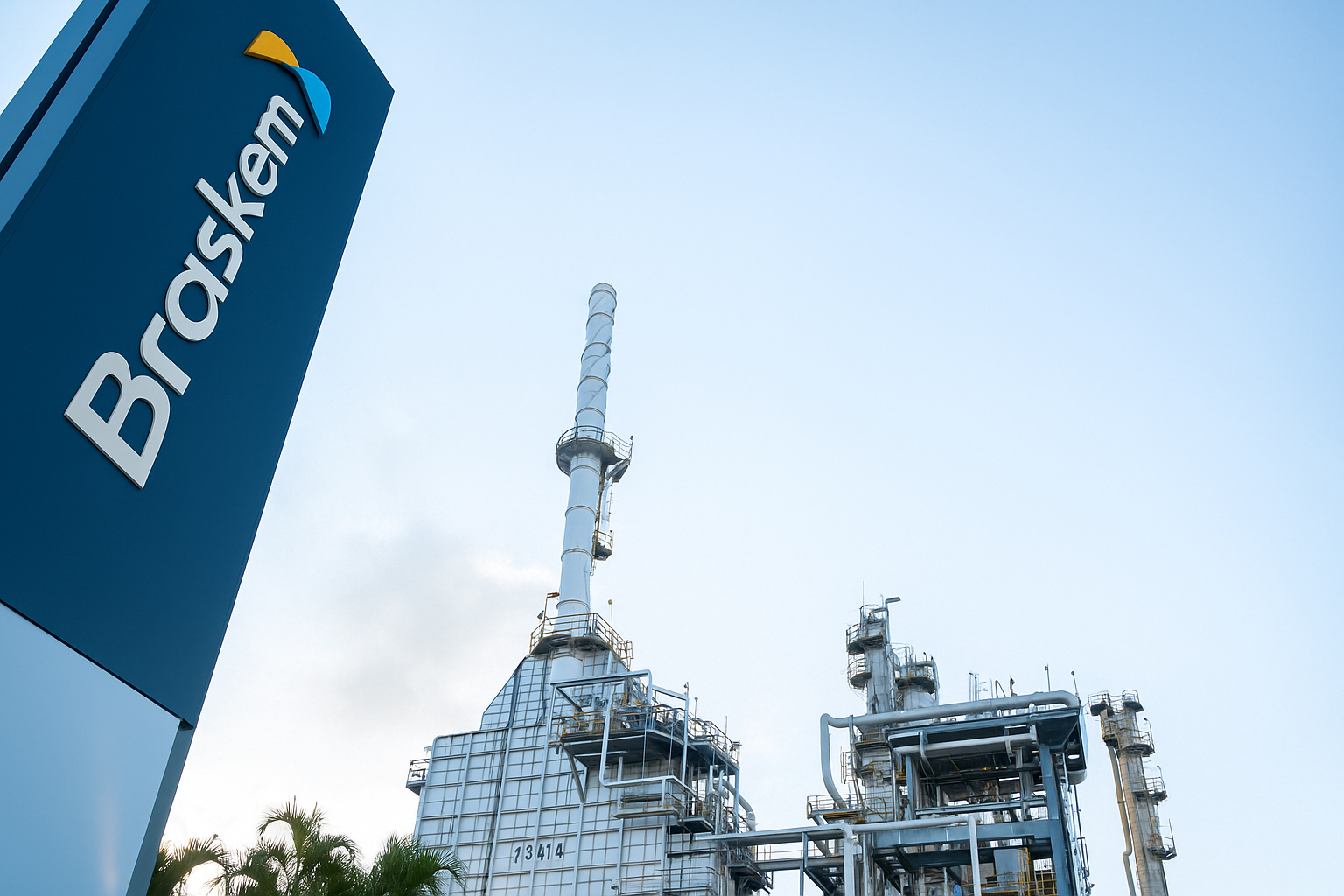
By Brazil Stock Guide – Braskem (BRKM5; BAK) reported a R$10.284 billion net loss in the fourth quarter of 2025, reversing earlier gains and leading the company to close the year with a R$9.879 billion loss. The quarterly result came close to the company’s worst annual loss on record, R$11.32 billion in 2024, underscoring a sharp deterioration at year-end.
A significant portion of the loss came from the reversal of deferred tax assets, which accounted for more than half of the quarterly loss after the company reassessed the likelihood of using these credits. Such reversals occur when a company determines it is unlikely to generate sufficient taxable income to utilize these credits, leading to an income tax expense and reducing reported earnings.
The decline intensified in the final quarter. Recurring EBITDA fell to R$589 million, from R$810 million in the previous quarter. Net revenue dropped 7% to R$16.1 billion. For full-year 2025, EBITDA totaled R$3.156 billion, while cash consumption reached R$5.8 billion, highlighting a mismatch between operating generation and capital structure.
The company said it remains focused on financial discipline and operational efficiency, according to its earnings release.
Brazil Weakens
Braskem’s core market continued to deteriorate. Utilization rates fell to 59%, reflecting scheduled maintenance in Bahia, lower feedstock availability in São Paulo and softer demand. Resin sales declined 6%, while key chemicals dropped 15%, signaling a sharper contraction in basic products.
Prices followed weaker international spreads, pressuring margins. As a result, regional EBITDA reached R$772 million, down 30% quarter-on-quarter. Tax effects, including PIS/Cofins credits linked to REIQ, helped cushion the impact but did not change the underlying operational weakness.
The operational slowdown comes alongside a strained balance sheet. Leverage stood at 14.74x, broadly stable from 14.76x in the previous quarter, but nearly double the 7.42x recorded a year earlier. Gross debt totaled around R$47 billion, against R$10.5 billion in cash, limiting financial flexibility. Cash flow remained negative, with R$5.8 billion consumed in the year, reducing the company’s ability to deleverage.
In the near term, maturities remain manageable but material. The company faces roughly R$5 billion in amortizations in 2026, with obligations spread over subsequent years, requiring continued access to capital markets for refinancing.
International Divergence
Outside Brazil, performance diverged and remains tied to the global cycle. In the United States and Europe, operations posted negative EBITDA of roughly R$160 million, reflecting scheduled shutdowns, lower product availability and compressed spreads amid weak demand. Lower output, reduced volumes and weaker pricing combined to erode profitability.
Mexico, however, delivered the main operational improvement. Utilization rose to 85%, driven by increased ethane supply, a critical input for petrochemical production. In previous quarters, supply constraints had limited output and pressured results.
With improved feedstock availability, the operation was able to restore volumes and dilute fixed costs, returning to positive EBITDA of around R$60 million in the quarter. Still, the improvement reflects operational normalization rather than a structural market shift. It was not enough to offset losses in the U.S. and Europe, and the unit remains dependent on stable ethane supply to sustain recovery.
Structural Liability
The Alagoas geological event remains a key structural overhang. Provisions totaled R$3.5 billion at the end of 2025, following payments and revisions during the year.
Since the beginning of the event, Braskem has provisioned R$18.0 billion, of which R$15.3 billion has already been disbursed, reflecting the scale of the financial impact. Funds have been allocated to relocation and compensation programs, cavity closure and monitoring, and urban mitigation measures.
The company also highlighted a R$1.2 billion agreement with the State of Alagoas and progress in compensation programs, increasing visibility on remaining obligations. Still, the liability continues to weigh on cash flow and investor perception.
What is at stake is the company’s ability to navigate multiple pressures at once. Beyond high leverage and weak cash generation, Braskem continues to carry a material environmental liability and a debt profile that requires ongoing financial discipline.
For 2026, the company plans R$2.6 billion in capex, about 31% below the six-year average — the lowest level in the period, signaling a defensive stance to preserve cash.
With the fourth-quarter result sufficient to erase the year’s improvement, the company now awaits the outcome of negotiations with IG4 Capital, which has signed an agreement with Novonor for the transfer of control of Braskem.



Leave a Reply